

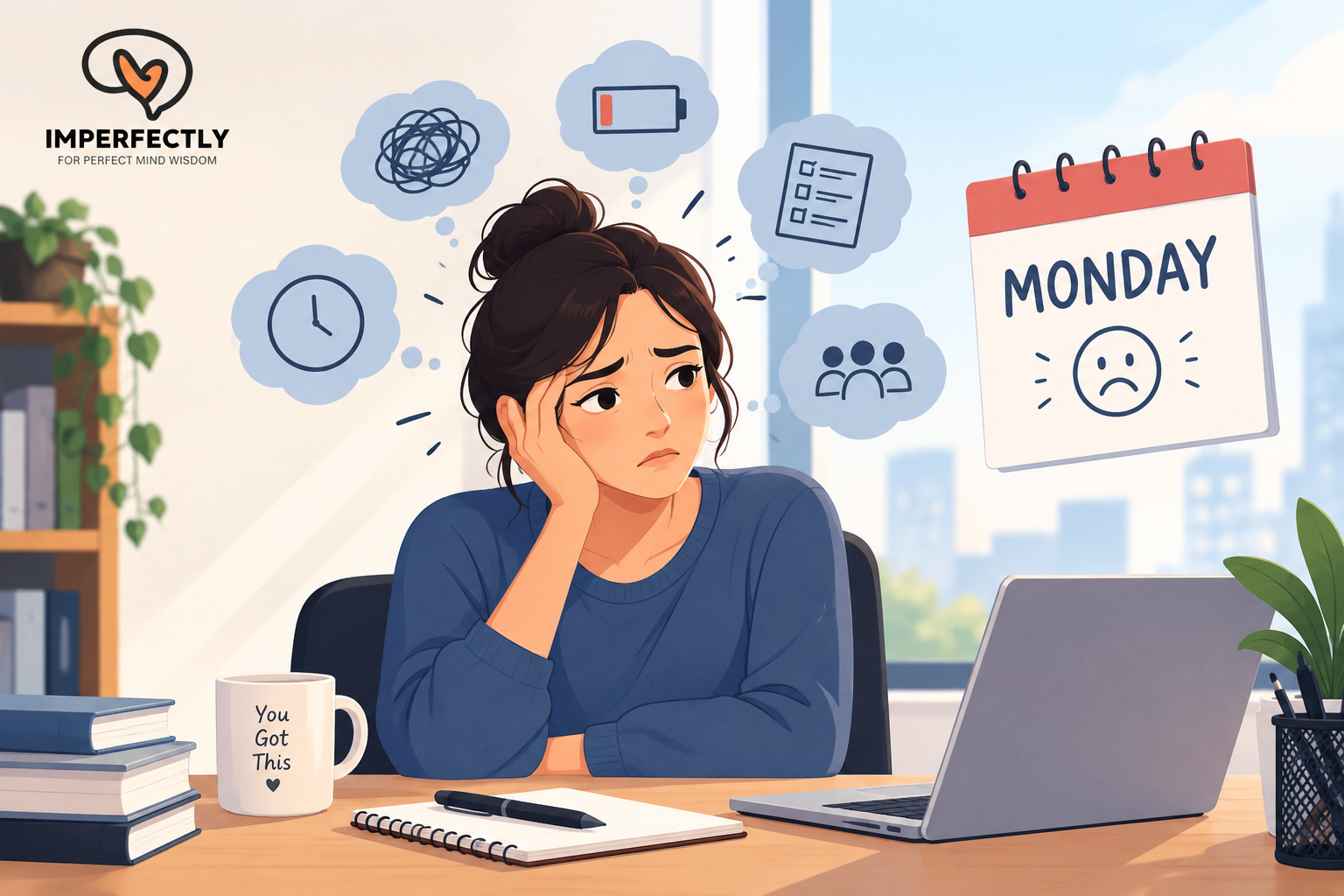
Workplace Anxiety: Why Monday Can Feel Like a Mental Health Trigger
For many people, workplace anxiety does not begin when they sit down at their desk. It can start on Sunday evening, when the weekend is almost over and thoughts about Monday begin creeping in. A notification from work, an unfinished task, a difficult manager, or simply the thought of another demanding week can create a heavy feeling before the workweek has even started.
That experience is more common than people realize. In practice, workplace anxiety often appears in subtle ways: poor sleep on Sunday night, irritability on Monday morning, stomach discomfort before work, racing thoughts during the commute, or a strong urge to avoid opening emails.
Importantly, feeling some Monday stress does not automatically mean someone has an anxiety disorder. However, when the pattern becomes intense, frequent, or starts affecting sleep, relationships, concentration, or everyday functioning, it deserves attention.
Why Monday Can Trigger Workplace Anxiety
Monday represents more than the first day of the working week. For someone experiencing workplace anxiety, it can represent a return to pressure, expectations, uncertainty, and situations they may have been trying not to think about during the weekend.
During the weekend, the nervous system may finally get a chance to slow down. Then Sunday evening arrives, and the mind begins preparing for everything waiting on Monday.
For example, someone might think:
- “I have so much work waiting for me.”
- “What if my manager is unhappy with me?”
- “I probably missed something in my emails.”
- “I don’t know how I’ll finish everything.”
- “I just don’t want to go to work tomorrow.”
Consequently, the anxiety can begin before there is an actual problem in front of the person.
What Workplace Anxiety Can Actually Feel Like
One mistake people often make is assuming anxiety always looks like obvious panic. In real-world situations, workplace anxiety is frequently much quieter.
A person may continue working, attending meetings, and meeting deadlines while internally feeling overwhelmed.
Common Workplace Anxiety Symptoms
Some common signs include:
- Constantly worrying about work after office hours
- Difficulty switching off from work thoughts
- Feeling nervous before meetings
- Fear of making small mistakes
- Repeatedly checking emails or messages
- Difficulty concentrating
- Irritability or emotional exhaustion
- Headaches or muscle tension
- Increased heart rate or sweating
- Stomach discomfort
- Poor sleep, especially before Monday
- Feeling mentally exhausted despite having rested
- Avoiding conversations with colleagues or managers
- Procrastinating because a task feels overwhelming
However, symptoms can vary considerably. One person may become restless and overwork, while another may withdraw, procrastinate, or avoid responsibilities.
That difference matters because workplace anxiety is not always visible to coworkers.
Why Sunday Night Anxiety Can Be a Warning Sign
A particularly common pattern is what people casually call the “Sunday scaries.”
You may have had a relatively enjoyable weekend. Yet, as Sunday afternoon turns into evening, your mood changes.
You start thinking about Monday.
Then you remember the meeting.
Then the deadline.
Then the email you haven’t answered.
Before long, your mind is already at work even though you are physically at home.
This cycle can reinforce workplace anxiety because the brain begins associating Monday with threat before Monday actually arrives.
Over time, Sunday may stop feeling like a day of rest and become a countdown to stress.
Workplace Anxiety Is Not Always About the Job Itself
Another important practical point is that workplace anxiety is not necessarily caused by having a “bad job.”
Sometimes the underlying issue is the environment. In other cases, it may be workload, uncertainty, perfectionism, poor boundaries, interpersonal conflict, lack of control, or previous negative experiences at work.
For example, two employees can have the same workload but experience it completely differently.
One may think:
“This is busy, but I’ll handle it one task at a time.”
Another may think:
“If I don’t do everything perfectly, everyone will think I’m incompetent.”
The workload is similar. The emotional response is not.
Therefore, understanding the thought patterns behind workplace anxiety can be just as important as looking at the workload itself.
The Connection Between Workplace Anxiety and Perfectionism
In professional settings, perfectionism can sometimes look like ambition.
A perfectionistic employee may appear highly responsible because they:
- Double-check everything
- Stay late frequently
- Rarely say no
- Take responsibility for other people’s mistakes
- Respond to messages immediately
- Feel uncomfortable delegating
- Worry excessively about disappointing others
At first, this behavior may even be rewarded.
However, there is a hidden cost.
When your sense of safety depends on never making a mistake, ordinary workplace situations can start feeling threatening. A simple correction from a manager may feel like a personal failure.
This is one way workplace anxiety can quietly develop while a person continues to look “successful” from the outside.
How Work Messages Can Keep Anxiety Going
Modern work culture has blurred the boundary between professional and personal time.
A message at 9 p.m. may take only 30 seconds to read. Nevertheless, mentally, it can keep someone connected to work for hours.
The problem is not necessarily the message itself. The problem can be the expectation that you must always be available.
When people repeatedly check work notifications during dinner, weekends, or before sleeping, their brain gets fewer opportunities to disengage.
As a result, workplace anxiety can follow them home.
A Practical Boundary That Often Helps
Instead of trying to completely eliminate work thoughts, create a clear transition between work and personal time.
For example:
- Finish work by writing down unfinished tasks.
- Decide what needs attention tomorrow.
- Avoid repeatedly checking work notifications after your planned work hours.
- Give yourself a short transition activity after work.
- Keep your phone away from the bed when possible.
- Avoid using Sunday evening to mentally rehearse the entire week.
The goal is not to create a perfect routine. It is to teach your brain that work has an ending.
What to Do When Monday Anxiety Starts on Sunday
If workplace anxiety begins before the workweek, waiting until Monday morning to deal with it may not be enough.
Instead, try reducing uncertainty.
Prepare Without Overpreparing
Spend a limited amount of time identifying your first few priorities for Monday.
You do not need to plan every hour of the week.
A simple list such as:
- Most important task
- One meeting that needs preparation
- One small task that can be completed quickly
can make Monday feel more manageable.
Overplanning, on the other hand, can sometimes become another form of anxiety.
Separate Facts From Predictions
Ask yourself:
What do I know?
versus
What am I predicting?
For example:
“I have a meeting with my manager tomorrow” is a fact.
“My manager is definitely going to criticize me” is a prediction.
This distinction can help reduce workplace anxiety because anxious thinking often treats predictions as if they are already confirmed.
Don’t Solve Monday at 11 p.m.
This is a mistake professionals commonly make.
They lie in bed trying to solve tomorrow’s problems tonight.
Unfortunately, an exhausted brain rarely becomes more productive through late-night worrying.
If a thought keeps returning, write it down and decide when you will address it. Then return your attention to rest.
What Not to Do When You Have Workplace Anxiety
People often develop coping strategies that provide short-term relief but make anxiety worse over time.
Avoiding Everything
Skipping meetings, delaying emails, or repeatedly taking sick days may temporarily reduce anxiety.
However, avoidance can teach the brain:
“Work really is dangerous, and I escaped it.”
That can make the next situation feel even more threatening.
Working Excessively
Another common response is the opposite: working harder and longer to prevent anything from going wrong.
Unfortunately, overworking can contribute to exhaustion, irritability, poor sleep, and eventually burnout.
Constant Reassurance-Seeking
Repeatedly asking colleagues:
“Was that email okay?”
“Do you think my manager is angry?”
“Did I make a mistake?”
may provide temporary reassurance. However, if reassurance becomes necessary every time anxiety appears, confidence can gradually become dependent on other people’s responses.
Workplace Anxiety and Difficult Managers
Sometimes the anxiety is telling you something important.
Not every case of workplace anxiety is an internal problem that can be solved by changing your mindset.
If a workplace includes persistent humiliation, intimidation, discrimination, unreasonable demands, harassment, or unpredictable behavior from management, the environment itself may need to be addressed.
In those situations, telling someone simply to “think positively” is not useful.
Instead, consider practical steps such as documenting concerning incidents, understanding workplace policies, speaking with an appropriate manager or HR representative, seeking support from someone you trust, and getting professional help when the emotional impact becomes significant.
Your mental health matters, but so does the environment in which you are expected to function.
When Workplace Anxiety May Need Professional Support
Occasional stress is part of working life. However, professional support may be worth considering when workplace anxiety becomes persistent or starts interfering with everyday life.
Pay particular attention if you are:
- Frequently unable to sleep because of work
- Experiencing intense anxiety before work
- Having panic-like symptoms
- Avoiding work because of fear
- Struggling to concentrate consistently
- Feeling emotionally exhausted most of the time
- Experiencing significant changes in mood
- Using alcohol or other substances to cope with work stress
- Losing interest in activities outside work
- Finding that anxiety continues even when work problems are temporarily resolved
A psychologist can help identify anxiety patterns and develop practical strategies. A psychiatrist may be appropriate when symptoms are severe, persistent, or require medical assessment.
There is no prize for waiting until you are completely exhausted before asking for help.
How Psychologists and Psychiatrists Can Help With Workplace Anxiety
Professional support is not simply about sitting in a room and talking about your job.
A psychologist may help you understand the relationship between your thoughts, emotions, behaviors, and workplace situations. Depending on your needs, therapy can also focus on coping skills, boundaries, perfectionism, avoidance, emotional regulation, and anxiety management.
A psychiatrist can assess whether symptoms may be related to an anxiety disorder or another mental health concern and determine whether medical treatment should be considered.
In some situations, working with both professionals can provide a more complete approach.
The important point is that treatment should be based on the individual’s symptoms and circumstances rather than assuming every case of workplace anxiety needs the same solution.
A Healthier Way to Think About Monday
You do not necessarily need to love Mondays.
You also do not need to eliminate every uncomfortable feeling before work.
A more realistic goal is to reach a point where Monday feels like a normal part of the week rather than a threat.
That may involve changing how you approach unfinished work, setting boundaries, challenging unhelpful thought patterns, improving recovery time, addressing workplace problems, or getting professional support.
Small changes can matter because anxiety often grows through repeated patterns.
Likewise, improvement usually comes from changing those patterns gradually rather than expecting one perfect solution.
Workplace Anxiety Does Not Mean You Are Weak
One of the most damaging beliefs surrounding workplace anxiety is the idea that anxious employees are simply not resilient enough.
That is not necessarily true.
Someone can be highly capable, responsible, intelligent, and successful while still experiencing significant anxiety.
In fact, some of the people who appear to handle work exceptionally well may be carrying considerable internal pressure.
Therefore, instead of asking:
“Why can’t I handle work like everyone else?”
a more useful question is:
“What is making work feel unsafe, overwhelming, or difficult for me right now?”
That question creates room for practical change.
Start Your Mental Wellness Journey Today with Imperfectly
Your mental health deserves support that goes beyond simply searching for answers online. With Imperfectly, you can connect with qualified mental health and healthcare professionals and choose support based on your individual needs. Whether you are dealing with workplace anxiety, emotional stress, relationship concerns, or other mental wellness challenges, Imperfectly brings professional care and convenient digital access together in one place.
Download the Imperfectly App
📱 Connect with experienced Psychiatrists, Psychologists, Life Coaches, and Physicians
📅 Book online or in-clinic appointments in minutes.
📈 Track your recovery journey with personalized wellness insights.
🔒 Access secure prescriptions, therapy notes, and medical records anytime.
💙 Experience complete 360° mental healthcare in one application.
Contact Imperfectly
Imperfectly – Your Trusted 360° Mental Health Platform
🌐 Website: imperfectly.co
📱 Patient Portal: Imperfectly Patient Portal
📞 Phone: +91 8448073838
📧 Email: admin@imperfectly.co