

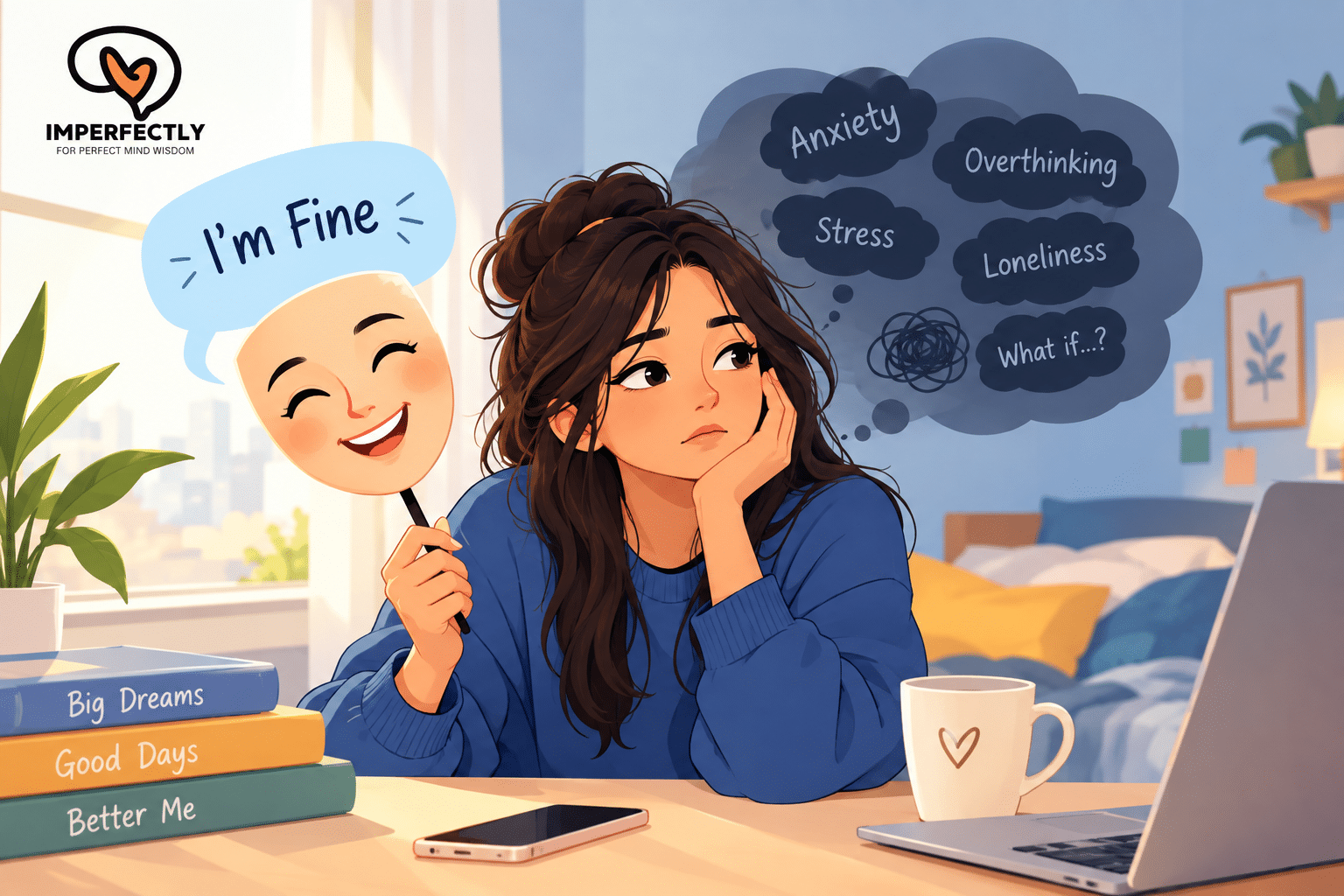
When “I’m Fine” Becomes a Habit
There is a big difference between genuinely feeling okay and automatically saying, “I’m fine,” whenever someone asks how you are. For many people, that two-word response gradually becomes a habit. It can become easier to hide what is happening inside than to explain it, especially when emotions feel complicated, exhausting, or difficult to put into words.
Over time, “I’m Fine” Becomes a Habit can affect the way a person understands their own emotions and communicates with people around them. Someone may continue working, attending college, talking to friends, taking care of their family, and even laughing normally while privately feeling overwhelmed.
The difficult part is that emotional struggles do not always look dramatic from the outside. In real-world conversations, people often seek professional support only after they have spent months telling everyone, including themselves, that everything is fine.
When “I’m Fine” Becomes a Habit Instead of an Answer
At first, saying “I’m fine” may simply be a convenient response.
Someone asks, “How are you?”
You answer, “I’m fine.”
Then you move on.
There is nothing automatically unhealthy about that. The concern begins when the answer becomes automatic even when you know you are struggling.
For example, a person may be dealing with relationship problems but tell friends they are fine. Another may feel constantly anxious at work but continue saying everything is under control. Someone else may feel lonely but avoid admitting it because they do not want to appear needy.
Eventually, saying I’m fine when you’re not can become a form of emotional avoidance.
The person may not even consciously decide to hide their feelings. It simply becomes their usual response.
Why People Start Hiding Emotional Struggles
In my experience working around mental-health concerns, people rarely hide difficult emotions for just one reason.
Sometimes they have learned that talking about emotions creates conflict. Sometimes they have been told to “be strong” for so long that vulnerability feels uncomfortable.
Other times, the person has tried opening up before and felt dismissed.
Statements such as:
- “Everyone has problems.”
- “You are overthinking.”
- “Just stay positive.”
- “Things could be worse.”
- “You need to be stronger.”
may be intended as encouragement, but they can make someone less willing to talk next time.
Consequently, hiding emotional struggles can become a learned coping pattern.
The Difference Between Privacy and Emotional Suppression
Not every private person is emotionally struggling.
Some people simply prefer to process their emotions independently. That is perfectly reasonable.
The difference is often found in choice and flexibility.
A person who values privacy can usually decide when and with whom they want to talk.
Someone experiencing emotional suppression may feel that they cannot talk, even when they desperately want support.
For instance, they might think:
“I want someone to ask me what is actually wrong, but if they ask, I will still say I’m fine.”
That contradiction is worth paying attention to.
Emotional Suppression Can Become Exhausting
Keeping difficult emotions hidden requires effort.
You may have to monitor what you say, control your reactions, avoid certain conversations, and pretend that situations do not bother you.
One difficult conversation might not matter much. However, repeating this pattern for months can become emotionally exhausting.
This is particularly noticeable when a person starts experiencing changes such as:
- becoming unusually irritable
- withdrawing from people
- struggling to enjoy things they previously enjoyed
- feeling mentally exhausted
- having difficulty concentrating
- sleeping much more or less than usual
- constantly feeling overwhelmed
- becoming emotionally numb
These signs do not automatically mean someone has a mental-health disorder. Nevertheless, they can indicate that something deserves attention.
Signs That “I’m Fine” May Not Mean “I’m Okay”
One of the most common mistakes is looking for one dramatic warning sign.
In reality, emotional difficulties often appear through small changes.
For example, imagine someone who normally enjoys meeting friends. They begin cancelling plans repeatedly. When asked what is happening, they say, “Nothing, I’m just tired.”
A week later, the same thing happens.
Then again.
Eventually, “I’m fine” becomes less of an answer and more of a shield.
Your Words and Behaviour Do Not Match
A useful question is:
Does what you say match what you are experiencing?
Someone may say:
“I’m completely fine.”
But at the same time, they may be crying frequently, avoiding people, struggling to sleep, feeling constantly tense, or losing interest in everyday activities.
That mismatch does not prove that something is seriously wrong. However, it can be a useful reason to pause and check in with yourself.
You Keep Saying “Nothing” Because Explaining Feels Too Difficult
Sometimes the problem is not that a person has nothing to say.
It is that there is too much to say.
When several problems build up at once—work pressure, relationship conflict, financial concerns, family responsibilities, loneliness—it can become difficult to identify where to begin.
So instead of explaining everything, the person says:
“I’m fine.”
And the conversation ends.
Why Saying “I’m Fine” Can Feel Safer
For some people, hiding their feelings provides short-term relief.
If you tell someone you are struggling, you may have to answer follow-up questions.
You may worry about being judged.
You may have to admit that something has affected you more than you expected.
You may even worry about becoming a burden.
Therefore, saying “I’m fine” can feel easier.
However, what works as short-term protection can become a long-term communication barrier.
The Fear of Becoming a Burden
This is particularly common among people who are used to taking care of others.
They may think:
“I don’t want to bother anyone.”
“Everyone already has enough problems.”
“I should be able to handle this myself.”
“I don’t want people to worry about me.”
These thoughts can sound responsible. However, repeatedly ignoring your own emotional needs does not necessarily make you stronger.
Sometimes, it simply means your needs remain unaddressed.
What Happens When You Hide Your Feelings for Too Long?
There is no single outcome for everyone.
Some people eventually open up and feel better after receiving appropriate support. Others continue functioning outwardly while becoming increasingly disconnected from their emotions.
Over time, difficulty expressing emotions can affect relationships.
A partner may think:
“You never tell me what is wrong.”
A friend may think:
“You don’t trust me.”
A family member may say:
“You have changed.”
Meanwhile, the person may genuinely believe:
“I don’t know how to explain what I’m feeling.”
That is an important distinction.
Sometimes people are not unwilling to communicate. They simply have not learned how to communicate difficult emotions safely.
How to Stop Automatically Saying “I’m Fine”
You do not need to suddenly tell everyone everything.
In fact, forcing yourself to disclose deeply personal information before you are ready can backfire.
Instead, start by becoming more honest with yourself.
Replace “I’m Fine” With a More Accurate Answer
You can use simple responses such as:
- “I’m having a difficult day.”
- “I’m not feeling great, but I’m not ready to talk about it yet.”
- “There is a lot on my mind.”
- “I’m feeling overwhelmed.”
- “I don’t know exactly what I’m feeling yet.”
- “Can we talk about this later?”
These responses create honesty without requiring you to explain everything immediately.
Start With One Safe Person
You do not need to tell your entire story to everyone.
Choose one person with whom you feel reasonably safe.
You could begin with:
“I’ve been saying I’m fine a lot lately, but honestly, I haven’t been feeling like myself.”
That single sentence can open a much more meaningful conversation.
When Professional Mental Health Support May Help
There is an important difference between having a difficult week and experiencing persistent emotional distress.
Consider speaking with a qualified mental-health professional when emotional difficulties continue, interfere with everyday life, affect relationships, or become increasingly difficult to manage on your own.
A psychologist can help you understand emotional patterns and develop healthier ways of coping and communicating.
A psychiatrist can assess symptoms from a medical and psychiatric perspective and determine whether treatment, including medication when appropriate, may be useful.
You do not have to wait until everything feels unbearable before seeking support.
Asking for Help Does Not Mean You Failed
One misconception I have seen repeatedly is the belief that professional support is only for people who are “really unwell.”
That is not how mental healthcare needs to work.
People seek professional support for many reasons: persistent stress, relationship difficulties, anxiety, emotional exhaustion, grief, sleep problems, changes in mood, or simply because they do not understand what they are experiencing.
Getting help early can sometimes make it easier to understand what is happening before problems become more disruptive.
How Friends and Family Can Respond When Someone Says “I’m Fine”
If you suspect someone is struggling, repeatedly asking “What’s wrong?” may not always work.
Instead, create space without forcing disclosure.
You might say:
“You don’t have to talk about it right now, but I’m here if you want to.”
That sentence communicates support without demanding an explanation.
Also, avoid immediately giving advice.
Sometimes people need to feel heard before they are ready to hear solutions.
Notice Changes, Not Just Words
If someone repeatedly says they are fine but their behaviour has changed significantly, pay attention.
Are they isolating themselves?
Have they stopped doing things they previously enjoyed?
Do they appear constantly exhausted?
Are they becoming unusually irritable?
Are they struggling to manage everyday responsibilities?
These changes may be more informative than the words “I’m fine” alone.
You Don’t Have to Have the Perfect Words
One of the biggest barriers to honest emotional communication is the belief that you need to understand everything before talking about it.
You don’t.
You can say:
“I don’t know what’s wrong.”
“I can’t explain it properly.”
“I just don’t feel like myself.”
“I need someone to listen.”
Those are valid starting points.
In many cases, understanding comes after the conversation begins, not before.
Start Your Mental Wellness Journey Today with imperfectly
Taking care of your mental health does not always begin with knowing exactly what is wrong. Sometimes, it starts with acknowledging that “I’m fine” no longer describes how you actually feel. Imperfectly provides a connected mental-health experience where you can access professional support, explore your concerns, and take practical steps toward better emotional wellbeing. Whether you are looking for a psychiatrist, psychologist, life coach, or physician, the Imperfectly platform is designed to make accessing support simpler and more convenient.
Download the Imperfectly App
📱 Connect with experienced Psychiatrists, Psychologists, Life Coaches, and Physicians
📅 Book online or in-clinic appointments in minutes.
📈 Track your recovery journey with personalized wellness insights.
🔒 Access secure prescriptions, therapy notes, and medical records anytime.
💙 Experience complete 360° mental healthcare in one application.
Contact Imperfectly
Imperfectly – Your Trusted 360° Mental Health Platform
🌐 Website: https://imperfectly.co
📱 Patient Portal: https://imperfectly.co/application/
📞 Phone: +91 8448073838
📧 Email: admin@imperfectly.co