

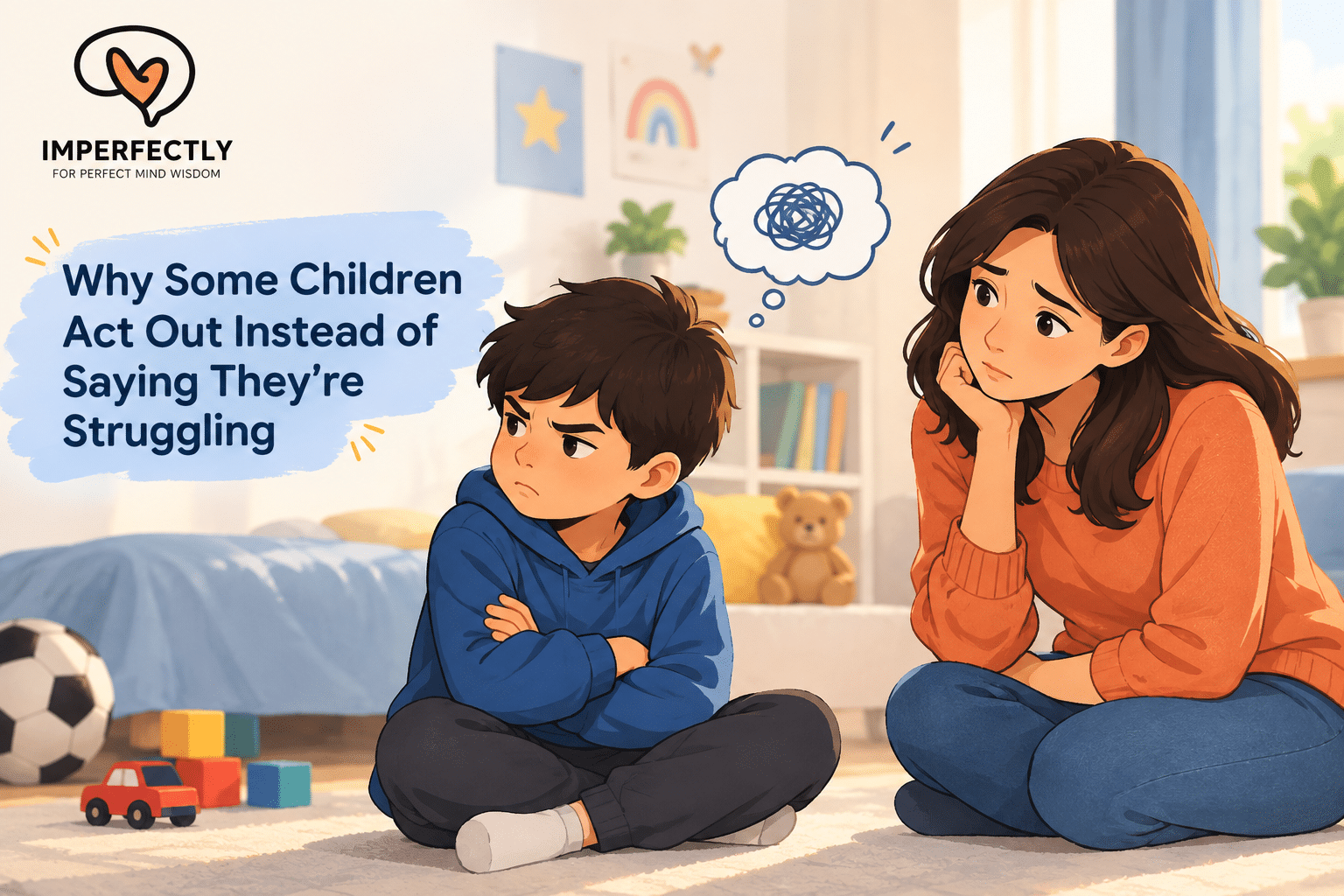
Why Children Act Out Instead of Saying They’re Struggling
Why children act out is a question many parents ask when a child suddenly becomes angry, withdrawn, aggressive, defiant, or unusually difficult at home or school. What looks like misbehavior may sometimes be a child’s way of expressing emotions they cannot yet explain. A child may not know how to say, “I am overwhelmed,” “I am worried about school,” or “Something happened that I don’t know how to handle.” Instead, those feelings can appear through behavior.
This is why understanding why children act out requires looking beyond the behavior itself. In everyday clinical work, parents often describe a child as “stubborn,” “naughty,” or “difficult,” only to discover that the behavior started after a stressful event, friendship problem, academic pressure, family change, or emotional struggle.
Why Children Act Out Instead of Talking About Their Feelings
Children do not always have the emotional vocabulary adults have.
An adult might say:
“I feel anxious because I am worried that I will fail.”
A child may simply refuse to go to school.
An adult might say:
“I feel left out by my friends.”
A child may become angry with their parents instead.
That difference is important. Children are still learning how to identify emotions, understand them, and communicate them. Therefore, behavior can sometimes become their communication system.
This does not mean that every difficult behavior has a hidden emotional cause. Children can also misbehave because they are tired, frustrated, testing boundaries, or learning self-control. However, when a behavior is sudden, persistent, or noticeably different from the child’s usual personality, it deserves a closer look.
What Does It Mean When Children Act Out?
When children act out, the behavior may be the visible part of a much larger emotional experience.
For example, a child may:
- become angry over small situations
- refuse to attend school
- argue constantly with parents
- withdraw from family members
- fight with siblings
- lose interest in favorite activities
- become unusually quiet
- complain of headaches or stomachaches
- have frequent emotional outbursts
- become aggressive or destructive
The behavior itself still needs boundaries. However, simply stopping the behavior may not solve the reason it is happening.
A useful question is:
“What happened before this behavior started?”
That question can sometimes provide more information than repeatedly asking, “Why are you behaving like this?”
Why Children Act Out When They Feel Overwhelmed
Emotional overload is one reason why children act out.
Imagine a child who has been struggling with schoolwork, worrying about an upcoming test, and having problems with friends. During the day, the child may hold everything together at school.
Then they come home.
A simple request such as “Finish your homework” suddenly produces shouting or crying.
From the parent’s perspective, the reaction may seem completely disproportionate. From the child’s perspective, however, that small request may be the final pressure added to an already overloaded emotional system.
This is something parents sometimes miss because they see the final reaction but not everything that happened earlier.
Why Children Act Out Because of School Stress
School can create emotional pressure in ways children do not always explain.
A child who is struggling academically may not say:
“I am afraid that I am falling behind my classmates.”
Instead, parents may hear:
“I hate school.”
“I don’t want to do homework.”
“My teacher is annoying.”
“I don’t care about my grades.”
Sometimes the child genuinely does not understand that anxiety or fear is driving the avoidance.
Academic pressure can also affect self-confidence. If a child repeatedly experiences difficulty with schoolwork, they may start avoiding situations where they expect to fail.
Therefore, why children act out may sometimes have more to do with fear of failure than unwillingness to cooperate.
Why Children Act Out Because of Friendship Problems
Friendship problems are another commonly overlooked factor.
Children may experience:
- exclusion from a friendship group
- teasing
- bullying
- arguments with friends
- social embarrassment
- difficulty making friends
- fear of being rejected
Yet many children do not immediately tell their parents.
Instead, the emotional impact may appear at home.
Parents might notice that the child becomes angry after school, refuses to talk about their day, avoids school activities, or suddenly spends much more time alone.
In these situations, children acting out may be connected to social stress rather than deliberate disobedience.
Why Children Act Out After Changes at Home
Children can be affected by changes adults sometimes assume they will easily understand.
A new school, moving to another city, parental separation, conflict at home, the arrival of a new sibling, changes in family routines, or other major disruptions can affect a child’s sense of security.
Even when adults do not discuss every detail with the child, children are often very observant.
They notice changes in tone.
They notice arguments.
They notice when parents are worried.
They notice when routines change.
Consequently, why children act out can sometimes be connected to uncertainty or a need for reassurance.
Signs That a Child May Be Struggling
Not every tantrum or argument indicates an emotional problem.
What matters more is a pattern of change.
Parents may want to pay closer attention when they notice:
- a sudden change in personality
- frequent anger or irritability
- persistent sadness
- withdrawal from friends or family
- repeated school refusal
- major changes in sleep
- changes in appetite
- declining academic performance
- loss of interest in hobbies
- frequent unexplained physical complaints
- unusually intense fears or worries
- repeated aggressive behavior
One difficult day is usually not enough to understand what is happening.
Instead, look at how often it happens, how intense it is, how long it has continued, and whether it is affecting everyday life.
Why Children Act Out Differently at Home and School
A child may behave completely differently in different environments.
For example, a teacher may say:
“Your child is very quiet and cooperative in class.”
At home, the same child may have frequent emotional outbursts.
Parents sometimes interpret this as proof that the child is choosing to misbehave.
That is not necessarily what is happening.
Some children spend the entire school day controlling their emotions and following expectations. Once they reach a familiar and emotionally safe environment, those emotions can come out.
This can help explain why children act out at home even when they appear fine elsewhere.
Common Mistakes Parents Make When Children Act Out
Calling the Child “Bad” or “Difficult”
Labels can quickly become part of a child’s identity.
There is a major difference between saying:
“You behaved aggressively.”
and:
“You are an aggressive child.”
The first describes behavior.
The second labels the child.
Parents can set firm boundaries without turning a difficult moment into a judgment about the child’s character.
Immediately Punishing Without Understanding the Trigger
Consequences can have a place in parenting. However, punishment alone may not address the reason the behavior keeps returning.
If a child repeatedly refuses school, for example, simply taking away screen time may not address bullying, anxiety, academic difficulties, or social problems.
The behavior may stop temporarily while the underlying problem remains.
Comparing the Child With Other Children
“Your brother doesn’t behave like this.”
“Your cousin gets better marks.”
“Other children can handle this.”
These comparisons can increase shame rather than improve emotional regulation.
Children need guidance, but they also need an environment where they can discuss difficult emotions without immediately feeling judged.
How Parents Can Respond When Children Act Out
Start with the immediate situation.
If a child is hitting, throwing objects, or putting someone at risk, safety comes first.
Once the situation has settled, have the emotional conversation.
Instead of asking:
“Why did you do that?”
try more specific questions:
“What happened before you became angry?”
“Did something happen at school?”
“Were you worried about something?”
“Did someone upset you?”
“Was today harder than usual?”
Specific questions can be easier for children to answer than broad questions about their emotions.
Give Children More Than One Way to Communicate
Not every child wants to sit across from a parent and have a serious conversation.
Some children talk more openly while:
- drawing
- playing
- walking
- travelling in the car
- doing homework together
- preparing food
- getting ready for bed
The timing matters too.
A child who says “I don’t want to talk” at 6 p.m. may spontaneously tell you what happened at school at 9 p.m.
Parents do not always need to force the conversation immediately.
Sometimes leaving the door open is more effective.
What If a Child Says, “I Don’t Know”?
This answer is extremely common.
It does not always mean the child is hiding something.
Sometimes “I don’t know” means the child genuinely does not know how to describe the feeling.
Parents can help by offering choices.
“Are you angry, sad, worried, or embarrassed?”
“Did something happen with your friends?”
“Were you worried about getting something wrong?”
Giving children words for different emotions can gradually improve their ability to communicate.
Why Children Act Out Does Not Mean Parents Should Ignore Boundaries
Understanding emotional struggles does not mean allowing harmful behavior.
Children still need limits.
A parent can say:
“You are allowed to be angry, but you are not allowed to hit.”
Or:
“I understand that you are frustrated about homework, but we still need to find a safe way to handle that frustration.”
This teaches an important distinction:
Feelings can be accepted while harmful behavior still has consequences.
That balance is important when responding to children acting out.
When Should Parents Consider Professional Support?
Professional support can be useful when a child’s behavior is persistent, increasingly intense, or interfering with school, relationships, family life, or everyday functioning.
For example, parents may consider seeking guidance when:
- behavior continues for weeks or becomes progressively worse
- school attendance is being affected
- friendships are being significantly affected
- the child is increasingly isolated
- emotional outbursts are becoming difficult to manage
- sleep or appetite has changed considerably
- the child frequently expresses hopelessness or worthlessness
- parents are unsure what is causing the change
A psychologist can help explore emotional, behavioral, social, family, and school-related factors.
A psychiatrist may be appropriate when a child needs a psychiatric assessment or medical treatment.
Seeking professional guidance does not automatically mean a child will receive a diagnosis. Sometimes the first goal is simply understanding what is happening and identifying healthier ways to cope.
A Practical Way to Understand Why Children Act Out
When your child’s behavior changes, consider these five questions:
1. When Did the Behavior Start?
A timeline can reveal connections that are otherwise easy to miss.
2. What Happens Before the Behavior?
Look for repeated triggers rather than focusing only on the final outburst.
3. Where Does It Happen?
Does it happen at home, school, with friends, or everywhere?
4. Has Anything Changed Recently?
Consider school, friendships, family circumstances, routines, expectations, or other changes.
5. Is It Affecting Everyday Life?
Look at sleep, school attendance, friendships, family relationships, hobbies, and general functioning.
These questions can help parents move from simply asking why children act out to understanding what the behavior may be communicating.
The Behavior May Be Telling You Something
Children do not always have the words to say:
“I am struggling.”
“I am scared.”
“I feel left out.”
“I don’t know what to do.”
Sometimes, they show it instead.
That does not mean every outburst should be excused or every behavior interpreted as a sign of a mental health condition. Rather, it means parents can look at behavior with both compassion and boundaries.
When parents become curious about what is underneath repeated behavior, they may discover information that would otherwise remain hidden.
Sometimes the most useful response is not:
“Why are you behaving like this?”
but:
“Something seems different lately. I’m here if something is bothering you.”
That simple shift can create a safer opportunity for a child to begin talking.
Start Your Mental Wellness Journey Today with Imperfectly
Children and families sometimes need more than advice from a search engine or a quick conversation. Imperfectly provides a 360° mental health platform where individuals and families can connect with experienced mental health and healthcare professionals through accessible digital care. Whether you are looking for psychological support, psychiatric guidance, or broader wellbeing support, Imperfectly aims to make the process of finding appropriate professional care simpler and more convenient.
Download the Imperfectly App
📱 Connect with experienced Psychiatrists, Psychologists, Life Coaches, and Physicians.
📅 Book online or in-clinic appointments in minutes.
📈 Track your recovery journey with personalized wellness insights.
🔒 Access secure prescriptions, therapy notes, and medical records anytime.
💙 Experience complete 360° mental healthcare in one application.
Contact Imperfectly
Imperfectly – Your Trusted 360° Mental Health Platform
🌐 Website: https://imperfectly.co
📱 Patient Portal: https://imperfectly.co/application/
📞 Phone: +91 8448073838
📧 Email: admin@imperfectly.co