

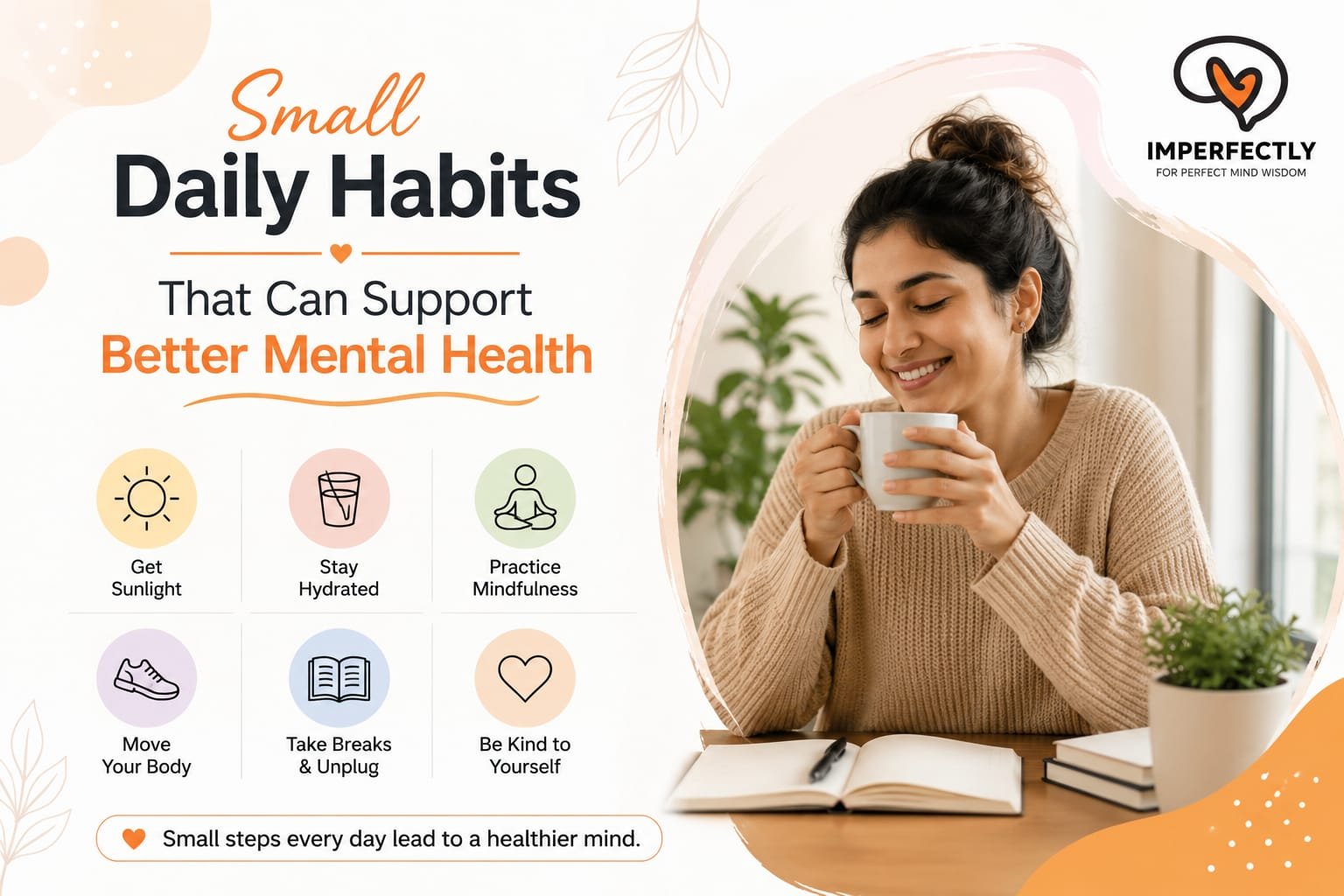
Small Daily Habits That Can Support Better Mental Health
Mental health does not always improve because of one major lifestyle change. More often, small daily habits for better mental health create the steady foundation that helps people feel more balanced, focused, and emotionally resilient over time. A few minutes of movement, a consistent sleep routine, a proper meal, or an honest conversation may seem insignificant on a difficult day. However, when these actions are repeated regularly, they can make a meaningful difference.
In clinical practice, one of the most common mistakes is expecting motivation to come first. It usually does not. When someone is struggling emotionally, waiting to “feel ready” before taking care of themselves can keep them stuck. Instead, starting with something small and realistic often works better.
The goal is not to create a perfect routine. Rather, it is to build a routine that you can return to—even after a difficult day.
Why Small Daily Habits for Better Mental Health Matter
When people think about improving their mental health, they often imagine major changes: exercising every morning, meditating for thirty minutes, completely changing their diet, or following a strict productivity schedule.
In reality, that approach can sometimes create another source of pressure.
Small habits work differently. They reduce the amount of effort required to get started. Consequently, they are easier to repeat, especially when energy, concentration, or motivation is low.
For example, drinking water after waking up is easier to maintain than promising yourself that you will completely transform your lifestyle next week. Taking a ten-minute walk may be more realistic than committing to an intense workout every day.
The habit itself may look ordinary. The consistency is what makes it valuable.
1. Start the Day Without Immediately Reaching for Your Phone
For many people, the first few minutes after waking up are filled with notifications, emails, social media, and news.
That immediate flood of information can put the brain into a reactive mode before the day has properly started.
Instead, try creating a short buffer between waking and checking your phone. It could be just 10 or 15 minutes.
During that time, you might:
- Drink some water.
- Open the curtains.
- Stretch gently.
- Sit quietly for a few minutes.
- Think about what actually needs your attention today.
This is not about avoiding technology completely. Rather, it is about deciding when technology gets access to your attention.
2. Keep Your Sleep and Wake Times Relatively Consistent
Sleep is one of the areas I would pay close attention to when someone says they are feeling emotionally drained.
People often focus only on how many hours they sleep. However, consistency matters too.
Going to bed at 11 p.m. one night, 2 a.m. the next, and 10 p.m. after that can make it harder for the body to settle into a predictable rhythm.
You do not need a perfect sleep schedule. Instead, aim for reasonably consistent sleeping and waking times whenever your circumstances allow.
A Practical Sleep Habit
Rather than trying to overhaul your entire evening routine, start with one change.
For example:
- Keep your phone away from the bed.
- Dim the lights before sleeping.
- Avoid working from your bed.
- Create a short wind-down routine.
- Keep your wake-up time reasonably consistent.
If sleep problems continue for weeks or significantly affect daily functioning, it is worth discussing them with a qualified healthcare professional rather than assuming they are simply a lack of discipline.
3. Move Your Body, Even When You Don’t Feel Like Exercising
Physical activity and mental well-being are closely connected, but exercise does not have to mean spending an hour at the gym.
A ten-minute walk counts.
Stretching between work sessions counts.
Taking the stairs counts.
Dancing to two songs at home counts.
The most useful form of movement is often the one you are actually willing to repeat.
For someone experiencing low motivation, saying “I need to exercise every day for an hour” can feel overwhelming. Saying “I will walk outside for ten minutes” is much easier to act on.
And once you start, you may naturally continue for longer.
4. Eat at Regular Intervals
When life becomes stressful, meals are often one of the first routines to disappear.
Someone may skip breakfast, work through lunch, survive on coffee, and then wonder why they feel exhausted or irritable later.
Food is not a cure for mental health difficulties. Nevertheless, regular and adequate nourishment supports the body while you manage emotional demands.
A practical approach is to avoid making meals unnecessarily complicated.
Keep a few easy options available so that eating does not require significant planning when you are already tired.
5. Spend a Few Minutes Outside
A short change of environment can sometimes interrupt a repetitive thought pattern.
You do not need to go hiking or spend an entire afternoon outdoors.
Step onto a balcony.
Walk around the block.
Sit in a nearby park.
Get some morning daylight.
Even a brief break from the same room, screen, and mental workload can provide a useful reset.
This is particularly helpful for people who spend most of their day indoors or working at a computer.
6. Make One Genuine Human Connection Every Day
One of the most underestimated small daily habits for better mental health is maintaining meaningful social contact.
That does not necessarily mean having a long conversation.
You could:
- Call a friend.
- Check in with a family member.
- Have tea with a colleague.
- Send someone a thoughtful message.
- Talk honestly with someone you trust.
The important distinction is between connection and social media consumption.
Scrolling through hundreds of posts can feel socially stimulating while still leaving someone feeling isolated.
A genuine conversation, even a short one, can be very different.
7. Give Your Mind a Short Break From Constant Input
The modern day rarely gives the brain much quiet.
There are notifications, advertisements, messages, meetings, videos, podcasts, and endless scrolling.
Consequently, some people are physically tired but mentally overstimulated.
Try creating a small period of intentional quiet.
You could sit without your phone for five minutes, take a quiet walk, or simply finish your tea without simultaneously watching something.
The objective is not meditation perfection.
It is giving your attention somewhere to rest.
8. Write Down What Is Taking Up Mental Space
When several worries are competing for attention, thoughts can begin to feel bigger than they actually are.
Writing them down can create a little psychological distance.
You might divide a page into three simple sections:
What is bothering me?
What can I control today?
What can wait?
This is particularly useful when your mind keeps replaying the same problem.
You are not required to solve everything immediately. Sometimes the first useful step is simply getting the thoughts out of your head and onto paper.
9. Practice One Small Act of Self-Respect
Self-care is often presented as something elaborate: spa days, vacations, long meditation sessions, or expensive wellness activities.
Those things can be enjoyable, but everyday self-care is often much less glamorous.
It might mean:
- Saying no to an unnecessary commitment.
- Taking a proper lunch break.
- Going to bed instead of continuing to work.
- Cleaning one small area of your room.
- Asking for help when you need it.
- Not responding immediately when you are emotionally activated.
These actions communicate something important: your needs deserve attention too.
10. Don’t Turn Mental Health Habits Into Another Performance Test
This is perhaps the most important practical point.
People sometimes create a beautiful mental wellness routine and then feel like failures when they cannot maintain it.
That defeats the purpose.
Your mental health routine should support your life—not become another source of guilt.
If you miss your walk one day, restart tomorrow.
If you sleep late, return to your routine the following night.
If you spend an evening scrolling instead of reading, do not turn it into a judgment about your character.
Consistency is not the same as perfection.
The “Minimum Version” Technique
For each habit, create a smaller version that you can do on difficult days.
For example:
Normal day: 30-minute walk
Difficult day: 5-minute walk
Normal day: Cook a balanced meal
Difficult day: Eat something simple and nourishing
Normal day: 20 minutes of journaling
Difficult day: Write three sentences
Normal day: Call a friend
Difficult day: Send a short message
This approach prevents an all-or-nothing mindset.
How to Build Small Daily Habits for Better Mental Health That Actually Last
The best routine is usually not the most impressive one. It is the one that fits your real life.
Start with one or two habits rather than changing everything at once.
For example, your first week might look like this:
- Wake up around the same time each day.
- Take a ten-minute walk.
- Drink enough water throughout the day.
- Spend five minutes away from screens.
- Contact one person you trust.
Once those actions feel reasonably natural, add another habit.
Attach New Habits to Existing Routines
A useful trick is to connect a new behavior with something you already do.
For example:
After brushing my teeth → I will stretch for two minutes.
After lunch → I will walk for ten minutes.
Before getting into bed → I will put my phone away.
This removes some of the decision-making involved in starting the habit.
What to Do When You Lose Motivation
Motivation is unreliable.
It changes with sleep, stress, workload, relationships, physical health, and countless other factors.
Therefore, building your mental wellness routine around motivation alone is risky.
Instead, make the desired action easy to begin.
Put your walking shoes somewhere visible.
Keep a water bottle nearby.
Place your journal beside your bed.
Schedule important conversations instead of waiting for the “right mood.”
The less friction between you and the habit, the more likely you are to follow through.
When Small Habits Are Not Enough
Small daily habits can support mental well-being, but they are not a replacement for professional mental healthcare when someone is experiencing significant or persistent symptoms.
If sadness, anxiety, panic, intrusive thoughts, sleep problems, emotional distress, loss of interest, or difficulty functioning continues or becomes difficult to manage, professional support can make an important difference.
Likewise, someone does not have to wait until their situation becomes a crisis before seeking help.
A psychologist, psychiatrist, physician, or other appropriately qualified professional can help identify what is happening and determine what type of support may be appropriate.
The purpose of healthy habits is to support your well-being—not to convince you that you should manage everything alone.
A Simple Daily Mental Wellness Checklist
You do not need to complete every item every day.
Instead, use this as a gentle reminder:
- Did I get enough rest?
- Did I eat something nourishing?
- Did I move my body?
- Did I spend some time away from screens?
- Did I connect with someone?
- Did I give myself a genuine break?
- Did I do one thing that was important to me?
- Did I treat myself with reasonable kindness?
Some days, you will answer “yes” to most of these.
Other days, you may manage only one or two.
That still counts.
Start Your Mental Wellness Journey Today with Imperfectly
Imperfectly is designed to make mental healthcare more accessible by bringing different forms of professional support into one connected platform. Through Imperfectly, individuals can connect with experienced psychiatrists, psychologists, life coaches, and physicians, choose online or in-clinic care, and keep track of their wellness journey. Instead of treating mental health as a one-time appointment, the platform supports a more connected approach to ongoing mental healthcare, helping people find the right professional support when they need it.
Download the Imperfectly App
📱 Connect with experienced Psychiatrists, Psychologists, Life Coaches, and Physicians.
📅 Book online or in-clinic appointments in minutes.
📈 Track your recovery journey with personalised wellness insights.
🔒 Access secure prescriptions, therapy notes, and medical records anytime.
💙 Experience complete 360° mental healthcare in one application.
Contact Imperfectly
Imperfectly – Your Trusted 360° Mental Health Platform
🌐 Website: https://imperfectly.co
📱 Patient Portal: https://imperfectly.co/application/
📞 Phone: +91 8448073838
📧 Email: admin@imperfectly.co