

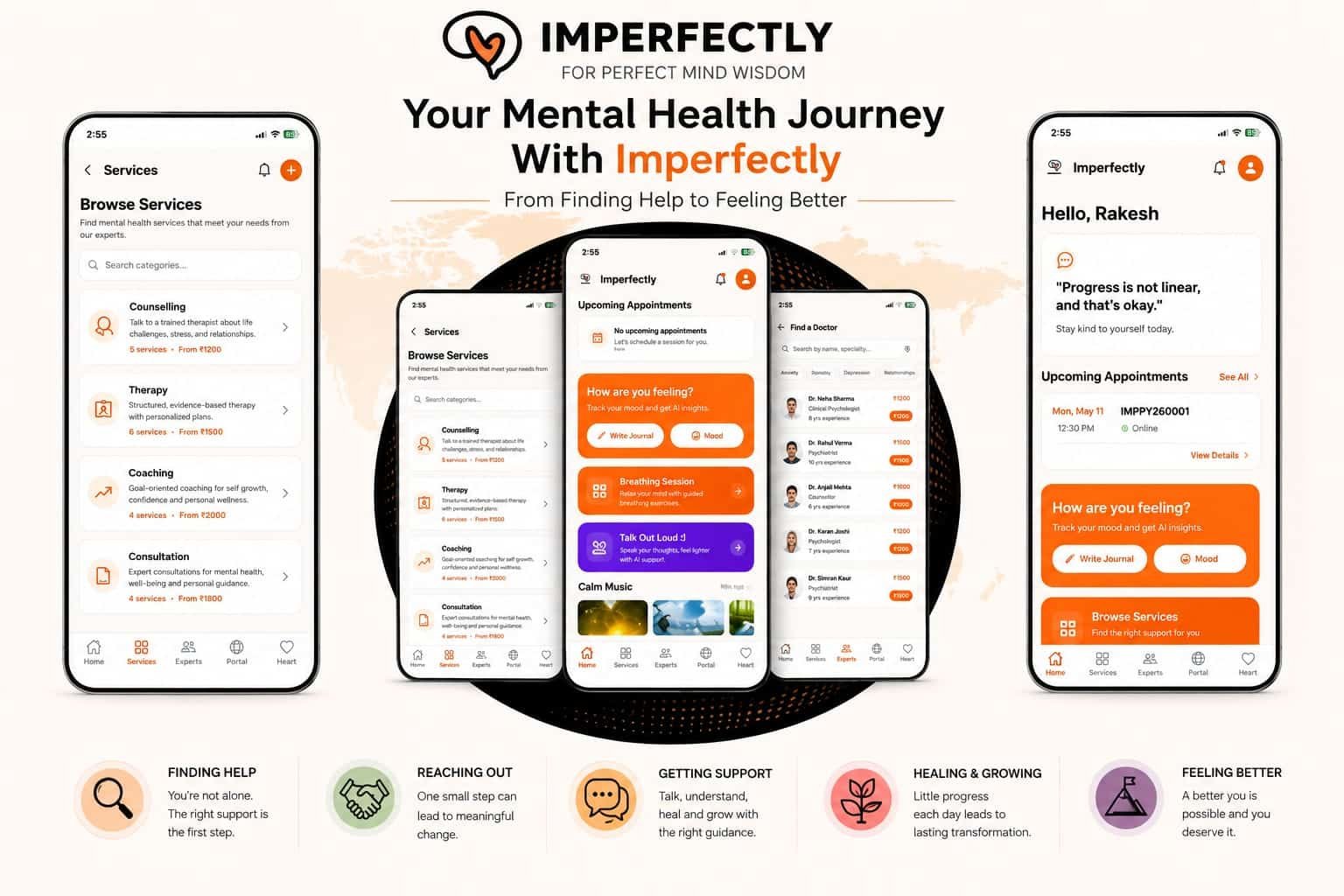
Your Mental Health Journey With Imperfectly: From Finding Help to Feeling Better
Starting a mental health journey with Imperfectly is not about suddenly having everything figured out. In real life, getting better rarely happens in a straight line. Some days you may feel ready to make a change, while on other days, simply admitting that you need support can feel difficult. What matters is having the right help when you are ready to take that first step.
Mental health care has also changed. People no longer have to wait until their problems become overwhelming before speaking with a professional. Today, support can begin with a conversation, a professional assessment, therapy, medical guidance, lifestyle support, or simply understanding what you are experiencing.
That is where Imperfectly aims to make the process easier. Instead of treating mental healthcare as a series of disconnected appointments, Imperfectly brings different forms of professional support together so people can take a more organized and continuous approach to their wellbeing.
What Your Mental Health Journey With Imperfectly Can Look Like
There is no universal mental health journey. Someone dealing with persistent anxiety may need a different approach from someone experiencing depression, relationship difficulties, burnout, sleep problems, or concerns that require psychiatric care.
Nevertheless, there are some practical stages that many people experience.
1. Recognizing That Something Needs to Change
The first step is often the one people postpone the longest.
You might notice that you are constantly tired, avoiding people, struggling to concentrate, losing interest in things you once enjoyed, feeling unusually irritable, or simply not feeling like yourself.
Importantly, you do not need to wait for your situation to become a crisis before asking for help.
A common mistake is thinking, “Other people have bigger problems than me.” Mental healthcare does not work that way. Your distress is worth discussing even when you cannot put a perfect label on it.
2. Finding the Right Mental Health Professional
Another important part of the mental health journey with Imperfectly is understanding which type of professional may be appropriate for your needs.
A psychologist may help with psychological assessment, therapy, emotional difficulties, behavioral patterns, and coping strategies.
A psychiatrist is a medical doctor specializing in mental health. They can assess psychiatric conditions, provide medical treatment when appropriate, and manage medication when it is clinically indicated.
A life coach can focus more on goals, accountability, habits, personal development, and practical life changes. Coaching, however, is not a substitute for psychiatric or psychological treatment when someone has a mental health disorder requiring clinical care.
A physician may also be important because physical health and mental wellbeing can influence each other. Sleep problems, hormonal changes, medication effects, nutritional issues, and other medical factors can sometimes affect mood, concentration, or energy.
The practical lesson is simple: the right professional depends on what you are experiencing, not on what is currently trending online.
Why the Mental Health Journey With Imperfectly Should Be Personal
Mental healthcare is not a checklist where everyone follows the same five steps.
Two people can use the same words—“I feel anxious”—and have completely different underlying situations.
One person may be dealing with work-related stress. Another may have panic symptoms. Someone else may be experiencing trauma-related difficulties. Therefore, a useful mental healthcare platform should leave room for individual assessment rather than assuming that one solution fits everyone.
The mental health journey with Imperfectly is designed around this idea of connected and personalized care.
Professional Support Should Start With Listening
One of the most overlooked parts of mental healthcare is the quality of the initial conversation.
People sometimes arrive at their first appointment believing they need to explain everything perfectly. They do not.
You can say:
- “I don’t know exactly what is wrong.”
- “I have been feeling different lately.”
- “I am functioning, but I don’t feel okay.”
- “I cannot explain why I am struggling.”
- “I have tried dealing with this on my own, but it isn’t working.”
These statements can be valuable starting points for a professional.
In practice, honest information is usually more useful than trying to give the “right” answer during an appointment.
How Imperfectly Brings Different Forms of Care Together
Traditional mental healthcare can sometimes feel fragmented. You may have one provider for therapy, another for medical care, separate records, and little visibility into how your overall care is progressing.
Imperfectly is designed to bring these pieces together through a 360° mental healthcare approach.
Through the Imperfectly platform, users can connect with experienced Psychiatrists, Psychologists, Life Coaches, and Physicians, depending on their individual needs.
Book Online or In-Clinic Appointments
Convenience matters more than many healthcare providers realize.
When booking an appointment requires too many steps, people can easily postpone it. Therefore, Imperfectly allows patients to book professional appointments online or choose in-clinic care where available.
The goal is to reduce unnecessary friction between recognizing that you need help and actually receiving it.
Keep Your Mental Healthcare Information Organized
Mental healthcare can involve prescriptions, therapy notes, assessments, and medical records.
Having important information organized in one place can make future appointments more productive. Instead of repeatedly trying to remember what happened months ago, relevant information can be available when needed.
Of course, patients should always understand who can access their information and how their data is protected.
Tracking Progress During Your Mental Health Journey With Imperfectly
One of the biggest misconceptions about mental health recovery is that progress should always feel obvious.
It usually does not.
Sometimes progress looks like feeling less overwhelmed. Sometimes it means sleeping more consistently. At other times, it means recognizing an unhealthy pattern earlier than you would have before.
For example, imagine someone who used to cancel every social plan because of anxiety. A month later, they still experience anxiety but attend one gathering instead of avoiding every invitation.
That may look small from the outside.
For the person experiencing it, however, it can represent meaningful progress.
Look for Patterns, Not Perfect Results
Wellness tracking can be useful because it encourages you to notice patterns over time rather than judging yourself based on one difficult day.
You might begin noticing:
- Which situations increase your stress.
- How your sleep affects your mood.
- Whether certain habits influence your energy.
- How consistently you are attending therapy.
- Which coping strategies actually help.
- When symptoms tend to become more difficult.
These insights can also give you better information to discuss with your healthcare professional.
What to Expect From Therapy and Professional Mental Healthcare
Many people begin therapy expecting an immediate solution.
That expectation can create unnecessary disappointment.
Therapy is usually a process. Depending on the person’s circumstances and treatment approach, early sessions may involve understanding the problem, discussing history, identifying patterns, setting goals, and developing an appropriate treatment plan.
You May Not Feel Better After Every Session
This is worth understanding before starting.
Some sessions can feel relieving. Others can leave you thinking deeply about uncomfortable experiences. Sometimes you may feel frustrated because change seems slower than expected.
That does not automatically mean therapy is failing.
However, it is also important not to stay indefinitely with an approach that does not seem appropriate. If you feel stuck, discuss it with your mental health professional. Treatment can sometimes be adjusted.
Medication Is Not a Personal Failure
For conditions where medication is clinically appropriate, taking prescribed medication is not a sign that someone is weak or incapable of managing life.
At the same time, medication should be assessed and prescribed by an appropriately qualified medical professional. People should not start, stop, or change psychiatric medication without professional guidance.
The right treatment can differ considerably from person to person.
Common Mistakes People Make on Their Mental Health Journey
After working with mental healthcare processes, one pattern becomes clear: people often struggle not because they do not care about their wellbeing, but because they expect recovery to work like a quick fix.
Waiting Until Things Become Severe
You do not have to reach breaking point before seeking support.
Early professional guidance can sometimes prevent problems from becoming more disruptive.
Searching for a Diagnosis Online
Online information can help you understand mental health terminology. However, repeatedly comparing your experiences with symptom lists can also increase anxiety and confusion.
Use online information as a starting point for questions—not as a replacement for professional assessment.
Expecting One Appointment to Fix Everything
A single appointment can be valuable, but meaningful change often requires continuity.
Think about mental healthcare more like physical rehabilitation: assessment matters, treatment matters, and follow-up matters too.
Changing Professionals Too Quickly
Finding the right professional fit can take time.
If you have concerns about your treatment, raise them directly where possible. Sometimes a misunderstanding can be resolved through a conversation. If the professional relationship genuinely is not working, seeking another qualified professional can be reasonable.
Trying to Handle Everything Alone
Independence is valuable, but isolation is not the same thing as strength.
Seeking professional support can be one of the most practical decisions you make for yourself.
Making Your Mental Health Journey With Imperfectly More Consistent
Consistency does not mean attending every appointment perfectly or feeling positive every day.
Instead, it means staying engaged with your care even when progress feels slow.
A practical approach is to:
Keep Track of Important Changes
Notice changes in mood, sleep, stress, habits, relationships, and daily functioning.
Be Honest During Appointments
Tell your professional what is improving and what is not. Honest feedback helps them understand whether the current approach is working.
Follow Your Treatment Plan
If your professional recommends therapy sessions, medical follow-up, lifestyle changes, or other interventions, try to follow the plan consistently.
If something is difficult to follow, discuss it rather than silently abandoning it.
Give Recovery Time
Mental wellbeing rarely improves according to a fixed deadline.
Some people notice changes quickly. Others need longer-term support. Comparing your timeline with somebody else’s can create unnecessary pressure.
When You Should Consider Reaching Out for Professional Support
Consider speaking with a qualified mental health professional when emotional or psychological difficulties begin interfering with everyday life.
This might include persistent changes in mood, anxiety that feels difficult to control, significant sleep problems, difficulty concentrating, loss of interest in normal activities, relationship difficulties, emotional exhaustion, or recurring thoughts that cause significant distress.
If you are experiencing thoughts of harming yourself or someone else, or feel that you may not be able to keep yourself safe, seek urgent professional or emergency support rather than relying only on an app or online information.
Start Your Mental Wellness Journey Today with Imperfectly
Your mental healthcare does not have to begin with having all the answers. Sometimes, the most important first step is simply deciding that you deserve support.
With Imperfectly, you can connect with Psychiatrists, Psychologists, Life Coaches, and Physicians through one mental healthcare platform. You can book online or in-clinic appointments, keep important healthcare information organized, and use personalized wellness insights to better understand your progress.
The goal is not to promise a perfect journey. Real mental health journeys have setbacks, questions, slow periods, and unexpected progress. Instead, Imperfectly is built to help make professional support more accessible, connected, and easier to manage.
Download the Imperfectly App
 Connect with experienced Psychiatrists, Psychologists, Life Coaches, and Physicians.
 Book online or in-clinic appointments in minutes.
 Track your recovery journey with personalized wellness insights.
 Access secure prescriptions, therapy notes, and medical records anytime.
 Experience complete 360° mental healthcare in one application.
Contact Imperfectly
Imperfectly – Your Trusted 360° Mental Health Platform

Patient Portal: Imperfectly Application
 Phone: +91 8448073838
 Email: admin@imperfectly.co