

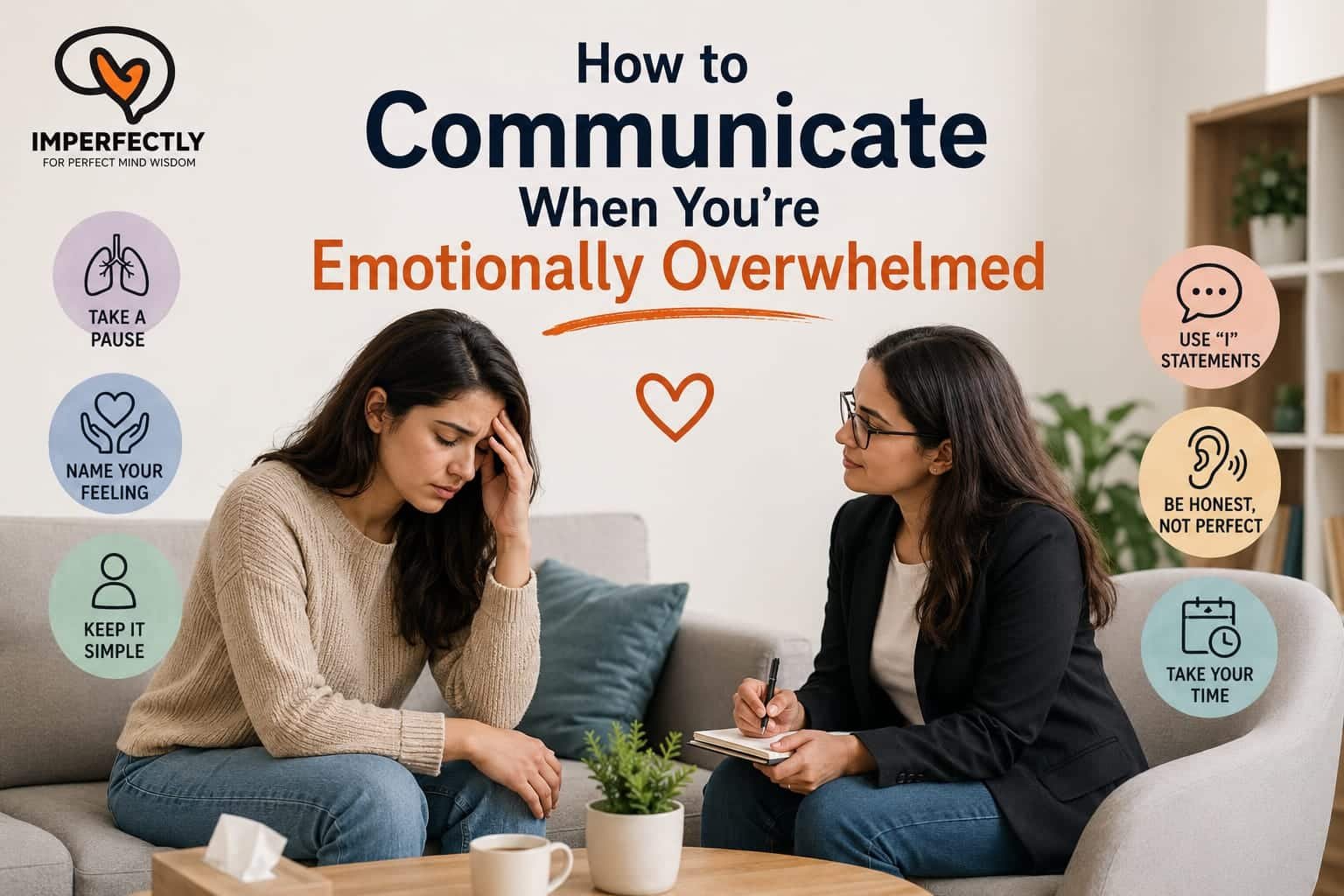
How to Communicate When You’re Emotionally Overwhelmed
When emotions become too intense, even a simple conversation can feel exhausting. Learning how to communicate when emotionally overwhelmed is not about finding the perfect words; it is about creating enough emotional space to communicate honestly without saying something you may regret later. Whether you are dealing with anger, anxiety, sadness, frustration, or mental exhaustion, the goal is not to suppress what you feel. Instead, it is to slow the conversation down, identify what you need, and communicate it clearly.
From years of working around mental-health communication, one pattern appears repeatedly: people often wait until they are already at their emotional limit before trying to explain themselves. By that point, even a reasonable conversation can turn into an argument, shutdown, crying, avoidance, or complete silence.
The good news is that communication does not have to be perfect to be healthy. In fact, knowing how to communicate when emotionally overwhelmed can prevent many unnecessary conflicts.
Why Emotional Overwhelm Makes Communication Difficult
When you are emotionally overwhelmed, your brain is focused more on managing the immediate emotional threat than carefully choosing your words.
You may notice that you:
- struggle to explain what is wrong
- become unusually quiet
- talk too quickly
- become defensive
- cry unexpectedly
- become irritated by small comments
- forget what you wanted to say
- assume the other person will not understand
- send a long emotional message and regret it later
- say “I’m fine” when you are clearly not fine
This does not necessarily mean you are a poor communicator.
Often, it means you are trying to communicate while your emotional capacity is already overloaded.
That distinction matters.
Emotional overwhelm is different from simply being upset
Being upset does not always interfere with communication. You might feel angry or sad and still be able to explain yourself.
Emotional overwhelm is different because the intensity of the emotion can temporarily reduce your ability to organise thoughts, listen, process information, and respond calmly.
Therefore, the first step is not always “talk it out.”
Sometimes the healthiest communication begins with saying:
“I want to talk about this, but I need a little time to calm down first.”
That is communication too.
How to Communicate When Emotionally Overwhelmed Without Shutting Down
The biggest practical mistake people make is believing they have only two choices: continue the conversation or completely avoid it.
There is a third option: pause without disappearing.
For example, instead of leaving the room without explanation, try:
“I’m feeling overwhelmed right now. I don’t want to argue with you, so I need 20 minutes to collect my thoughts. I will come back and talk about it.”
This does three important things.
First, it acknowledges the problem.
Second, it communicates your emotional state.
Third, it gives the other person some reassurance that you are not simply abandoning the conversation.
Use a short sentence when your mind feels overloaded
When you are overwhelmed, long explanations can make communication harder.
Keep your first statement simple:
“I’m overwhelmed and I’m struggling to explain myself.”
Or:
“There is a lot going on in my head right now. Can we slow this conversation down?”
Or:
“I care about this conversation, but I’m not able to have it calmly right now.”
These statements are useful because they explain the situation without forcing you to immediately solve it.
Stop Trying to Explain Everything at Once
When people feel misunderstood, they often start giving every detail they can remember.
That usually makes the conversation longer, not clearer.
Instead, identify the one thing you most need the other person to understand.
Ask yourself:
- What am I feeling?
- What triggered it?
- What do I need right now?
- What do I want the other person to understand?
You do not need to answer every question out loud.
For example, instead of saying:
“You never listen to me, and last week you did the same thing, and then when I tried to explain it you started talking about your own problems…”
Try:
“I felt dismissed when I was talking about something important to me. Right now, I need you to listen before we discuss solutions.”
The second version is shorter, but more useful.
Focus on the present conversation
Another common mistake is bringing ten previous conflicts into one emotionally difficult conversation.
That may feel justified, especially if those experiences have accumulated. However, it can quickly turn one issue into a courtroom-style argument about who did what months ago.
When possible, stay with the current issue.
You can always say:
“There are other things we need to discuss later, but I want to deal with this one first.”
That creates structure when emotions are already high.
Use “I” Statements Without Turning Them Into Blame
“I” statements are often recommended in communication advice, but there is an important nuance: simply starting a sentence with “I feel” does not automatically make it healthy communication.
Compare:
“I feel like you are selfish.”
with:
“I felt ignored when I was speaking and you continued looking at your phone.”
The first describes the other person’s character.
The second describes a specific experience.
That difference can dramatically change the direction of a conversation.
A practical formula for emotional communication
A useful structure is:
When X happened → I felt Y → I need Z.
For example:
“When the plan changed without telling me, I felt frustrated and unimportant. I need us to communicate changes earlier.”
This is particularly helpful when you need to communicate when emotionally overwhelmed because it gives your thoughts a simple framework.
What to Say When You Cannot Find the Right Words
Sometimes you know something is wrong, but you genuinely cannot explain it.
Do not force yourself to produce a perfect explanation.
You can say:
“I don’t fully understand what I’m feeling yet.”
That sentence is completely valid.
You can also say:
“I know I’m upset, but I need some time to understand why.”
Or:
“I want to explain this properly, but my thoughts are all over the place.”
Communication does not require complete emotional clarity before the conversation begins.
In fact, sometimes talking gently helps you discover what you actually feel.
How to Ask for Space Without Hurting the Other Person
Asking for space can be healthy. However, vague statements such as “Leave me alone” can easily be interpreted as rejection.
Instead, explain what the space means.
For example:
“I need some quiet time. This isn’t me avoiding you. I just need to settle down before we continue.”
If possible, give a realistic timeframe.
“Can we talk again after dinner?”
or:
“Give me about 30 minutes, and I’ll come back to this.”
This is especially important in close relationships because uncertainty can create additional anxiety for both people.
Space should not become silent punishment
There is a significant difference between taking a healthy pause and using silence to punish someone.
A healthy pause communicates:
“I need time so I can communicate better.”
Silent treatment communicates:
“I want you to suffer because I am angry.”
The behaviour may look similar from the outside, but the intention and follow-through are very different.
Communicating When You Are Angry
Anger often creates a false sense of urgency.
You may feel that you have to respond immediately because otherwise the other person will “get away with it.”
In reality, responding while extremely angry can create a second problem on top of the original one.
Before responding, ask:
“Do I want to solve this, or do I want the other person to feel how hurt I feel?”
There is nothing wrong with being angry. However, communication becomes more productive when the purpose is understood.
Avoid permanent statements
Words such as:
- “always”
- “never”
- “everyone”
- “nothing”
- “you don’t care”
- “you are exactly like…”
can make the other person defensive almost instantly.
Instead of:
“You never care about what I say.”
Try:
“I don’t feel heard in this conversation.”
The second statement leaves room for discussion.
Communicating When You Are Anxious
Anxiety can make communication go in the opposite direction from anger.
Instead of saying too much, you may say almost nothing.
You might worry:
- “What if they get angry?”
- “What if they leave?”
- “What if I make things worse?”
- “What if they misunderstand me?”
When this happens, write down the main point before talking.
You do not need to prepare a speech.
Write three things:
- What happened
- How I feel
- What I need
For example:
“The deadline changed unexpectedly. I feel overwhelmed and anxious. I need some help prioritising what needs to be done first.”
This simple preparation can make it easier to communicate when emotionally overwhelmed.
When Texting Is Better—and When It Is Not
Text messages are not automatically bad for emotional conversations.
In some situations, writing can help you slow down and choose your words.
For example, if speaking makes you freeze, you might text:
“I’m struggling to talk about this face-to-face right now. I want you to know that I am upset, and I would like to discuss it when I can explain myself properly.”
However, avoid sending an emotionally overwhelming message containing several paragraphs written in the middle of an argument.
A useful rule is:
Write to clarify, not to unload.
If you have typed a huge message, read it once before sending it. Ask:
“Will this help the other person understand me, or am I simply transferring my emotional overload onto them?”
That one question can prevent many regrettable messages.
How to Communicate When Emotionally Overwhelmed at Work
Emotional overwhelm does not only happen in relationships.
Work pressure, deadlines, difficult colleagues, criticism, uncertainty, and burnout can all affect communication.
You do not necessarily need to tell your manager every personal detail.
Instead, communicate the practical problem.
For example:
“I have several urgent tasks at the moment. Could we clarify which one should take priority?”
Or:
“I want to complete this correctly, but I need clarification on the deadline.”
This approach turns emotional overload into a concrete workplace conversation.
Do not apologise for every emotional reaction
Another common workplace mistake is over-apologising.
You do not have to say:
“Sorry, I’m terrible at this. Sorry I’m stressed. Sorry I’m asking so many questions.”
Instead, communicate confidently:
“I need clarification before I proceed.”
That is not weakness. It is professional communication.
What to Do When You Start Crying During a Conversation
Crying does not mean you have lost control or that your point is invalid.
Some people become embarrassed when they cry and immediately say:
“Forget it.”
But crying can simply be a physical response to emotional intensity.
If you can, continue with a simple statement:
“I’m emotional right now, but I still want to finish this conversation.”
If you need a pause, take one.
The goal is not to eliminate emotion from communication. The goal is to communicate without allowing emotion to completely control the conversation.
How to Communicate When Emotionally Overwhelmed With Someone You Love
Close relationships can be especially difficult because the emotional stakes are higher.
You may expect your partner, parent, sibling, or close friend to automatically understand what you need.
Unfortunately, people cannot reliably read each other’s minds.
Instead of expecting them to guess, tell them.
For example:
“I don’t need advice right now. I just need you to listen.”
Or:
“Can you sit with me for a few minutes? I don’t want to solve anything yet.”
Or:
“I need reassurance more than solutions right now.”
These are small sentences, but they can completely change how the other person responds.
Tell people how they can support you
People often say:
“I need support.”
The problem is that “support” means different things to different people.
For one person, support means listening.
For another, it means practical help.
For someone else, it means physical presence or reassurance.
So be specific:
“Could you listen for five minutes without giving advice?”
That gives the other person something useful to do.
When You Are Too Overwhelmed to Talk at All
There will be moments when communication genuinely needs to wait.
If you are extremely distressed, exhausted, angry, or emotionally flooded, forcing a serious conversation may make things worse.
In those moments, use a holding statement:
“I can’t have this conversation properly right now. I don’t want to avoid it, so let’s talk later when I can think more clearly.”
Then follow through.
That final part matters.
If you repeatedly say “later” and never return to the conversation, the pause eventually becomes avoidance.
Common Communication Mistakes During Emotional Overwhelm
Mistake 1: Trying to solve everything immediately
Not every emotional problem needs an immediate solution.
Sometimes the first goal is simply to understand what happened and what each person is feeling.
Mistake 2: Expecting the other person to know what you need
Even people who care deeply about you cannot always guess what you need.
Ask directly.
Mistake 3: Using silence instead of communicating
Taking space can be healthy.
Disappearing without explanation usually creates another problem.
Mistake 4: Sending messages while highly activated
If your heart is racing and you are typing faster than you can think, consider waiting before pressing send.
Mistake 5: Turning feelings into accusations
Your feelings are valid, but they do not automatically prove your interpretation of another person’s intentions.
You can say:
“I felt ignored.”
without claiming:
“You intentionally ignored me.”
That distinction leaves room for reality to be more complicated.
Mistake 6: Believing good communication means staying calm all the time
Healthy communication does not require you to become emotionless.
You can be frustrated, sad, angry, or scared and still communicate responsibly.
A Simple Emergency Script for Emotional Overwhelm
When you cannot think of what to say, use this structure:
“I’m feeling overwhelmed right now. I care about this conversation, but I need a little time before I can talk about it properly. I’m not ignoring the issue. I just want to come back to it when I can communicate more clearly.”
You can adapt it to almost any situation.
For example:
With a partner:
“I love you, but I’m too overwhelmed to have this conversation calmly right now. Can we talk tonight?”
With a friend:
“I’m having a difficult day and don’t have the capacity to explain everything yet. Can I get back to you later?”
At work:
“I have several priorities competing right now. Can we clarify what needs to be handled first?”
With family:
“I want to discuss this, but I need a little time to organise my thoughts.”
The wording does not need to be perfect. What matters is honesty, clarity, and follow-through.
When Emotional Overwhelm Keeps Happening
Occasional emotional overwhelm is part of being human.
However, if you regularly feel unable to communicate, constantly fear conflict, experience intense emotional reactions, or find that your relationships are repeatedly affected, it may be worth speaking with a mental-health professional.
A psychologist or psychiatrist can help explore what is contributing to the pattern and identify healthier ways to manage difficult emotions and communication.
Importantly, seeking professional support does not mean you have failed at handling your emotions. Sometimes, learning to communicate effectively requires more than willpower.
Final Thoughts: Communication Does Not Have to Be Perfect
Learning to communicate when emotionally overwhelmed is not about becoming perfectly calm before speaking.
It is about recognising when your emotional capacity is stretched, communicating that honestly, and choosing a response that protects both the relationship and your own wellbeing.
Sometimes the most emotionally mature sentence is:
“I need a little time before I can talk about this.”
Sometimes it is:
“I don’t need a solution. I just need you to listen.”
And sometimes it is simply:
“I don’t know how to explain what I’m feeling yet.”
Those sentences may feel small, but they create space for healthier conversations.
Most importantly, remember that communication is a skill—not a personality trait. It can be practised, improved, and supported with professional guidance when needed.
Start Your Mental Wellness Journey Today with Imperfectly
At Imperfectly, mental healthcare is designed around the reality that emotional wellbeing is rarely just about one issue. Whether you need support understanding difficult emotions, managing stress, navigating relationships, or addressing a more complex mental-health concern, Imperfectly connects you with experienced mental-health and healthcare professionals in one accessible platform. Through its 360° approach, you can connect with Psychiatrists, Psychologists, Life Coaches, and Physicians, choose online or in-clinic appointments, and keep important wellness information organised in one place. Visit Imperfectly
Download the Imperfectly App
📱 Connect with experienced Psychiatrists, Psychologists, Life Coaches, and Physicians.
📅 Book online or in-clinic appointments in minutes.
📈 Track your recovery journey with personalized wellness insights.
🔒 Access secure prescriptions, therapy notes, and medical records anytime.
💙 Experience complete 360° mental healthcare in one application.
Contact Imperfectly
Imperfectly – Your Trusted 360° Mental Health Platform
🌐 Website: imperfectly.co
📱 Patient Portal: Imperfectly Patient Portal
📞 Phone: +91 8448073838
📧 Email: admin@imperfectly.co