

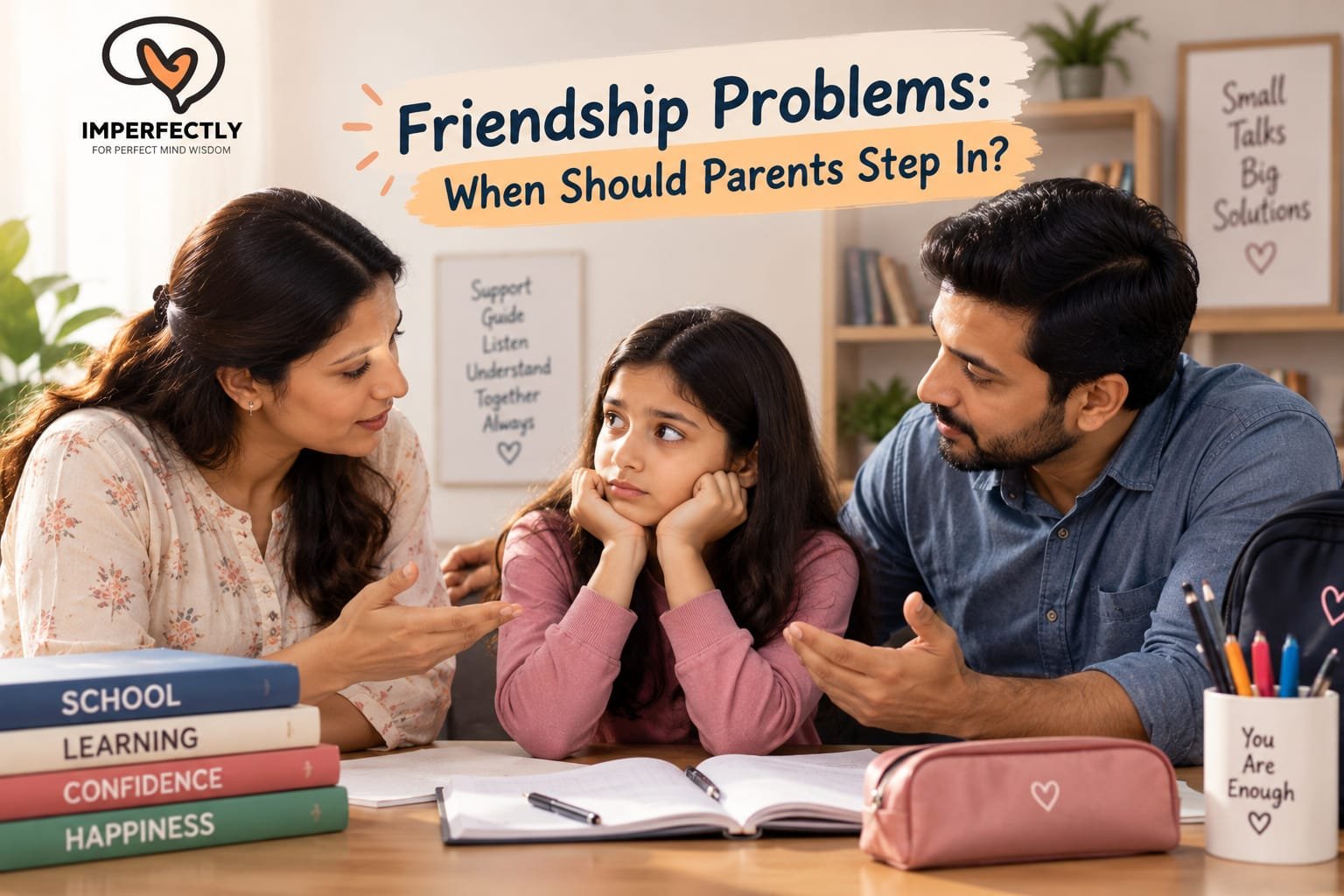
Friendship Problems: When Should Parents Step In?
Friendship problems can be surprisingly painful for children. A forgotten invitation, an argument during play, a friend suddenly choosing someone else, or being left out of a group can feel enormous to a child—even when adults see it as a small disagreement. So, when should parents step in?
That question is harder than it sounds. Parents naturally want to protect their children, but stepping into every disagreement can sometimes prevent a child from learning how to handle conflict, communicate clearly, set boundaries, and recover from disappointment.
On the other hand, staying completely out of the situation can be equally unhelpful when a child is being repeatedly excluded, humiliated, manipulated, threatened, or bullied.
After working with children and families, one practical lesson becomes clear: parents don’t need to solve every friendship problem. They need to know which problems require support, which require coaching, and which require immediate adult intervention.
Not Every Friendship Problem Needs a Parent to Intervene
Children’s friendships are messy. They change quickly, and disagreements are part of learning how relationships work.
For example, two eight-year-olds may argue over a game, refuse to speak to each other for an afternoon, and become friends again the next day. Similarly, teenagers may experience misunderstandings through messages, changing friend groups, or disagreements about plans.
In these situations, parents can easily become more involved than necessary.
Instead of immediately calling another parent or contacting the school, start by understanding what actually happened.
Ask:
- “What happened?”
- “How did that make you feel?”
- “What do you think happened from your friend’s side?”
- “What have you already tried?”
- “What would you like to happen now?”
These questions do something important: they help children think instead of simply waiting for an adult to fix the situation.
A useful rule for parents
If your child is upset but still feels safe, has other supportive relationships, and can participate in solving the problem, coaching may be more useful than intervention.
That does not mean ignoring the problem. It means staying close without taking control.
When Should Parents Step In?
The answer changes when the friendship problem stops being an ordinary disagreement and becomes a repeated pattern of harm.
Parents should pay closer attention when a child says the same friend repeatedly insults them, excludes them, threatens them, controls who they can play with, spreads embarrassing information, or pressures them to do things they do not want to do.
For instance, there is a major difference between:
“My friend didn’t invite me to the party.”
and:
“My friend tells everyone they can’t be my friend, threatens to expose my private messages, and says I’ll have nobody if I leave.”
The first may involve disappointment and social learning. The second can involve manipulation and emotional harm.
Therefore, when should parents step in? When the pattern is persistent, the power balance is unequal, or the child’s emotional or physical safety is being affected.
Look for Patterns, Not Just One Incident
One of the most common mistakes parents make is reacting strongly to a single event.
A child may come home saying, “Nobody likes me.”
That sentence deserves attention, but it should not automatically be treated as proof that everyone is deliberately excluding the child.
Children often describe an entire day through the emotion they are experiencing at that moment.
Instead, look for patterns over time.
Signs that deserve closer attention
Watch for changes such as:
- Suddenly refusing to attend school or activities
- Frequent stomachaches or headaches before school
- Losing interest in activities they previously enjoyed
- Becoming unusually withdrawn
- Persistent crying after social situations
- Changes in sleep or appetite
- Excessive worry about messages or group chats
- Constantly checking whether friends are upset with them
- Giving away possessions to keep a friendship
- Becoming afraid to disagree with a particular friend
- Saying they have nobody they can trust
- A sudden drop in confidence
One sign alone does not necessarily mean there is a serious problem. However, several changes occurring together deserve a closer conversation.
When a Friendship Becomes Controlling
Not all unhealthy friendships look aggressive.
Sometimes the problem is control.
A child may have a friend who constantly decides what they will play, who they can sit with, who they can talk to, or what they are allowed to say.
Older children and teenagers may experience similar behavior through group chats and social media.
A friend might say:
“If you talk to her, we’re not friends.”
Or:
“If you don’t send me that picture, I’ll tell everyone your secret.”
These statements should not simply be dismissed as “kids being kids.”
Children need to learn that friendship should not require fear, constant obedience, or giving up their boundaries.
Teach the difference between conflict and control
Healthy friendship can include disagreement.
A healthy friend can say:
“I didn’t like what happened.”
An unhealthy dynamic may sound more like:
“You have to do what I say, or I’ll make sure everyone leaves you.”
That distinction is extremely important.
Bullying Requires a Different Response
Parents sometimes hesitate to intervene because they worry about being seen as overprotective.
However, bullying should not be treated like an ordinary friendship disagreement.
Repeated behavior involving humiliation, intimidation, exclusion, threats, physical aggression, or a significant power imbalance requires adult involvement.
If bullying is happening at school, parents should document what they know and communicate with the appropriate school staff rather than encouraging the child to simply “ignore it.”
Likewise, if there are threats of physical harm, sexual exploitation, serious harassment, or dangerous behavior, immediate adult intervention is appropriate.
In these circumstances, the question is no longer simply when should parents step in. The question becomes how quickly and appropriately they need to act.
What Parents Often Get Wrong
Even caring parents can accidentally make friendship problems worse.
Calling the other parent immediately
This is understandable, particularly when your child is crying.
However, if the situation is a normal disagreement, contacting the other family before understanding the full story can turn a manageable childhood conflict into an adult conflict.
Telling the child to “just ignore it”
This advice is often given with good intentions.
Unfortunately, children can interpret it as:
“My parents don’t understand.”
Instead, help them decide what ignoring, responding, setting a boundary, or asking for help would look like.
Calling the other child “toxic”
Be careful with labels.
A child who behaved badly once is not necessarily a “toxic person.” Children are still developing emotional regulation, empathy, communication skills, and social awareness.
Focus on the behavior, not the child’s identity.
Solving everything for them
If a parent writes every message, makes every phone call, chooses every response, and confronts every friend, the child may become increasingly dependent on adults to manage relationships.
Support should build capability, not dependence.
What Parents Can Do Instead
The most effective approach is often somewhere between doing nothing and taking over.
Start by listening.
Then help your child identify what they can control.
For example:
“If your friend keeps interrupting you, what could you say?”
“What would a boundary look like here?”
“Who else could you spend time with?”
“What would make you feel safer?”
“What would you do if it happened again?”
This approach gives children practical tools while keeping the parent emotionally available.
Help your child build more than one friendship
Another overlooked issue is social dependence.
When a child has only one close friend, every disagreement can feel catastrophic.
Encourage opportunities to build connections through sports, hobbies, clubs, creative activities, school groups, or other shared interests.
The goal is not to create a huge social circle.
Rather, it is to help the child understand that one difficult friendship does not define their entire social world.
When Should Parents Talk to the School?
School involvement becomes appropriate when the problem is affecting the child’s education, safety, attendance, or ability to participate comfortably in school.
Before contacting the school, gather specific information.
Instead of saying:
“My child is being bullied.”
Try to explain:
“My child reports that this has happened several times over the past two weeks, mainly during lunch. They are now asking to stay home from school.”
Specific information makes it easier for teachers and school staff to understand the situation and respond appropriately.
When Professional Support May Help
Sometimes friendship problems reveal something deeper.
A child may repeatedly struggle to maintain friendships, become intensely distressed by minor disagreements, fear rejection, or have difficulty understanding social cues.
In other cases, the friendship issue may be contributing to significant anxiety, low mood, isolation, or changes in daily functioning.
At that point, speaking with a child psychologist, psychiatrist, or another qualified mental-health professional can be helpful.
Professional support is not an admission that something is “wrong” with the child. Sometimes a neutral professional simply gives the child a safer place to understand what is happening and develop better coping and communication skills.
A Simple Parent Decision Check
When you are unsure whether to intervene, ask yourself five questions:
Is my child safe?
If there is physical danger, serious bullying, threats, coercion, or exploitation, act.
Is this a repeated pattern?
A one-time disagreement is different from behavior happening repeatedly.
Can my child handle this with support?
If your child can talk, set boundaries, seek help, and try a solution, coaching may be enough.
Is the situation affecting daily life?
Look at school attendance, sleep, mood, confidence, appetite, and participation in normal activities.
Am I helping—or reacting from my own fear?
This last question is uncomfortable but important.
Sometimes a parent’s memories of being excluded, bullied, or rejected can make a child’s friendship problem feel especially threatening.
Pause before acting and ask: “What does my child need from me right now?”
That question can prevent an emotional reaction from becoming an unnecessary escalation.
The Goal Is Not to Prevent Every Friendship Problem
Children cannot grow up without experiencing rejection, disagreements, disappointment, or changes in friendships.
Those experiences, when handled safely, can teach valuable skills.
They learn how to apologize.
They learn how to recognize unfair behavior.
They learn that friendships can change.
They learn to say no.
They learn that being rejected by one person does not mean they are unworthy of friendship.
Most importantly, they learn that they can experience a difficult relationship without losing themselves in it.
So, when should parents step in?
Step in when safety, dignity, wellbeing, or a significant power imbalance is involved. Coach when the problem is manageable. And stay available throughout both.
The strongest parental response is rarely about fixing the friendship. It is about helping the child develop the confidence and judgment to navigate relationships as they grow.
Start Your Mental Wellness Journey Today with Imperfectly
At Imperfectly, mental wellness is approached as a complete journey rather than a single appointment. Families can connect with experienced mental-health and healthcare professionals for support with emotional wellbeing, behavioral concerns, relationships, stress, and other challenges. Through accessible professional care, Imperfectly aims to make it easier for individuals and families to find the right support when they need it.
Download the Imperfectly App
📱 Connect with experienced Psychiatrists, Psychologists, Life Coaches, and Physicians.
📅 Book online or in-clinic appointments in minutes.
📈 Track your recovery journey with personalized wellness insights.
🔒 Access secure prescriptions, therapy notes, and medical records anytime.
💙 Experience complete 360° mental healthcare in one application.
Contact Imperfectly
Imperfectly – Your Trusted 360° Mental Health Platform
🌐 Website: https://imperfectly.co
📱 Patient Portal: https://imperfectly.co/application/
📞 Phone: +91 8448073838
📧 Email: admin@imperfectly.co