

How Childhood Experiences Shape Perfectionist Tendencies
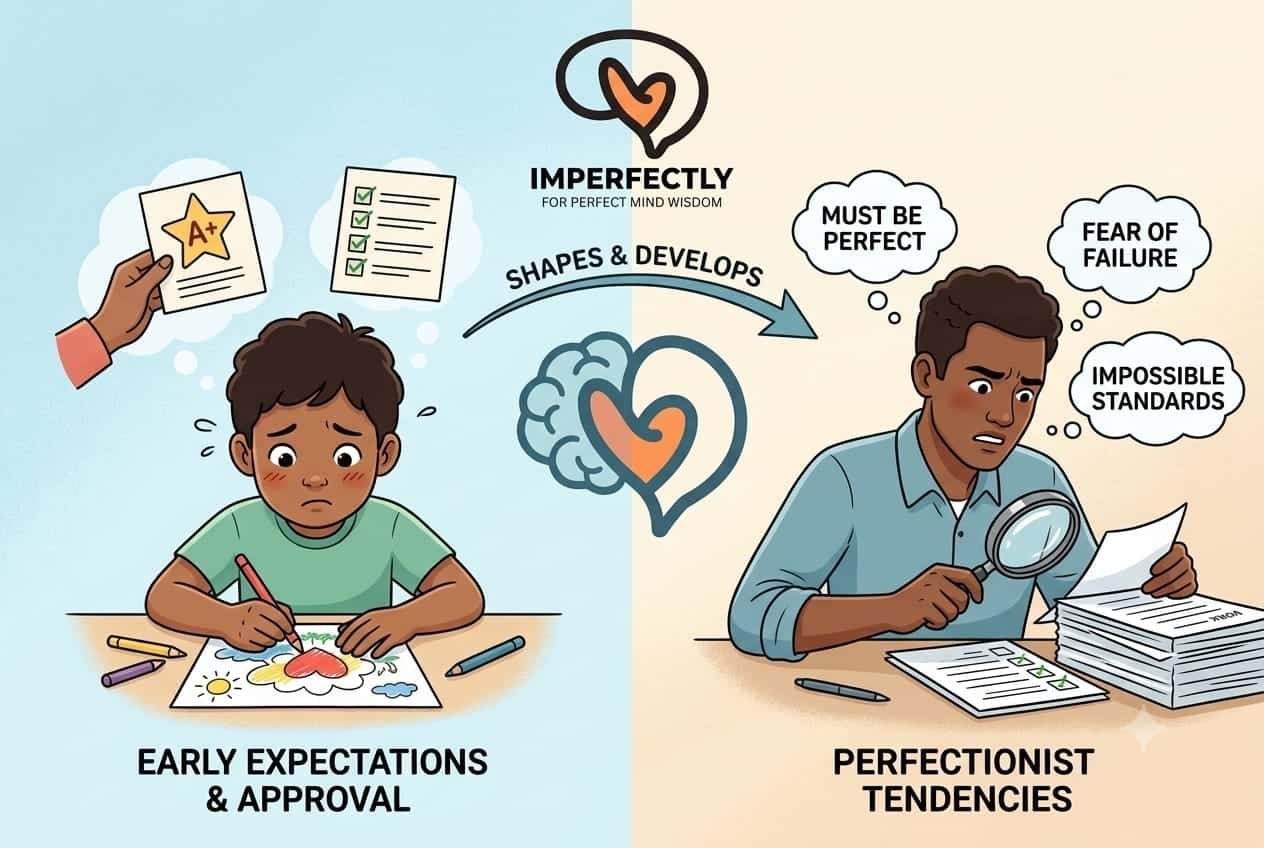
Childhood experiences and perfectionism are closely connected, even though many people don’t recognize the link until adulthood. Perfectionism is often misunderstood as a personality strength, associated with discipline, ambition, or high achievement. However, after years of working with individuals struggling with anxiety, burnout, relationship challenges, and self-esteem issues, one pattern becomes remarkably consistent: perfectionism rarely begins with a desire to be perfect. Instead, it frequently develops as a survival strategy during childhood.
Children naturally seek safety, acceptance, and emotional connection. Therefore, when love, praise, or security appear to depend on performance or behavior, they begin adapting in ways that increase their chances of being accepted. Over time, these experiences create a powerful connection between childhood experiences and perfectionism, shaping perfectionist tendencies that continue well into adulthood.
Rather than simply striving for excellence, perfectionists often believe that mistakes threaten their worth, relationships, or identity. Consequently, understanding the relationship between childhood experiences and perfectionism allows individuals to address the underlying emotional patterns instead of only managing the visible behaviors.
What Is Childhood Experiences and Perfectionism?
Perfectionism is more than setting high standards. It involves attaching personal value to flawless performance while experiencing excessive self-criticism whenever expectations are not met.
In clinical practice, perfectionism usually appears through:
Fear of Making Mistakes
Individuals avoid challenges because failure feels emotionally unsafe rather than simply disappointing.
Constant Self-Criticism
Instead of celebrating accomplishments, attention immediately shifts toward flaws or areas requiring improvement.
Difficulty Accepting Praise
Compliments often feel uncomfortable because internal standards remain much higher than external expectations.
Chronic Overworking
Many perfectionists continue working long after reaching acceptable standards because “good enough” never feels sufficient.
How Childhood Experiences and Perfectionism Are Connected
Perfectionism is rarely inherited as a fixed trait. Instead, childhood environments significantly influence how children evaluate themselves and the world around them.
Conditional Love and Childhood Experiences and Perfectionism
One of the strongest contributors is conditional acceptance.
Children who consistently hear statements such as:
- “We’re proud when you get top grades.”
- “Don’t embarrass the family.”
- “Good children don’t make mistakes.”
gradually learn that achievement earns love.
Eventually, success becomes emotionally connected to belonging, while mistakes become associated with rejection.
Years later, these adults continue chasing impossible standards without fully understanding why satisfaction never lasts.
Highly Critical Parenting
Constructive feedback helps children grow.
However, constant criticism teaches something very different.
Parents who primarily notice mistakes unintentionally communicate that nothing is ever enough.
As adults, these individuals often develop an internal critic that sounds remarkably similar to voices they heard growing up.
Even after receiving promotions, awards, or recognition, the internal dialogue continues saying:
“I should have done better.”
Excessive Praise for Achievement
Interestingly, perfectionism does not always grow from criticism.
Sometimes it develops through excessive praise focused exclusively on results.
For example:
Instead of hearing:
“I’m proud of your effort.”
Children repeatedly hear:
“You’re the smartest.”
“You’re the best.”
Eventually, maintaining this identity becomes exhausting because every mistake threatens the image they have built.
Living in Unpredictable Homes
Children raised in chaotic households often become hyper-responsible.
If parents struggled with conflict, addiction, emotional instability, or inconsistent behavior, children frequently attempted to create order through perfect behavior.
Although perfection never truly controlled the environment, it provided a temporary sense of safety.
Consequently, many adults continue believing they must control every detail before they can relax.
Parentification
Some children become emotional caregivers for parents far too early.
They learn to suppress their own needs while becoming exceptionally responsible.
Although this maturity may appear admirable, it often comes with perfectionist expectations:
- Never disappoint anyone.
- Never ask for help.
- Never create additional problems.
These beliefs frequently continue throughout adulthood.
The Brain Learns Safety Through Repetition
From years of observing recovery journeys, one lesson becomes very clear.
Perfectionism is not simply a thinking problem.
It becomes deeply wired into emotional learning.
Whenever children receive approval after performing perfectly, the brain strengthens connections between achievement and emotional safety.
Likewise, when mistakes lead to criticism, shame, or emotional withdrawal, the nervous system begins treating imperfection as danger.
Therefore, even successful adults may experience overwhelming anxiety before relatively minor tasks.
Their reactions are not irrational.
They are learned survival responses.
Signs Childhood Perfectionism Is Still Affecting You
Many adults never recognize these patterns because they seem normal.
Common indicators include:
You Feel Guilty While Resting
Relaxation feels unproductive.
Therefore, even vacations become mentally exhausting.
Small Mistakes Feel Catastrophic
Minor errors trigger disproportionate shame instead of healthy learning.
You Delay Starting Important Tasks
Ironically, perfectionism often causes procrastination.
If work cannot be perfect, the brain chooses avoidance.
Success Brings Temporary Relief
Rather than creating confidence, achievements simply reduce anxiety for a short period before new expectations appear.
Asking for Help Feels Like Failure
Many perfectionists believe independence determines their worth.
As a result, they continue struggling alone even when support is available.
Common Misconceptions About Perfectionism
Several myths prevent people from seeking meaningful change.
Myth: Perfectionism Creates Success
In reality, healthy striving supports long-term achievement far better than perfectionism.
Perfectionism increases stress, burnout, indecision, and emotional exhaustion.
Myth: Lower Standards Mean Laziness
Recovering from perfectionism does not involve lowering standards.
Instead, it involves separating self-worth from performance.
Myth: Successful People Are Always Perfectionists
Many high performers achieve remarkable results because they embrace learning, adaptability, and resilience—not flawless execution.
Practical Ways to Break Childhood Perfectionist Patterns
Meaningful change requires addressing both thoughts and emotional conditioning.
Recognize Your Internal Script
Notice recurring beliefs such as:
- “I must never fail.”
- “People will reject me.”
- “I’m only valuable when I succeed.”
Awareness is the first step toward change.
Redefine Success
Measure progress through consistency, learning, and growth instead of flawless outcomes.
This shift gradually reduces performance anxiety.
Practice Safe Imperfection
Purposely complete low-risk tasks without over-editing.
Eventually, your nervous system learns that mistakes rarely produce the catastrophic outcomes it expects.
Build Self-Compassion
Research consistently shows that self-compassion improves motivation while reducing anxiety.
Treat yourself with the same patience you would offer a close friend facing similar challenges.
Seek Professional Support
Because perfectionism often develops from early emotional experiences, therapy can help uncover underlying beliefs while creating healthier coping strategies.
Working with experienced mental health professionals allows individuals to replace survival strategies with sustainable emotional resilience.
Start Your Mental Wellness Journey Today with Imperfectly
Healing perfectionism begins with understanding its roots rather than blaming yourself for having high standards. At Imperfectly, we recognize that emotional patterns formed during childhood can continue influencing confidence, relationships, career decisions, and overall well-being. Our team of experienced psychiatrists, psychologists, life coaches, and physicians provides compassionate, evidence-based support tailored to your unique experiences. Whether you’re struggling with anxiety, self-criticism, burnout, or perfectionist thinking, Imperfectly offers an integrated approach that helps you build emotional resilience, develop healthier coping strategies, and move toward lasting mental wellness with confidence.
Download the Imperfectly App
📱 Connect with experienced Psychiatrists, Psychologists, Life Coaches, and Physicians.
📅 Book online or in-clinic appointments in minutes.
📈 Track your recovery journey with personalized wellness insights.
🔒 Access secure prescriptions, therapy notes, and medical records anytime.
💙 Experience complete 360° mental healthcare in one application.
Contact Imperfectly
Imperfectly – Your Trusted 360° Mental Health Platform
🌐 Website: https://imperfectly.co
📱 Patient Portal: https://imperfectly.co/application/
📞 Phone: +91 8448073838
📧 Email: admin@imperfectly.co