

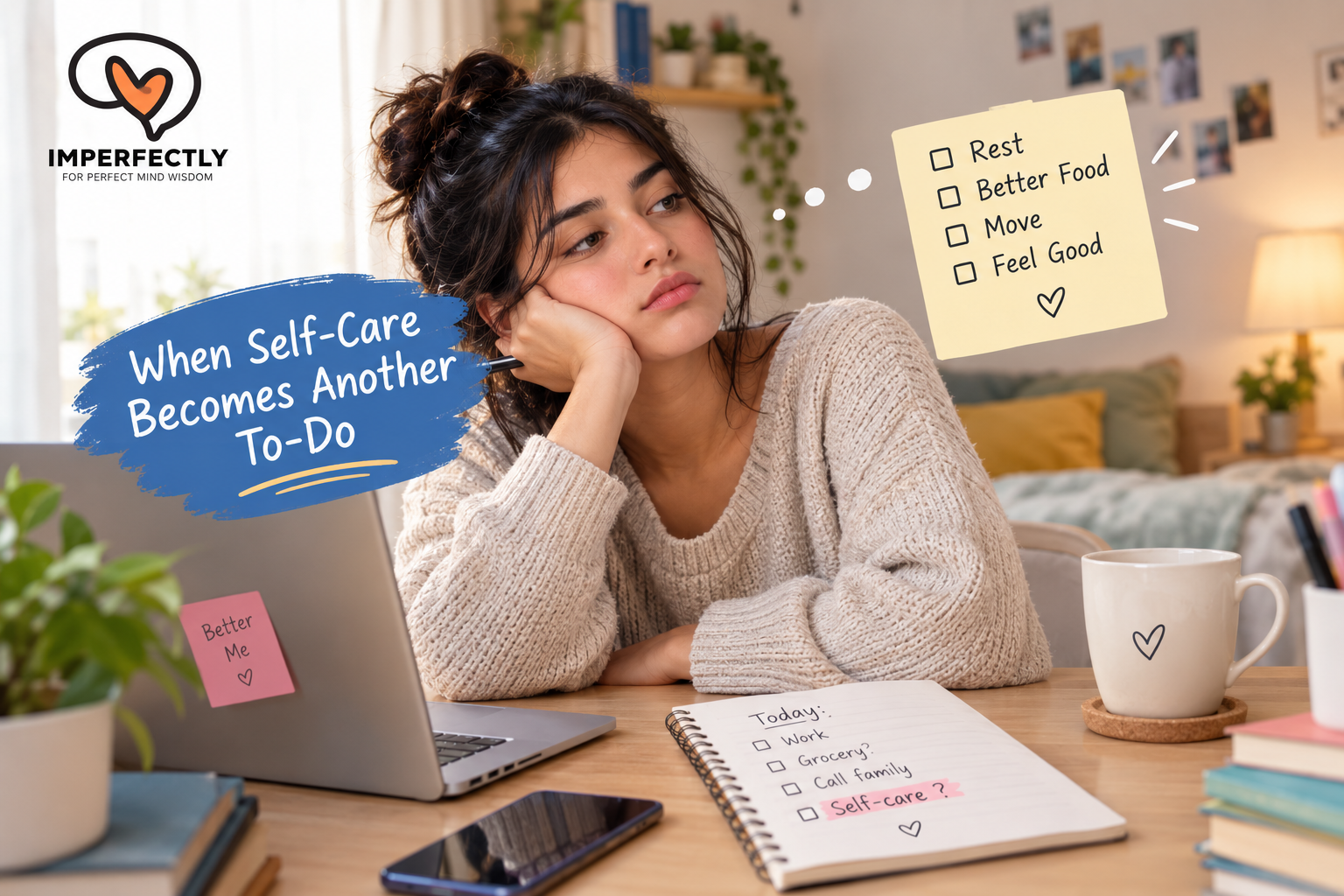
When Self-Care Becomes Another Thing on Your To-Do List
Taking care of your mental health is supposed to make life feel more manageable. Yet, for many people, even self-care can start feeling like another responsibility they have to complete. Wake up early, meditate, exercise, journal, drink enough water, practise mindfulness, sleep eight hours—and suddenly, taking care of yourself feels like another full-time job.
This is where something important gets missed: self-care is not supposed to become another performance you have to succeed at. When every wellness habit comes with a rule, deadline, or expectation, the activity that was meant to reduce pressure can actually create more of it.
When Self-Care Starts Feeling Like Work
There is nothing wrong with having routines that support your wellbeing. The problem begins when those routines become another measure of whether you are “doing enough.”
For example, someone may decide to meditate for 20 minutes every morning. Initially, it feels calming. But after a few weeks, missing one morning creates guilt.
Then the thinking can change:
“I missed meditation today.”
becomes:
“I am not taking care of myself properly.”
That shift matters.
From a practical mental-health perspective, I have seen people turn perfectly reasonable wellness habits into rigid personal rules. They start tracking everything—sleep, steps, meditation, journaling, screen time, water intake and exercise—until their wellbeing becomes another dashboard they feel they are failing to maintain.
The Pressure to Have a Perfect Wellness Routine
Social media can make this even harder.
You may see someone waking up at 5 a.m., exercising, journaling, eating perfectly, practising gratitude and ending the day with a relaxing nighttime routine.
It can look inspiring.
However, what you see is usually a small part of someone’s life.
Comparing your difficult Tuesday morning with somebody else’s carefully selected Instagram routine can create unrealistic expectations. Consequently, self-care becomes less about what genuinely helps you and more about trying to recreate somebody else’s lifestyle.
The Signs That Self-Care Has Become Another To-Do List
Sometimes the problem is not the activity itself. It is the pressure attached to it.
Watch for these signs:
- You feel guilty when you miss a wellness activity.
- You have a long list of things you “must” do every day.
- Rest feels unproductive unless you have earned it.
- You constantly measure whether you are doing enough.
- You feel anxious when your routine changes.
- You compare your routine with people online.
- You continue a wellness activity even when it is clearly exhausting you.
- Taking care of yourself creates more stress than relief.
None of these automatically means that your routine is unhealthy. However, together they can be useful signals that your approach needs more flexibility.
When “Self-Care” Starts Creating Guilt
Guilt is one of the biggest warning signs.
Suppose you planned to exercise after work but had an exhausting day. Instead of allowing yourself to rest, you spend the evening feeling guilty because you did not complete your workout.
In that situation, the issue is no longer simply exercise.
The issue is the belief that rest has to be earned.
That belief can quietly turn healthy habits into another source of emotional pressure.
Self-Care Does Not Have to Look Productive
One of the most common misconceptions about self-care is that it needs to produce a visible result.
You exercised.
You meditated.
You finished your journal.
You completed your skincare routine.
You tracked your mood.
You checked everything off.
But sometimes, the most useful thing you can do is something that produces absolutely nothing.
You can sit quietly.
You can take a nap.
You can listen to music.
You can cancel a non-essential plan.
You can spend time with someone you trust.
You can simply have an ordinary evening without trying to improve yourself.
Rest Is Not a Failure of Self-Care
Rest often becomes difficult for people who are accustomed to being productive.
They may think:
“I should be doing something useful.”
However, constantly trying to optimise yourself can become exhausting.
Real wellbeing sometimes involves doing less—not adding another activity to your schedule.
A More Flexible Approach to Self-Care
A healthier approach is to ask what you actually need today rather than automatically following the same routine every day.
For instance:
If you are physically exhausted:
Rest may be more useful than forcing yourself through an intense workout.
If you feel lonely:
Calling a friend may help more than spending another hour journaling.
If your mind feels overloaded:
Reducing commitments may be more helpful than adding another mindfulness exercise.
If you feel emotionally stuck:
Talking with a mental-health professional may be more appropriate than trying another wellness trend.
This is where flexibility becomes important.
Replace “I Have To” With “What Would Help Me?”
Try changing the question.
Instead of:
“What should I do for self-care today?”
ask:
“What would make today slightly easier?”
That small change can remove a surprising amount of pressure.
Sometimes the answer will be exercise.
Sometimes it will be therapy.
Sometimes it will be a proper meal.
Sometimes it will be sleep.
And sometimes it will be doing absolutely nothing for a while.
Why More Self-Care Is Not Always Better
There is a tendency to assume that if something is healthy, more of it must be better.
That is not necessarily true.
Exercise can be beneficial, but constantly pushing yourself can become stressful.
Journaling can be useful, but analysing every emotion can sometimes keep you stuck inside your thoughts.
Mindfulness can support wellbeing, but turning it into another daily performance target defeats the purpose.
Consequently, the goal should not be to collect as many wellness habits as possible.
The goal is to find habits that genuinely support your life.
Your Routine Should Fit Your Life
A self-care routine that only works when everything goes perfectly is probably too rigid.
Real life includes:
- unexpected work
- family responsibilities
- poor sleep
- travel
- illness
- difficult conversations
- financial stress
- relationship problems
- days when motivation disappears
Therefore, a sustainable routine needs room for imperfect days.
If missing one day makes you feel like everything has failed, the routine may need more flexibility.
When Professional Support May Be More Helpful
Self-care can support mental wellbeing, but it should not become a substitute for professional care when someone is struggling significantly.
For example, persistent anxiety, depression, overwhelming stress, recurring intrusive thoughts, major sleep problems or difficulty functioning in everyday life may require professional assessment and support.
In those situations, adding another wellness habit to your schedule may not address the underlying problem.
A psychologist or psychiatrist can help understand what is actually happening and determine what kind of support may be appropriate.
Start Your Mental Wellness Journey Today with Imperfectly
Mental wellness does not have to mean managing everything alone or following a perfect routine. At Imperfectly, the focus is on making professional mental healthcare more accessible, connected and personalised. Through the Imperfectly platform, individuals can connect with qualified professionals, access care according to their needs, and keep important aspects of their mental-health journey in one secure place. Whether you are looking for professional guidance, ongoing support or a better way to manage your mental wellness, Imperfectly brings different areas of healthcare together so that getting support feels simpler and more approachable.
Download the Imperfectly App
📱 Connect with experienced Psychiatrists, Psychologists, Life Coaches, and Physicians
📅 Book online or in-clinic appointments in minutes.
📈 Track your recovery journey with personalised wellness insights.
🔒 Access secure prescriptions, therapy notes, and medical records anytime.
💙 Experience complete 360° mental healthcare in one application.
Contact Imperfectly
Imperfectly – Your Trusted 360° Mental Health Platform
🌐 Website: imperfectly.co
📱 Patient Portal: Imperfectly Patient Portal
📞 Phone: +91 8448073838
📧 Email: admin@imperfectly.co