

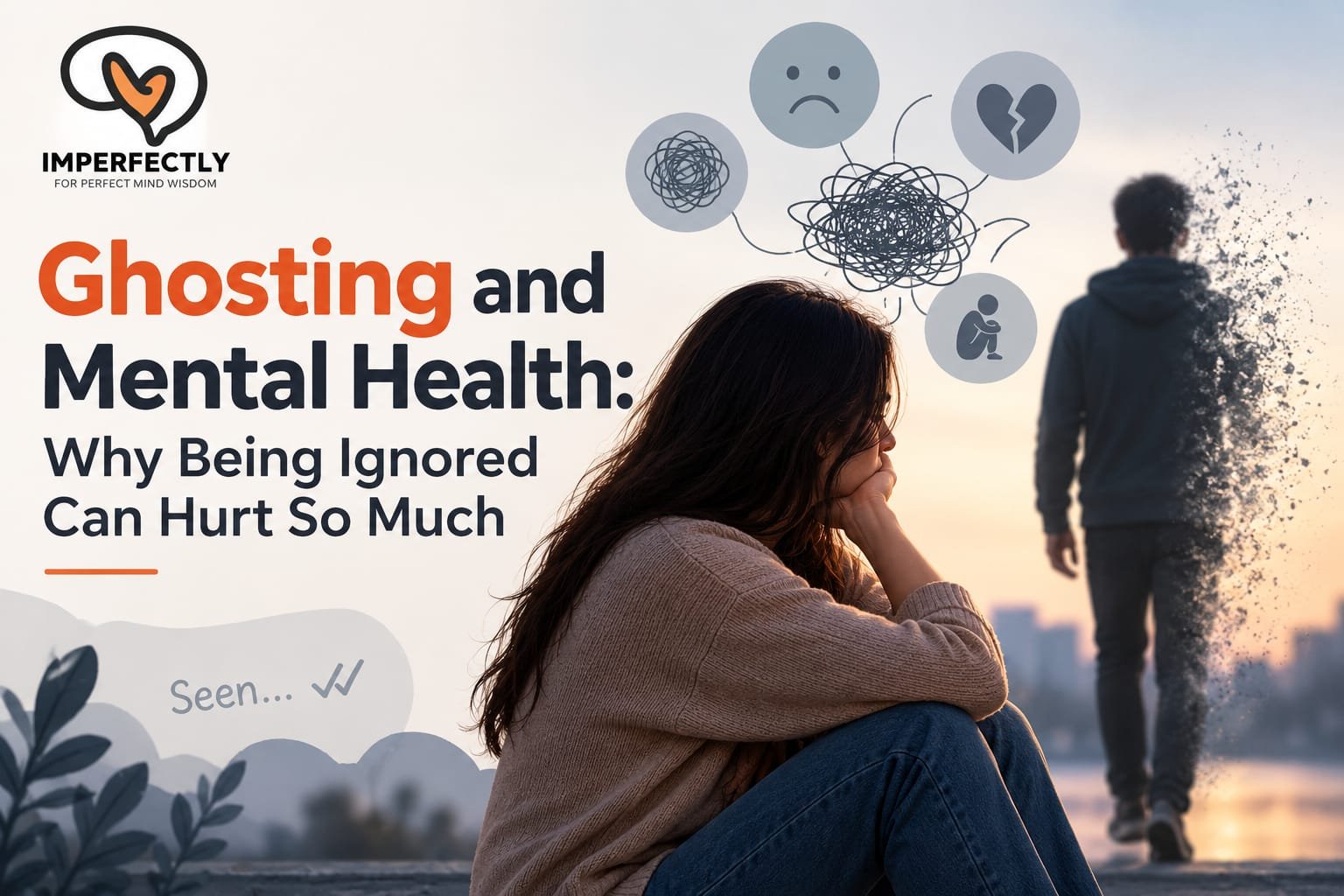
Ghosting and Mental Health: Why Being Ignored Can Hurt So Much
Ghosting and mental health are more closely connected than many people realize. Being suddenly ignored by someone you trusted can leave you confused, rejected, anxious, and stuck wondering what went wrong. Although ghosting is common in dating, friendships, workplaces, and even family relationships, the emotional impact can be surprisingly intense.
From a practical mental-health perspective, one of the hardest parts of ghosting is not simply losing contact. It is being left without an explanation. When there is no clear ending, the mind often keeps trying to complete the unfinished story.
That is why someone may think, “Did I say something wrong?”, “Why did they change?”, or “Should I message them again?” repeatedly for days or even weeks.
What Is Ghosting?
Ghosting happens when a person suddenly stops communicating without providing a clear explanation or closure. They may stop replying to messages, avoid calls, disappear from social media interactions, or completely withdraw from a relationship.
Ghosting can happen after one date, several months of friendship, a romantic relationship, or even a professional interaction.
However, there is an important distinction: not every delayed response is ghosting.
People can become busy, overwhelmed, ill, or temporarily unavailable. Ghosting usually refers to a repeated and unexplained withdrawal where communication effectively ends without clarification.
Where Ghosting Commonly Happens
Ghosting is often associated with dating apps, but it is not limited to romantic relationships.
It can happen in:
- Romantic relationships
- Friendships
- Online friendships
- Family relationships
- Social groups
- Professional relationships
- Job applications or interviews
Because of this, the emotional consequences can vary considerably depending on the relationship and the person’s previous experiences.
Ghosting and Mental Health: Why Does Being Ignored Hurt So Much?
The emotional pain of ghosting can feel disproportionate to the length of the relationship. Someone may think, “We only talked for a few weeks, so why am I still upset?”
The answer is that emotional attachment is not measured by the calendar.
When someone disappears without explanation, several psychological processes can happen at the same time.
Your Brain Wants an Explanation
The human mind naturally looks for patterns and explanations, particularly when something unexpected happens.
A clear breakup can hurt, but there is usually a recognizable event: someone communicates that the relationship has ended.
Ghosting removes that explanation.
As a result, the mind may repeatedly replay conversations, messages, dates, arguments, or small details looking for a clue.
This can turn into a cycle:
Something happened → I don’t know why → I analyze what happened → I create possible explanations → I still don’t know → I analyze it again.
That cycle can be mentally exhausting.
Uncertainty Can Be More Difficult Than Rejection
One practical difference between rejection and ghosting is certainty.
When someone says, “I don’t want to continue this relationship,” the statement may be painful, but it provides information.
Ghosting leaves the situation ambiguous.
You may not know whether the person is angry, uninterested, overwhelmed, dealing with a personal problem, or simply choosing not to communicate.
Therefore, the brain may keep searching for certainty that may never arrive.
The Emotional Impact of Ghosting
The effects of ghosting are different for everyone. Some people move forward relatively quickly, while others experience significant emotional distress.
Common reactions include:
- Confusion
- Sadness
- Anger
- Rejection
- Anxiety
- Embarrassment
- Self-doubt
- Difficulty concentrating
- Repeatedly checking the person’s social media
- Wanting to send another message
- Fear of being abandoned again
Sometimes the person does not initially feel extremely upset. The emotions may appear later, particularly when they realize that there may not be an explanation or final conversation.
Ghosting Can Trigger Self-Blame
One of the most common mistakes after being ghosted is immediately assuming responsibility.
People may think:
“Maybe I was too available.”
“Maybe I talked too much.”
“Maybe I wasn’t interesting enough.”
“Maybe I should have behaved differently.”
Self-reflection can be useful when it is balanced. However, repeatedly searching for a personal flaw without evidence can become harmful.
You cannot determine the reason for someone’s disappearance simply by analyzing yourself.
There may be information you do not have—and sometimes there is no satisfying explanation.
Ghosting Effects on Mental Health Can Be Stronger After Previous Rejection
Past experiences matter.
Someone who has previously experienced abandonment, repeated rejection, betrayal, or unstable relationships may react more strongly to sudden silence.
The current situation can bring back emotions connected to earlier experiences.
This does not mean that the person is “overreacting.” It means the present situation may be interacting with an older emotional wound.
This is one reason two people can experience exactly the same ghosting situation and respond very differently.
Why Social Media Can Make Ghosting Harder
Modern communication has created another complication: you may stop receiving someone’s messages while continuing to see their online presence.
You might notice that they are:
- Posting stories
- Liking other people’s posts
- Appearing online
- Following new people
- Sharing photos
- Responding to others
That can make the silence feel personal.
However, online activity rarely provides the complete context of someone’s life or intentions.
Checking their profile repeatedly can also create a short-term feeling of control while keeping the emotional wound active.
The Social Media Checking Cycle
A common pattern looks like this:
You feel anxious → check their profile → find something ambiguous → become more anxious → check again.
The behavior feels like information gathering, but often it simply creates more questions.
Taking a break from checking their social media can therefore be more useful than trying to decode every online activity.
How to Cope With Ghosting Without Losing Yourself
There is no perfect formula for recovering from ghosting. However, some approaches are consistently more useful than repeatedly chasing an explanation.
Accept the Information You Actually Have
You may never know why the person stopped responding.
That is uncomfortable, but accepting the available information can be healthier than creating increasingly complicated explanations.
The information you have may simply be:
They are no longer communicating with me.
You do not need to know every reason before deciding how you want to take care of yourself.
Give Yourself Permission to Feel Hurt
Another common mistake is minimizing the experience.
People sometimes say:
“It wasn’t even a serious relationship.”
“I shouldn’t care this much.”
“Other people have bigger problems.”
Emotional pain does not become invalid because someone else has experienced something worse.
Instead, acknowledge what happened without judging yourself for having a reaction.
Avoid Sending Repeated Messages for Closure
If you have already reached out and received no response, sending multiple follow-up messages rarely creates the closure you are hoping for.
In some situations, one respectful message asking whether everything is okay may be reasonable.
After that, continuing to chase an answer can increase anxiety and make it harder to move forward.
Talk to Someone You Trust
Isolation tends to make rumination louder.
Talking to a trusted friend, family member, psychologist, or another mental-health professional can help you separate facts from assumptions.
For example:
Fact: They stopped responding.
Assumption: I must have done something terrible.
Those are not the same thing.
That distinction can be surprisingly powerful.
Ghosting and Mental Health: When Should You Seek Professional Support?
Most people experience emotional discomfort after being ghosted and gradually recover.
However, professional support may be worth considering when the experience begins interfering with everyday life.
Pay attention if you notice:
- Persistent anxiety or sadness
- Major sleep changes
- Difficulty concentrating at work or school
- Loss of interest in normal activities
- Intense self-blame
- Repeated relationship fears
- Frequent panic or overwhelming distress
- Difficulty trusting people after the experience
- Thoughts of self-harm or suicide
If you are experiencing thoughts of self-harm or suicide, seek immediate support from a qualified mental-health professional or local emergency/crisis service rather than dealing with it alone.
What Ghosting Can Teach Us About Relationships
Ghosting can reveal something important about communication and boundaries.
A person’s decision to disappear does not automatically define your value.
At the same time, the experience can encourage you to think about what you want in future relationships.
For example, you might decide that you value:
- Direct communication
- Emotional consistency
- Respectful conflict
- Clear boundaries
- Mutual effort
- Honest conversations
These preferences are useful because they help you recognize what a healthy relationship looks like for you.
Don’t Turn One Ghosting Experience Into a Rule About Everyone
After being ghosted, it can be tempting to think:
“Nobody can be trusted.”
That conclusion may feel protective, but it can also prevent healthy connections later.
Instead, try to keep the conclusion specific:
“This person chose not to communicate with me.”
That statement describes what happened without predicting what every future relationship will look like.
How to Move Forward After Being Ghosted
Moving forward does not necessarily mean forgetting the person immediately.
It means gradually returning your attention to your own life.
You can start by:
- Limiting repeated profile checking.
- Maintaining your normal routine.
- Spending time with supportive people.
- Getting enough sleep and movement.
- Writing down what you know versus what you are assuming.
- Avoiding repeated attempts to force closure.
- Speaking with a mental-health professional if distress continues.
Most importantly, do not make your entire self-worth dependent on receiving an explanation from someone who has chosen not to provide one.
Final Thoughts on Ghosting and Mental Health
Ghosting hurts because relationships involve attachment, expectations, vulnerability, and the need for connection. When communication suddenly disappears, the mind may struggle with the unanswered questions just as much as the loss itself.
The emotional impact of ghosting should not be dismissed simply because the relationship was short or existed primarily online.
At the same time, being ghosted does not automatically mean that something is wrong with you.
You may not get the explanation you wanted. Nevertheless, you can still create your own sense of closure by accepting what happened, protecting your boundaries, reconnecting with your life, and seeking professional support when you need it.
Mental wellness is not about never being hurt. It is about learning how to respond to difficult experiences without allowing them to define your identity or future relationships.
Start Your Mental Wellness Journey Today with Imperfectly
If ghosting, relationship difficulties, anxiety, or emotional stress are beginning to affect your everyday life, you don’t have to work through everything alone. Imperfectly connects you with experienced mental health and healthcare professionals who can help you understand your concerns and choose appropriate support. Whether you prefer online care or an in-clinic appointment, you can take a practical first step toward better mental wellness with support that fits your needs.
Download the Imperfectly App
📱 Connect with experienced Psychiatrists, Psychologists, Life Coaches, and Physicians
📅 Book online or in-clinic appointments in minutes.
📈 Track your recovery journey with personalized wellness insights.
🔒 Access secure prescriptions, therapy notes, and medical records anytime.
💙 Experience complete 360° mental healthcare in one application.
Contact Imperfectly
Imperfectly – Your Trusted 360° Mental Health Platform
🌐 Website: https://imperfectly.co
📱 Patient Portal: https://imperfectly.co/application/
📞 Phone: +91 8448073838
📧 Email: admin@imperfectly.co