

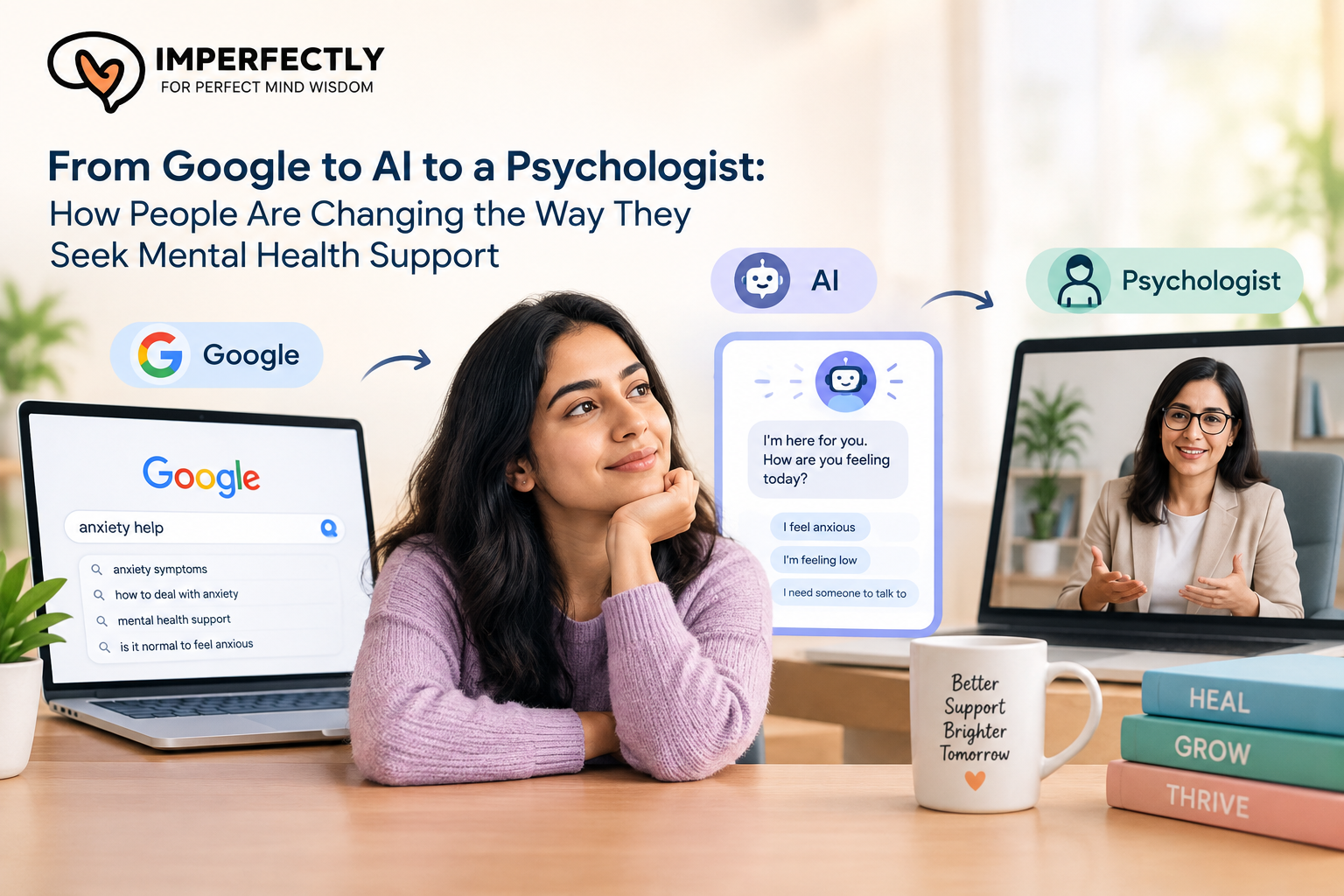
From Google to AI to a Psychologist: How People Are Changing the Way They Seek Mental Health Support
Changing the way people seek mental health support has become one of the most noticeable shifts in how people deal with emotional and psychological difficulties. Not long ago, someone struggling with anxiety, low mood, relationship problems, intrusive thoughts, or burnout might have spoken to a family member or directly booked an appointment with a psychologist or psychiatrist. Today, the journey often begins somewhere very different: Google.
A person may first search, “Why am I feeling anxious all the time?” Then, after reading articles and watching videos, they may turn to an AI chatbot because they want an immediate conversation without feeling judged. Eventually, if the problem continues or starts affecting everyday life, they may decide to speak with a psychologist or psychiatrist.
This does not necessarily mean people trust professionals less. Instead, changing the way people seek mental health support reflects a growing desire for information, privacy, convenience, and immediate emotional reassurance before taking the next step.
From years of observing how people approach mental-health care, one thing is clear: the path to professional help is rarely a straight line anymore.
Why People Often Start With Google
For many people, searching online feels easier than admitting to another person that something is wrong.
Someone experiencing panic symptoms may search for the difference between anxiety and a panic attack. Someone having unwanted thoughts may search whether intrusive thoughts are normal. A parent might look up signs of ADHD in a child before considering an assessment.
There is nothing inherently wrong with seeking information. In fact, a good search can help someone recognize that their experience deserves attention.
The problem begins when online information becomes a substitute for proper assessment.
Search results can tell you that a symptom is associated with anxiety, depression, OCD, ADHD, trauma, sleep problems, medication effects, or several other conditions. They cannot sit across from you, understand your history, observe changes in your behaviour, or determine what is actually happening in your particular situation.
The common mistake: self-diagnosing from symptoms
This is one of the most common patterns in changing the way people seek mental health support.
A person reads five symptoms of a condition and realizes they experience four of them. Suddenly, they are convinced they have that disorder.
In practice, mental-health professionals look at much more than a symptom checklist. They consider duration, severity, frequency, personal history, functioning, other symptoms, environmental factors, physical health, medication, substance use, and several other factors.
So online information can be a useful starting point—but it should be treated as a starting point, not a final diagnosis.
From Google Searches to AI Conversations
The next major change has been the rise of AI.
Instead of searching through ten different websites, people can now describe what they are feeling in one conversation. They may type something like:
“I keep replaying conversations in my head.”
Or:
“I feel exhausted but I don’t know why.”
Or:
“I have thoughts that scare me, but I don’t want to act on them.”
For someone who is nervous about talking to another person, an AI conversation can feel less intimidating.
That is an important reason AI and mental health have become part of the modern support journey.
Why AI feels easier to approach
There are several practical reasons.
First, AI is available immediately. There is no appointment waiting period.
Second, people can ask questions anonymously without worrying about how they will be perceived.
Third, they can repeat themselves, ask basic questions, or explain something several times.
Finally, AI can help people organize their thoughts when they do not know how to explain what they are experiencing.
For example, a person might use AI to turn a confusing collection of thoughts into a list they can later discuss with a psychologist.
That can actually be useful.
However, there is an important distinction: conversation is not the same thing as clinical care.
Where AI Support Has Limits
One of the biggest mistakes people make when changing the way people seek mental health support is assuming that a convincing AI conversation is equivalent to professional assessment.
It isn’t.
A psychologist brings clinical training, professional judgment, experience with human behaviour, and the ability to understand the broader context of an individual’s life.
A psychiatrist brings medical expertise and can assess whether symptoms may require medical treatment, including medication where appropriate.
AI can provide information and conversational support, but it should not become the only source of help when symptoms are persistent, severe, worsening, or interfering with daily life.
AI can help people take the first step
The more useful way to think about AI is not necessarily “AI versus psychologist.”
It can be:
Google → AI → professional support
For example, someone might search for information, use AI to better understand their concerns, and then speak with a qualified professional.
That is a much healthier model of changing the way people seek mental health support than expecting one tool to handle every part of the journey.
Why People Still Turn to Psychologists
Despite the growth of Google and AI, professional mental-health support remains important because people eventually need something technology cannot fully replace: a trained human who can understand their individual situation.
A psychologist does not simply listen and give generic advice.
A good psychologist notices patterns.
They may notice that a person’s anxiety increases in specific situations, that their thinking becomes more negative after certain experiences, or that a relationship problem is connected to deeper emotional patterns.
These details matter.
The human relationship matters more than people expect
One of the practical realities of mental-health care is that people often remember how safe and understood they felt during a session.
Someone may initially say, “I just want advice.”
But after a few sessions, the real issue may turn out to involve grief, self-esteem, family conflict, unresolved experiences, work pressure, or fear of rejection.
That is why finding mental health support is not simply about finding information. It is also about finding the right person and the right form of support.
The Modern Mental Health Journey Is No Longer Linear
Previously, people often imagined mental healthcare as a simple process:
Problem → Doctor → Treatment
Today, changing the way people seek mental health support looks much more like:
Feeling something → Google → Social media → AI → Talking to someone → Researching professionals → Booking an appointment → Professional assessment → Ongoing support
And sometimes people move backward and forward between these stages.
Someone may attend therapy while continuing to research their symptoms online. Another person may use an AI tool between appointments to organize questions. Someone else may discover a psychologist through an online platform after watching educational content.
This is not necessarily a problem.
The important question is whether digital tools are helping the person move toward appropriate care or keeping them stuck in endless searching.
When Searching Becomes Part of the Problem
There is a point where information-seeking stops being helpful.
This can happen particularly when someone is already anxious.
They search for one symptom.
Then another.
Then another.
Each new result creates another question.
Eventually, instead of feeling reassured, they feel even more uncertain.
For some people, repeated reassurance-seeking can become part of an anxiety or obsessive pattern.
That is one reason professionals often encourage people to look at the overall pattern rather than repeatedly checking individual symptoms online.
Ask yourself a different question
Instead of asking:
“What disorder do I have?”
consider asking:
“Is what I am experiencing affecting my life enough that I should speak with a professional?”
That question is usually much more useful.
If your sleep, work, studies, relationships, appetite, concentration, confidence, or everyday functioning is being significantly affected, professional support may be worth considering.
Convenience Is Changing Mental Healthcare
Another major reason behind changing the way people seek mental health support is convenience.
People are busy.
Someone may work long hours. A student may be living away from home. A parent may struggle to find childcare. Someone in a smaller city may have limited access to certain specialists.
Digital healthcare can reduce some of these barriers.
Online appointments can make it easier to connect with professionals without spending hours travelling.
However, convenience should not mean compromising quality.
Digital does not have to mean impersonal
Good digital mental healthcare should still feel human.
Patients need privacy, qualified professionals, clear communication, secure handling of their information, and continuity of care.
The technology should make healthcare easier—not make the patient feel like they are interacting with a machine at every stage.
That distinction is becoming increasingly important as digital mental healthcare develops.
What People Should Look For in Professional Support
When someone finally decides to seek professional help, the next challenge is choosing where to start.
A common mistake is choosing a professional solely because they appear first in a search result.
Instead, consider whether the professional’s experience matches the concern you want to discuss.
For example, someone dealing with persistent anxiety may benefit from a psychologist experienced in anxiety-related concerns. Someone experiencing symptoms that may require medical evaluation may need to consult a psychiatrist.
You should also feel comfortable asking about the professional’s qualifications, approach, appointment format, and what you can expect from the first session.
Don’t expect the first session to solve everything
This is another practical point that often gets overlooked.
The first appointment is frequently about understanding what is happening.
A professional may ask about your symptoms, history, relationships, daily routine, sleep, work, stress, and previous treatment.
That conversation may feel different from the immediate answers people get from Google or AI.
But that slower process is often what makes professional care more personalized.
What the Shift From Google to AI to Psychologists Really Means
The biggest change is not that people have stopped seeking professional help.
It is that they are often taking more steps before they seek it.
People want to understand what they are experiencing.
They want privacy.
They want immediate answers.
They want to compare options.
And they want healthcare that fits into their lives.
That is why changing the way people seek mental health support is not simply a technology story. It is a story about changing expectations around healthcare.
The best mental-health systems will need to meet people where they are while still guiding them toward appropriate professional care when it is needed.
A Better Way to Use Google, AI, and Professional Support
There is room for all three.
Use Google for:
Understanding basic mental-health concepts and finding reliable educational information.
Use AI for:
Organizing thoughts, preparing questions, reflecting on feelings, or finding general information.
Use psychologists and psychiatrists for:
Assessment, diagnosis where appropriate, treatment, therapy, medical evaluation, and personalized professional guidance.
The mistake is not using technology.
The mistake is expecting technology to replace the parts of care that require professional judgment and a real therapeutic relationship.
Start Your Mental Wellness Journey Today with Imperfectly
Mental health support does not have to begin with knowing exactly what is wrong or knowing which professional you need. Imperfectly makes the process simpler by bringing different areas of mental and healthcare support together in one accessible platform. Whether you are looking for a psychologist, psychiatrist, life coach, or physician, Imperfectly helps you take the next step toward appropriate support while keeping convenience, continuity, and patient experience at the centre of the journey.
What you can do with Imperfectly
📱 Download the Imperfectly App
🧠 Connect with experienced Psychiatrists, Psychologists, Life Coaches, and Physicians
📅 Book online or in-clinic appointments in minutes.
📈 Track your recovery journey with personalized wellness insights.
🔒 Access secure prescriptions, therapy notes, and medical records anytime.
💙 Experience complete 360° mental healthcare in one application.
Contact Imperfectly
Imperfectly – Your Trusted 360° Mental Health Platform
🌐 Website: https://imperfectly.co
📱 Patient Portal: https://imperfectly.co/application/
📞 Phone: +91 8448073838
📧 Email: admin@imperfectly.co
Final Thoughts
The journey toward mental-health support has changed dramatically.
For many people, it no longer starts in a doctor’s office. It may start with a Google search late at night, a conversation with AI, a social-media post, or a message to someone they trust.
That evolution can be positive when technology helps people recognize their concerns and makes professional support easier to access.
At the same time, information should not replace assessment, and AI should not be mistaken for a psychologist or psychiatrist.
Ultimately, changing the way people seek mental health support should make it easier—not harder—to reach the right human support when it matters.
The goal is not to choose between Google, AI, or a psychologist.
The goal is knowing when each one is useful and when it is time to take the next step.