

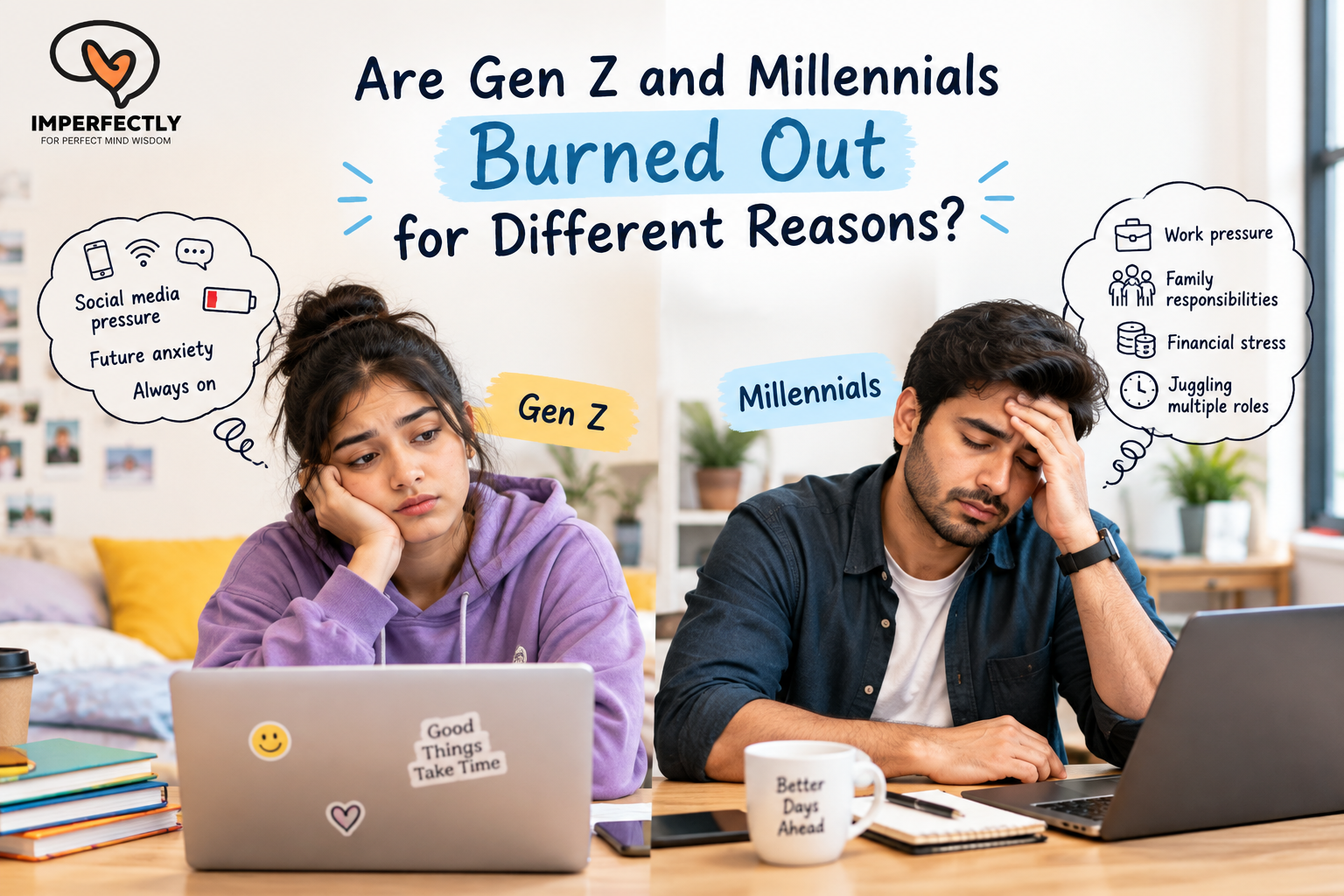
Are Gen Z and Millennials Burned Out for Different Reasons?
Gen Z and Millennials burnout can have different causes, even when the symptoms look similar. Both generations may experience exhaustion, low motivation, poor concentration, irritability, and emotional fatigue. However, the pressures behind that burnout can be very different.
Gen Z has entered adulthood in an environment shaped by social media, constant connectivity, rapid technological change, career uncertainty, and information overload. Millennials, meanwhile, have often spent years dealing with financial pressure, career expectations, housing costs, family responsibilities, and the challenge of balancing multiple roles.
After working with people experiencing prolonged stress, one thing becomes clear: burnout is rarely caused by one difficult day or one busy week. It usually develops when pressure continues for a long time and recovery keeps getting postponed.
Therefore, understanding Gen Z and Millennials burnout requires looking at the specific pressures each generation may be carrying rather than assuming that everyone needs the same solution.
What Is Gen Z and Millennials Burnout?
Burnout is more than ordinary tiredness.
Someone experiencing burnout may wake up exhausted, struggle to concentrate, lose interest in things they normally enjoy, become easily irritated, or feel emotionally disconnected from work and everyday life.
One of the most common mistakes is waiting until productivity completely collapses before recognising the problem.
Burnout often develops gradually.
A person may initially start checking work messages after hours. Then weekends stop feeling restorative. Small tasks begin to feel overwhelming. Eventually, even activities that were once enjoyable can feel like additional responsibilities.
However, burnout does not look exactly the same for everyone. Personal circumstances, workplace culture, financial situation, relationships, sleep, and existing mental health concerns can all influence how stress affects someone.
Gen Z Burnout: Why Younger Adults May Feel Exhausted
Gen Z burnout can be strongly influenced by the environment in which younger adults study, work, communicate, and socialise.
Unlike previous generations, many Gen Z adults have spent much of their lives surrounded by smartphones, social platforms, notifications, instant communication, and an endless stream of information.
That creates a unique problem: the working day may finish, but the brain may never feel completely switched off.
Digital Overload and Gen Z Workplace Burnout
A young professional might finish work and immediately move into another digital environment.
There may be:
- Work notifications
- WhatsApp messages
- Emails
- Social media
- News updates
- Career content
- Online conversations
- Financial information
- Entertainment
Although each activity may seem harmless individually, the constant switching can become mentally exhausting.
This is one reason Gen Z workplace burnout cannot always be addressed simply by telling someone to “work fewer hours.”
Sometimes the issue is that the brain receives very little genuine downtime.
Social Media and Gen Z Burnout
Social comparison can add another layer to Gen Z burnout.
A young adult may open social media and see someone their age travelling, buying a home, starting a business, getting promoted, or appearing to have a perfect relationship.
What they don’t see is the person’s debt, uncertainty, family problems, failed attempts, or ordinary days.
Consequently, constant comparison can create thoughts such as:
“Why am I behind?”
“Everyone seems to be doing better than me.”
“Am I wasting my time?”
Over time, these thoughts can contribute to anxiety, dissatisfaction, and emotional exhaustion.
Career Uncertainty and Gen Z Burnout
Another important factor is uncertainty about the future.
Young professionals may feel pressure to continuously improve their qualifications, learn new technology, build professional networks, develop a personal brand, and remain competitive.
The problem is that there may be no obvious point at which they can say, “I’ve done enough.”
That creates a form of psychological pressure where productivity becomes a permanent requirement rather than something with a clear limit.
Millennials Burnout: Why Long-Term Responsibilities Matter
Millennials burnout can develop from a different combination of pressures.
For many Millennials, the challenge isn’t necessarily figuring out what adulthood looks like anymore. Instead, it can be the responsibility of maintaining everything they have built.
A person may be managing:
- Career responsibilities
- Rent or mortgage payments
- Childcare
- Household responsibilities
- Relationship expectations
- Financial planning
- Elder-care responsibilities
- Long-term career goals
Nothing may appear dramatically wrong from the outside.
Yet there can be a constant feeling that something always needs attention.
Financial Pressure and Millennials Burnout
Financial stress can be a significant contributor to Millennials burnout.
Housing costs, family expenses, career expectations, savings goals, and long-term financial planning can create pressure that doesn’t disappear when the workday ends.
This is an important difference.
A person might technically leave the office at 6 p.m., but their brain can continue thinking about bills, childcare, investments, debt, or future financial security.
Consequently, physical separation from work does not necessarily mean psychological recovery.
Family Responsibilities and Millennials Workplace Burnout
Another issue associated with Millennials burnout is the number of roles many adults are expected to manage simultaneously.
Someone can be an employee, partner, parent, caregiver, and household manager at the same time.
Each responsibility may be manageable individually.
The problem comes from the cumulative load.
This is sometimes described as background responsibility—the mental list of things that must be remembered, organised, paid for, planned, or solved.
Even when someone is sitting quietly, their mind may still be working.
Gen Z and Millennials Burnout: What Symptoms Do They Share?
Despite different potential causes, Gen Z and Millennials burnout can produce very similar symptoms.
Emotional Symptoms of Generational Burnout
Someone experiencing burnout may notice:
- Irritability
- Emotional numbness
- Increased frustration
- Loss of motivation
- Feeling overwhelmed
- Reduced enjoyment
- Feeling detached from work or relationships
Sometimes the person doesn’t even describe themselves as “sad.”
Instead, they may say:
“I just don’t care anymore.”
That emotional disconnection can be an important warning sign.
Physical Symptoms of Gen Z and Millennials Burnout
Burnout can also be accompanied by:
- Persistent tiredness
- Poor sleep
- Headaches
- Muscle tension
- Appetite changes
- Feeling physically drained
It is important not to assume every physical symptom is caused by burnout. Persistent or concerning symptoms should be discussed with an appropriate healthcare professional.
Mental Symptoms of Generational Burnout
Concentration problems are particularly easy to overlook.
Someone may experience:
- Forgetfulness
- Difficulty making decisions
- Trouble starting tasks
- Reduced concentration
- Mental fog
- Constant distraction
A phrase professionals often hear is:
“My brain feels full.”
That description can capture the experience of prolonged mental overload surprisingly well.
Gen Z Burnout vs Millennials Burnout: What Is the Difference?
A useful way to understand Gen Z burnout vs Millennials burnout is to examine what happens outside working hours.
For some Gen Z adults, work follows them through their phones.
For some Millennials, work may be followed by another set of responsibilities at home.
Therefore, the problem may look different:
Gen Z may struggle to disconnect digitally, while Millennials may struggle to disconnect because responsibilities continue after work.
This is a broad pattern, not a rule. Plenty of Millennials experience digital overload, and many Gen Z adults carry significant family and financial responsibilities.
The individual situation always matters more than the generation label.
Workplace Burnout: Why Generation Isn’t the Whole Story
It would be a mistake to blame generational burnout entirely on age.
Workplace culture can have a much greater effect than someone’s birth year.
Imagine two employees doing similar jobs.
One has a manager who respects boundaries, provides realistic deadlines, encourages breaks, and recognises good work.
The other receives late-night messages, constantly changing priorities, unrealistic deadlines, and little recognition.
Their ages may not explain the difference.
Their working environments might.
That is why employers should focus on workplace conditions rather than simply assuming younger or older employees have different levels of resilience.
Common Mistakes When Managing Gen Z and Millennials Burnout
Mistake 1: Treating Burnout as a Sleep Problem
Sleep is essential, but sleeping longer does not automatically remove the source of chronic stress.
If someone wakes up and returns to the same overwhelming workload every morning, the underlying issue remains.
Mistake 2: Calling Burnout a Motivation Problem
A person experiencing burnout may hear:
“Just be more disciplined.”
“Try harder.”
“Think positively.”
“Stop being lazy.”
These statements can increase shame instead of solving the problem.
Burnout isn’t simply a lack of ambition.
Mistake 3: Comparing Gen Z and Millennials
Statements such as “Gen Z doesn’t want to work” or “Millennials are always stressed” are too simplistic.
Generational trends can help us understand broader patterns, but they should never be used to judge an individual.
Mistake 4: Waiting Until Burnout Becomes Severe
Many high-performing people seek support only when they can no longer maintain their usual performance.
That is often much later than necessary.
Early warning signs deserve attention.
Managing Gen Z Burnout in Everyday Life
For people experiencing Gen Z burnout, one practical starting point is creating genuine periods of digital recovery.
This can include:
- Turning off unnecessary notifications
- Creating work-free periods
- Avoiding constant email checking
- Taking breaks without automatically scrolling
- Protecting sleep from late-night screen use
- Setting realistic availability expectations
Most importantly, being constantly available is not the same as being productive.
Career development also doesn’t require saying yes to every opportunity.
Managing Millennials Burnout and Long-Term Stress
For people experiencing Millennials burnout, individual self-care may not be enough if the problem is an overwhelming combination of work, family, and financial responsibilities.
Instead, ask:
“What responsibility can be reduced, delegated, postponed, or renegotiated?”
That might mean discussing workload with a manager, sharing household responsibilities, establishing clearer family boundaries, or seeking professional support.
The most effective change is often the one that reduces the source of stress rather than simply helping someone tolerate it.
When Gen Z and Millennials Burnout Requires Professional Support
Not every stressful period means someone is experiencing burnout.
However, persistent exhaustion, emotional distress, anxiety, sleep difficulties, loss of interest, or difficulty functioning deserve attention.
If these problems continue despite reasonable attempts to rest and recover, speaking with a qualified mental health professional can help.
It is also important to remember that burnout can overlap with depression, anxiety, sleep disorders, and other mental health concerns.
Therefore, self-diagnosing based on online content isn’t always reliable.
A mental health professional can look at the wider picture and help identify what may actually be contributing to the symptoms.
What Employers Can Do About Generational Workplace Burnout
Employers also have an important role in reducing workplace burnout.
Simply telling employees to “practice self-care” is unlikely to work if the workplace rewards constant availability.
Instead, organisations can focus on:
- Clear workload expectations
- Realistic deadlines
- Healthy communication boundaries
- Supportive management
- Flexible working arrangements where appropriate
- Regular workload discussions
- Access to mental health resources
- A workplace culture where asking for help is acceptable
Interestingly, the solution doesn’t need to be completely different for every generation.
Most employees need similar fundamentals: reasonable expectations, respect, psychological safety, recognition, and enough time to recover.
Are Gen Z and Millennials Burned Out for Different Reasons?
Yes, sometimes—but the difference is more complicated than simply comparing generations.
Gen Z may experience burnout because of digital overload, social comparison, career uncertainty, and difficulty disconnecting from an always-connected environment.
Millennials may experience burnout because of long-term financial pressure, career responsibilities, family commitments, and the mental load of maintaining multiple areas of adult life.
However, these are broad patterns rather than fixed rules.
The more useful question isn’t:
“Which generation is more burned out?”
Instead, ask:
“What pressures is this person carrying, and what needs to change?”
That question leads to a much more useful conversation about mental health.
Burnout should not be treated as a personal failure. It can be a signal that the current balance between demands and recovery isn’t sustainable.
Recognising that signal early can make it easier to make meaningful changes and seek appropriate support.
Start Your Mental Wellness Journey Today with Imperfectly
Your mental health deserves support that looks at the whole person, not just one symptom. Imperfectly makes it easier to connect with qualified mental health and healthcare professionals based on your individual needs. Whether you’re dealing with burnout, stress, anxiety, emotional exhaustion, relationship concerns, or simply want to better understand your mental wellbeing, Imperfectly offers a convenient way to take the next step toward professional support.
Download the Imperfectly App
📱 Connect with experienced Psychiatrists, Psychologists, Life Coaches, and Physicians
📅 Book online or in-clinic appointments in minutes.
📈 Track your recovery journey with personalized wellness insights.
🔒 Access secure prescriptions, therapy notes, and medical records anytime.
💙 Experience complete 360° mental healthcare in one application.
Contact Imperfectly
Imperfectly – Your Trusted 360° Mental Health Platform
🌐 Website: https://imperfectly.co
📱 Patient Portal: https://imperfectly.co/application/
📞 Phone: +91 8448073838
📧 Email: admin@imperfectly.co