

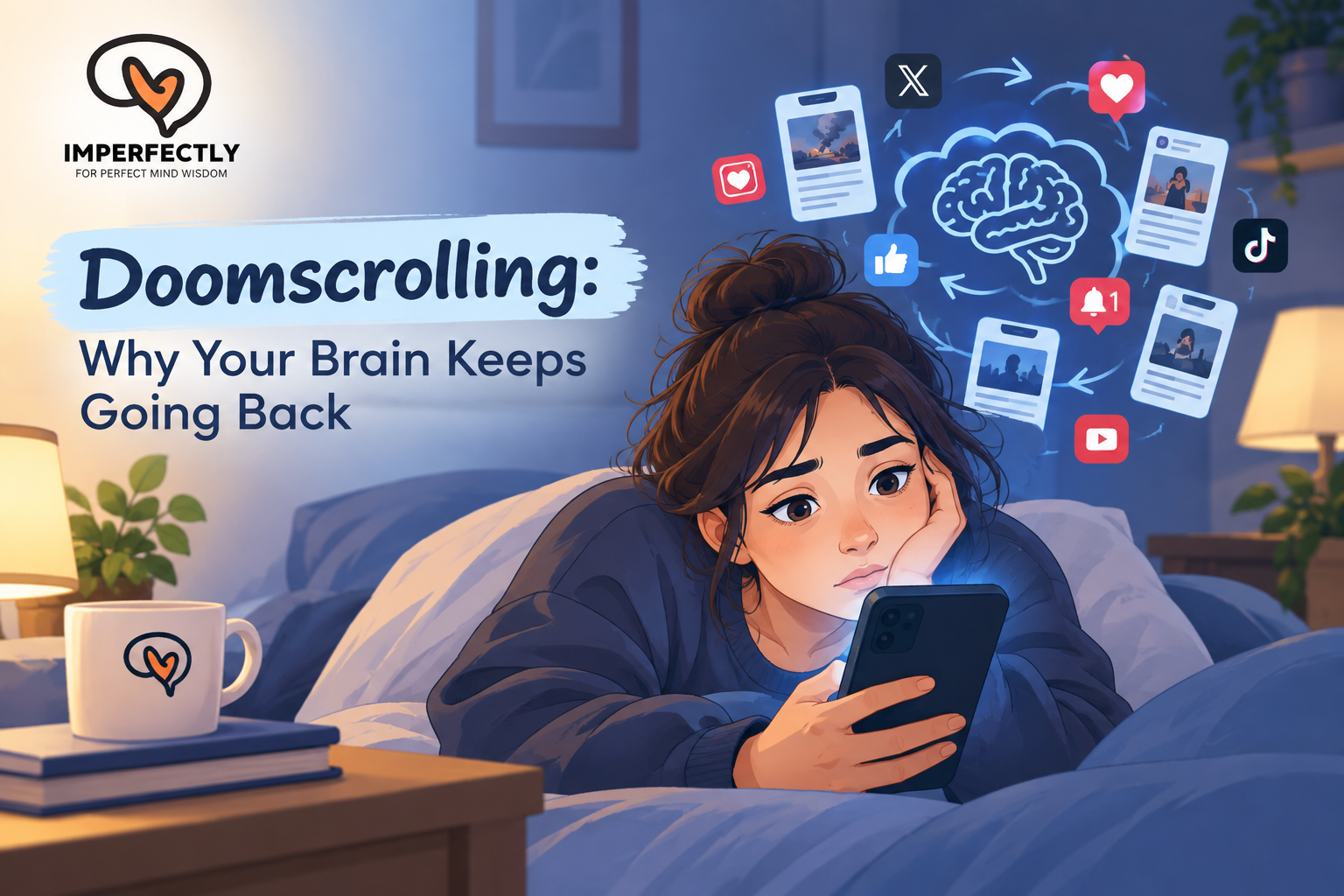
Doomscrolling: Why Your Brain Keeps Going Back
Doomscrolling is more than simply spending too much time on your phone. It is the habit of repeatedly scrolling through negative, alarming, or emotionally intense content even when you already know it is making you feel worse. You may tell yourself you will stop after one more post, yet somehow another 20 minutes disappear. Doomscrolling can leave you anxious, mentally exhausted, distracted, and still strangely compelled to keep looking.
From a mental-health perspective, this behaviour makes sense once you understand what your brain is trying to accomplish. It is often not looking for entertainment. It is looking for certainty, control, and an ending to an uncomfortable story.
The problem is that social media rarely provides that ending.
What Is Doomscrolling, Really?
Doomscrolling is the repeated consumption of distressing or negative online content, particularly when you continue scrolling despite feeling overwhelmed, anxious, or emotionally drained.
It often looks like this:
You see a worrying headline.
Then you open the comments.
Someone mentions another alarming detail.
You search for more information.
You move to another post.
Then another.
Eventually, you are no longer consciously choosing what to read. You are simply continuing the behaviour.
And that distinction matters.
In clinical conversations, people sometimes describe doomscrolling as a lack of self-control. However, that explanation misses an important part of the picture: the behaviour is being reinforced by the brain itself.
Why Your Brain Keeps Going Back to Negative Content
Your brain pays attention to potential threats
Human attention is naturally drawn toward information that might signal danger.
That tendency was useful long before smartphones existed. If something looked threatening, paying attention could help you respond quickly.
Today, however, the “threat” might be a breaking-news notification, frightening video, angry comment, health story, financial concern, or disturbing image.
Your brain does not always distinguish between:
“This information could help me stay safe.”
and
“This information is simply making me anxious.”
As a result, alarming content can capture attention more effectively than ordinary content.
Uncertainty makes scrolling harder to stop
One of the most overlooked drivers of doomscrolling is uncertainty.
Suppose you read about a frightening event. You may think:
“What happened?”
Then:
“Is there more information?”
Then:
“What happens next?”
That search can feel productive because you are gathering information.
Yet, in practice, you may be feeding the anxiety rather than resolving it.
There is always another update, another opinion, another comment, or another prediction.
Therefore, the brain never receives a clear signal that the search is finished.
Variable rewards keep you checking
Social platforms are particularly effective at keeping attention because you never know what the next swipe will reveal.
Most posts may be ordinary. Then suddenly you encounter something highly emotional, surprising, frightening, or personally relevant.
That unpredictability matters.
The brain learns:
“The next scroll might contain something important.”
So you keep scrolling.
This is one reason simply telling yourself, “I should have more discipline,” often does not solve the problem. You are dealing with a behaviour reinforced by a highly stimulating environment.
Doomscrolling Often Feels Like Taking Control
This is where things get particularly interesting.
People frequently doomscroll when they feel uncertain or powerless.
For example, during a crisis, someone might repeatedly check news updates because they believe that knowing more will help them feel prepared.
The intention is understandable.
Unfortunately, more information does not always create more control.
Sometimes it creates information overload.
You might begin the evening wanting to understand what is happening. Two hours later, you know dozens of frightening details but feel less capable of doing anything about them.
In therapy, this pattern can appear as a form of reassurance-seeking: “If I check one more time, maybe I will finally feel certain.”
Usually, certainty does not arrive.
Why Doomscrolling Can Make Anxiety Worse
Doomscrolling and anxiety can create a self-reinforcing cycle.
The doomscrolling cycle
Trigger → anxiety → scrolling → temporary sense of control → more disturbing information → increased anxiety → more scrolling
The important part is the temporary relief.
You may initially feel better because you are doing something rather than sitting with uncertainty.
However, that relief can teach your brain to repeat the behaviour the next time anxiety appears.
Consequently, the habit becomes stronger.
This is why doomscrolling can continue even when you consciously know that it is hurting your mood.
The Emotional Cost You May Not Notice Immediately
Doomscrolling does not always produce an obvious emotional crash.
Instead, the effects can be subtle.
You might notice that you:
- Become more irritable.
- Find it harder to concentrate.
- Feel mentally “full.”
- Have less patience with other people.
- Keep checking your phone automatically.
- Struggle to enjoy ordinary activities.
- Feel tense without knowing exactly why.
- Have difficulty switching your mind off at night.
Over time, this constant exposure to emotionally intense information can make ordinary life feel unusually quiet or boring.
That can make the phone even more attractive.
Doomscrolling at Night Is a Different Problem
Night-time doomscrolling deserves special attention.
When the day’s responsibilities are finished, many people finally have uninterrupted access to their phones. They may lie in bed thinking they will scroll for five minutes.
Then the cycle begins.
One concerning story leads to another. Because there are fewer distractions around you, the emotional impact of what you are reading may become stronger.
Furthermore, scrolling in bed can turn your usual sleep routine into a period of mental stimulation.
The result is familiar:
“I am exhausted, but my brain is still switched on.”
If this happens regularly, the issue may not be simply that you need more willpower. Your evening routine may have become associated with stimulation, checking, and emotional vigilance.
How to Know When Doomscrolling Is Becoming a Problem
You do not need to stop using social media completely.
The more useful question is:
“Is my relationship with this content still under my control?”
Pay attention if you regularly:
- Continue scrolling after deciding to stop.
- Feel worse after using social media but return anyway.
- Check news repeatedly for reassurance.
- Reach for your phone whenever you feel anxious.
- Lose track of time while consuming negative content.
- Sacrifice sleep to keep checking updates.
- Find yourself thinking about online content long after putting your phone down.
One occasional late-night scroll is not necessarily a mental-health problem.
However, when the behaviour becomes repetitive and begins interfering with sleep, relationships, work, concentration, or emotional wellbeing, it deserves more attention.
How to Break the Doomscrolling Cycle Without Deleting Every App
Notice the trigger before fighting the behaviour
Instead of immediately asking:
“How do I stop scrolling?”
ask:
“What was I feeling immediately before I started?”
Was it boredom?
Anxiety?
Loneliness?
Stress?
Uncertainty?
Avoidance?
This small shift can reveal something important.
Sometimes the phone is not the real problem. The phone is the coping strategy.
If you remove it without addressing what you were trying to escape, another behaviour may replace it.
Create a stopping point before you start
“I’m going to stop when I’ve had enough” is surprisingly unreliable.
Instead, establish a specific boundary.
For example:
- Check news once in the morning and once in the evening.
- Keep social media outside the bedroom.
- Use a timer before opening an app.
- Stop consuming distressing content 30–60 minutes before sleep.
- Choose one reliable source instead of repeatedly checking multiple feeds.
The goal is not perfection.
The goal is to make the stopping decision before your emotional system becomes activated.
Replace the behaviour, not just the screen
If you remove doomscrolling and leave an empty space, your brain may simply look for another source of stimulation.
Therefore, prepare an alternative.
Take a short walk.
Call someone.
Listen to music.
Read something unrelated to current events.
Write down what is worrying you.
Make tea.
Do something with your hands.
These alternatives may initially feel less exciting than scrolling. That’s normal.
Your brain has become accustomed to rapid novelty.
Give yourself permission not to know everything
This is perhaps the hardest lesson.
You are allowed to stop reading before you know every detail.
You are allowed to miss an update.
You are allowed to go to bed without knowing what happened in the last hour.
Being informed and being constantly informed are not the same thing.
Healthy information consumption includes an off switch.
When Doomscrolling May Be a Sign of Something Deeper
Sometimes persistent doomscrolling is connected to a broader emotional difficulty.
For one person, it may be anxiety.
For another, it may be loneliness or boredom.
Someone experiencing high stress may use constant information checking as a distraction. Someone struggling with obsessive patterns may repeatedly seek reassurance. Another person may simply have developed a strong habit through years of automatic phone use.
That is why there is no single “anti-doomscrolling trick” that works for everyone.
If you repeatedly try to change the habit and cannot, especially when it is affecting your sleep, work, relationships, or emotional wellbeing, speaking with a psychologist or psychiatrist can help identify what the behaviour is doing for you, rather than simply telling you to stop.
A Healthier Relationship With Your Phone Starts With Awareness
Doomscrolling is not evidence that you are weak or incapable of controlling yourself.
Your brain is responding to attention-grabbing information, uncertainty, emotional stimulation, and reinforcement.
Nevertheless, understanding the mechanism gives you something valuable: a chance to interrupt the cycle.
The next time you notice yourself scrolling through one alarming post after another, pause for a moment.
Ask yourself:
“Am I looking for useful information, or am I looking for relief from uncertainty?”
That question alone can create enough distance to make a different choice.
And ultimately, that is the goal—not never using your phone again, but being able to put it down when you decide the conversation is over.
Start Your Mental Wellness Journey Today with Imperfectly
Imperfectly is a 360° mental health platform designed to make professional mental healthcare easier to access and manage. Whether you are looking for support with anxiety, stress, emotional challenges, behavioural patterns, or other mental-health concerns, Imperfectly connects you with experienced psychiatrists, psychologists, life coaches, and physicians. Through convenient online and in-clinic appointments, personalised wellness insights, and secure access to prescriptions, therapy notes, and medical records, the platform brings different aspects of mental healthcare together in one place.
Download the Imperfectly App
- 📱 Connect with experienced Psychiatrists, Psychologists, Life Coaches, and Physicians
- 📅 Book online or in-clinic appointments in minutes.
- 📈 Track your recovery journey with personalized wellness insights.
- 🔒 Access secure prescriptions, therapy notes, and medical records anytime.
- 💙 Experience complete 360° mental healthcare in one application.
Contact Imperfectly
Imperfectly – Your Trusted 360° Mental Health Platform
🌐 Website: https://imperfectly.co
📱 Patient Portal: https://imperfectly.co/application/
📞 Phone: +91 8448073838
📧 Email: admin@imperfectly.co