

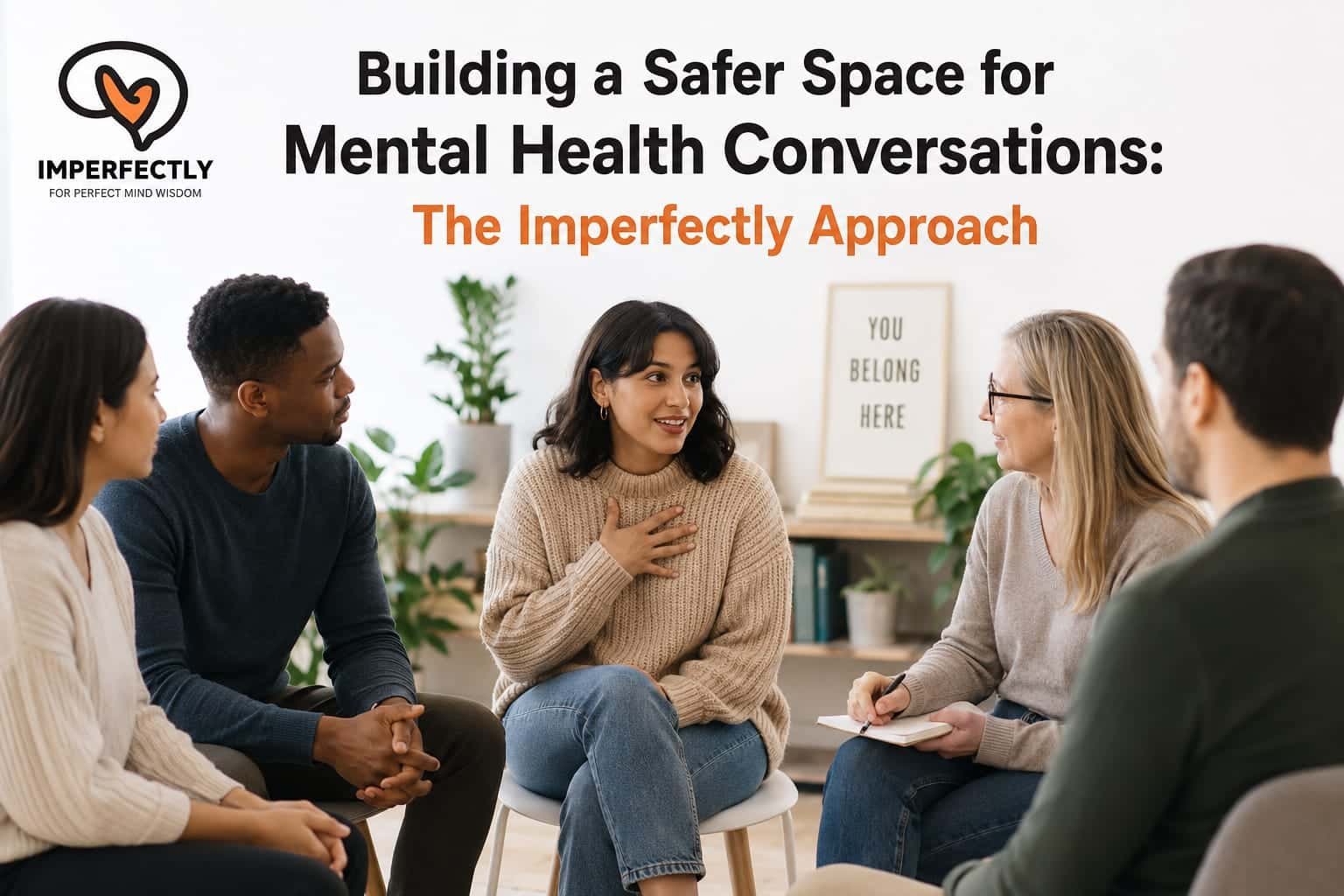
Building a Safer Space for Mental Health Conversations: The Imperfectly Approach
A safer space for mental health conversations is not simply a place where people are encouraged to “open up.” In real clinical and everyday settings, people often need much more than encouragement. They need to feel heard without being rushed, respected without being judged, and supported without being made to feel weak or difficult.
For many people, the hardest part of getting mental health support is not finding a psychologist or psychiatrist. It is saying, “I think something is wrong, and I need help.”
That sentence can carry fear, embarrassment, uncertainty, and sometimes years of silence.
At Imperfectly, we believe meaningful mental healthcare begins by making those conversations easier to have. Our approach focuses on creating a safer space for mental health conversations where people can connect with appropriate professionals, discuss what they are experiencing, and take practical steps toward better mental well-being.
Why Mental Health Conversations Can Feel So Difficult
People rarely avoid mental health conversations because they have nothing to say. More often, they are worried about what might happen after they say it.
Someone may think:
- “What if people think I am overreacting?”
- “What if my family does not understand?”
- “What if the psychologist judges me?”
- “What if I cannot explain what I am feeling?”
- “What if talking about it makes everything worse?”
- “Should I really seek professional help for this?”
These concerns are extremely common.
In practice, people often arrive for their first consultation with a carefully edited version of their experience. They may talk about poor sleep but leave out anxiety. They may mention work stress but avoid discussing panic attacks. They may describe relationship problems without explaining how overwhelmed they have actually become.
That is why creating a safer space for mental health conversations requires patience. People should not have to present a perfectly organised explanation of their emotions before receiving support.
What Makes a Safer Space for Mental Health Conversations?
A genuinely supportive environment is built through several small things rather than one grand gesture.
Listening Without Immediately Trying to Fix Everything
One of the most common mistakes in mental health conversations is moving too quickly into problem-solving.
A person says, “I have been feeling exhausted for weeks,” and the immediate response becomes:
“Try exercising.”
“Sleep earlier.”
“Think positively.”
“Take a break.”
Although these suggestions may be well-intentioned , they can unintentionally communicate that the person’s experience is simple to solve.
A better conversation starts with understanding.
What has been happening?
How long has it been happening?
What has changed?
How is it affecting daily life?
What does the person believe they need right now?
Only after understanding the situation can meaningful support begin.
Making Room for Imperfect Communication
People do not always know how to describe their mental health.
They might say:
“I just don’t feel like myself.”
“My mind won’t switch off.”
“Everything feels too much.”
“I am tired, but I cannot sleep.”
“I don’t know why I am reacting like this.”
These statements are not incomplete failures. They are often the starting point of an important conversation.
A safer space for mental health conversations allows someone to begin with whatever words they have. A trained professional can help explore the details gradually instead of expecting the person to arrive with a diagnosis or perfectly structured explanation.
Reducing Shame Around Seeking Help
There is still a common misconception that professional mental health support is only necessary when someone reaches a crisis.
That is not how preventive mental healthcare works.
People can seek support when they are struggling with stress, relationship difficulties, emotional changes, work pressure, persistent worry, sleep problems, low motivation, or simply a sense that something does not feel right.
Getting help earlier can also make it easier to understand what is happening before difficulties become more disruptive.
The Imperfectly Approach to Mental Health Conversations
At Imperfectly, the goal is not to make mental health conversations sound clinical or intimidating. Instead, the focus is on connecting people with appropriate support while respecting the fact that every person’s situation is different.
Connecting People With the Right Professionals
Mental healthcare is not one-size-fits-all.
Depending on the individual’s needs, support may involve a psychologist, psychiatrist, life coach, physician, or another appropriate professional.
That distinction matters.
For example, someone looking for structured psychological support may benefit from speaking with a psychologist, while someone experiencing symptoms that require psychiatric assessment may need a psychiatrist.
The right professional can help identify what kind of support is appropriate rather than leaving the individual to figure everything out alone.
Making Access More Convenient
Even when someone decides to seek help, practical barriers can get in the way.
Finding a professional, arranging an appointment, travelling to a clinic, remembering previous treatment information, and keeping track of ongoing care can feel overwhelming—particularly when someone is already struggling emotionally.
That is why accessibility is an important part of building a safer space for mental health conversations.
Imperfectly brings different aspects of mental healthcare together through one platform, helping users connect with professionals and manage important parts of their mental wellness journey.
Respecting Privacy and Personal Information
Mental health conversations can involve some of the most personal parts of someone’s life.
People may discuss family relationships, personal fears, emotional struggles, medication, previous treatment, work difficulties, or experiences they have never shared with anyone else.
Consequently, privacy and responsible handling of personal health information are not minor details. They are fundamental to building trust.
A person is more likely to communicate honestly when they understand that their information is being handled appropriately and that their care is being approached professionally.
What Professionals Can Do to Create Emotional Safety
Creating a safer space for mental health conversations is not solely the responsibility of technology or healthcare platforms. Professionals play an essential role.
Do Not Assume Silence Means Everything Is Fine
Some people become quiet when discussing something uncomfortable.
Others laugh.
Some change the subject.
Some minimise what happened.
These behaviours should not automatically be interpreted as a lack of concern. Sometimes they are signs that the person is struggling to talk about something difficult.
A thoughtful professional pays attention not only to what is being said, but also to what may be difficult to say.
Avoid Labelling Too Quickly
Another common mistake is rushing toward a label before understanding the person’s broader circumstances.
A person can experience anxiety without every anxious feeling meaning the same thing. Similarly, difficulty concentrating can have many possible causes.
Good mental healthcare requires assessment, context, and professional judgement.
Therefore, the conversation should come before conclusions.
Let the Person Ask Questions
People often feel embarrassed asking basic questions during mental health consultations.
They may worry that they “should already know” something.
They should not.
A supportive professional creates room for questions about treatment, therapy, medication, expectations, progress, and next steps.
A safer space for mental health conversations is one where asking questions is treated as part of care—not as an inconvenience.
How Families and Friends Can Support Better Mental Health Conversations
You do not need to be a mental health professional to make someone feel safer when they talk to you.
Sometimes the most useful response is surprisingly simple.
Instead of:
“Everyone goes through this.”
Try:
“That sounds really difficult. Do you want to talk about it?”
Instead of:
“You are thinking too much.”
Try:
“I can see that this is affecting you. How can I support you?”
Instead of:
“You should just move on.”
Try:
“Would you like me to listen, or would you like help thinking through what to do next?”
That final question can be particularly useful.
Not every difficult conversation requires advice. Sometimes a person needs to be heard first.
When a Conversation Should Lead to Professional Support
Friends and family can provide valuable emotional support, but they cannot replace professional assessment and treatment when that is needed.
Consider encouraging professional support when emotional or behavioural difficulties are:
- Persisting for an extended period
- Interfering with work, education, relationships, or daily responsibilities
- Becoming increasingly difficult to manage
- Affecting sleep or appetite significantly
- Accompanied by intense anxiety, sadness, anger, or hopelessness
- Leading to repeated avoidance or withdrawal
- Creating concerns about safety
Importantly, seeking professional support does not mean someone has failed to cope.
It means they are taking their well-being seriously.
If someone is in immediate danger or experiencing thoughts of suicide or self-harm, the situation requires urgent professional or emergency assistance rather than relying solely on an online platform, friend, or family member.
The Role of Technology in Creating a Safer Space
Technology cannot replace the human relationship at the heart of mental healthcare. However, it can remove some of the friction around accessing that relationship.
A well-designed mental health platform can help people:
- Find appropriate professionals
- Schedule appointments more conveniently
- Access online or in-clinic care
- Keep relevant health information organised
- Follow their wellness journey
- Stay connected with ongoing care
However, technology should remain a tool—not the treatment itself.
The quality of the professional interaction, the appropriateness of care, privacy, continuity, and the individual’s needs still matter most.
That is an important distinction when discussing a safer space for mental health conversations. Convenience is valuable, but trust and quality of care cannot be replaced by convenience alone.
Common Mistakes That Make Mental Health Conversations Less Safe
Even well-meaning people can accidentally shut down a conversation.
Turning the Conversation Into a Comparison
“I had it worse and I managed.”
This may be intended as encouragement, but it can make someone feel that their experience is not serious enough to matter.
Pain is not a competition.
Giving Unsolicited Advice
Advice offered too early can make people feel unheard.
First understand. Then ask whether they want suggestions.
Treating Every Problem as Positive Thinking
Positive thinking has its place, but it cannot replace appropriate support for persistent or significant mental health difficulties.
Telling someone to “stay positive” can sometimes make them feel guilty for having negative emotions in the first place.
Expecting Immediate Progress
Mental well-being rarely improves in a perfectly straight line.
There can be good weeks and difficult weeks. A setback does not automatically mean that support has failed.
Progress often looks less dramatic than people expect: sleeping slightly better, communicating more clearly, recognising triggers earlier, setting one boundary, or asking for help before reaching a breaking point.
Those changes matter.
Building a Culture Where Asking for Help Feels Normal
Ultimately, a safer space for mental health conversations is bigger than an app, clinic, consultation room, or website.
It is a culture.
It exists when a young adult can say they are struggling without being mocked.
It exists when a parent can admit they are overwhelmed without feeling like a failure.
It exists when a professional can acknowledge stress without fearing judgement.
It exists when seeking psychological or psychiatric support is treated as a responsible health decision rather than something to hide.
Creating that culture takes time. Nevertheless, every respectful conversation helps move it forward.
Start Your Mental Wellness Journey Today with Imperfectly
Imperfectly is designed to make mental healthcare more accessible, connected, and easier to navigate. As a 360° mental health platform, Imperfectly helps individuals connect with experienced Psychiatrists, Psychologists, Life Coaches, and Physicians while providing convenient options for online or in-clinic appointments. Through the platform, users can also keep track of their recovery journey, access relevant wellness insights, and manage important healthcare information in one place. Most importantly, Imperfectly aims to make taking the first step toward mental wellness feel less intimidating and more manageable.
Download the Imperfectly App
📱 Connect with experienced Psychiatrists, Psychologists, Life Coaches, and Physicians
📅 Book online or in-clinic appointments in minutes.
📈 Track your recovery journey with personalised wellness insights.
🔒 Access secure prescriptions, therapy notes, and medical records anytime.
💙 Experience complete 360° mental healthcare in one application.
Contact Imperfectly
Imperfectly – Your Trusted 360° Mental Health Platform
🌐 Website: https://imperfectly.co
📱 Patient Portal: https://imperfectly.co/application/
📞 Phone: +91 8448073838
📧 Email: admin@imperfectly.co