

What Is an OCD Thought Cycle? What Does an OCD Thought Feel Like?
What Does an OCD Thought Feel Like?</h2>
An OCD thought cycle can feel less like simply “having a strange thought” and more like getting mentally trapped in a question, fear, image, or possibility that refuses to settle. A person may know that the thought sounds unreasonable, yet still feel an intense need to analyse it, check it, neutralise it, or get reassurance.
For example, someone might suddenly think, “What if I accidentally harmed someone?” The thought itself may last only a few seconds. However, the mind can then start searching for certainty: Did I really do anything? What if I don’t remember? Should I check? What if I’m a bad person?
That is where the OCD thought cycle often becomes exhausting.
Importantly, having an intrusive thought does not automatically mean someone has OCD. Unwanted thoughts are part of ordinary human thinking. The difference is often what happens next—the importance the brain assigns to the thought and the repeated attempts to obtain certainty or reduce distress.
What Is an OCD Thought Cycle?
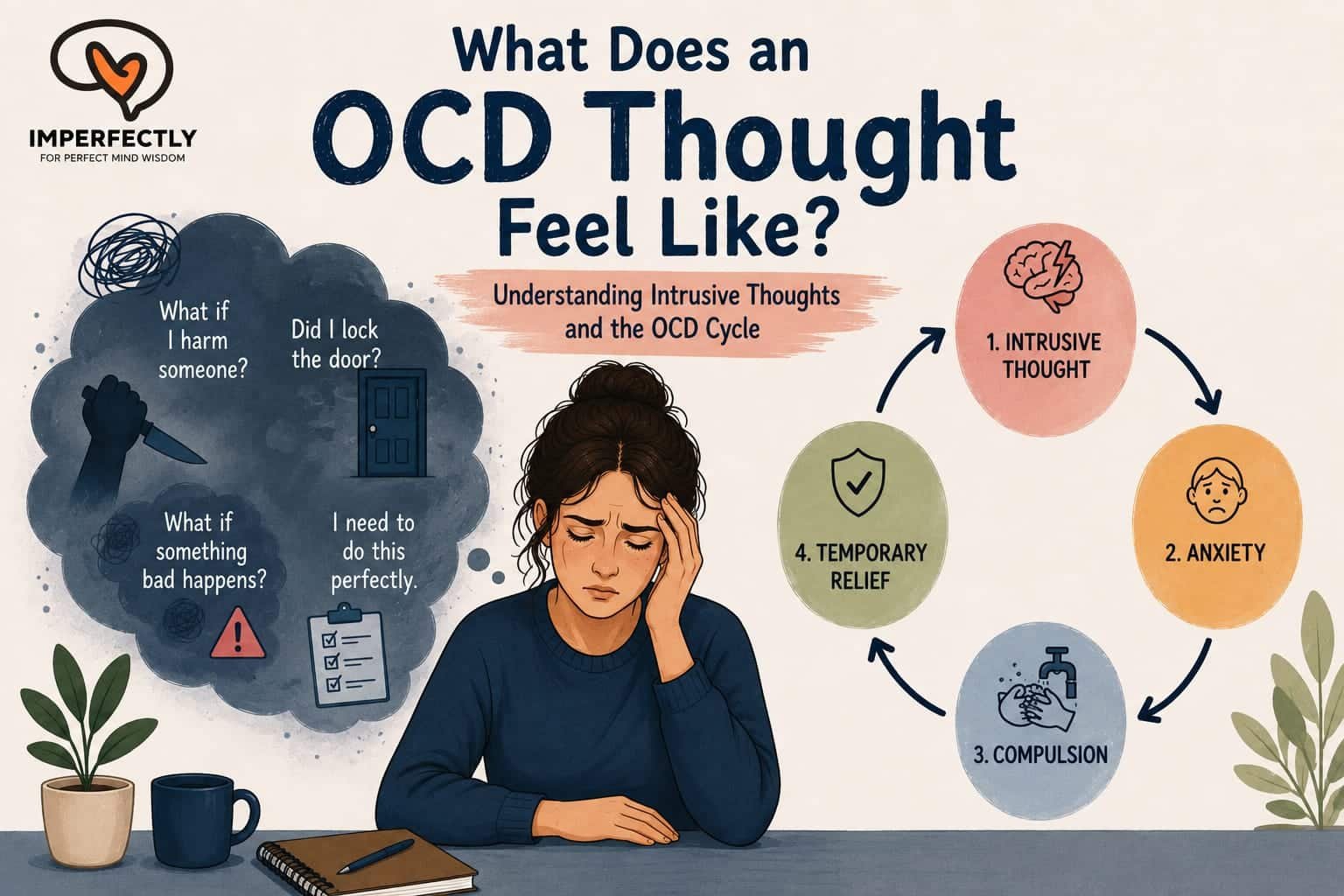
An OCD thought cycle is a repeating pattern involving an unwanted obsession, rising anxiety or discomfort, and a response intended to make that discomfort go away.
The response might be obvious, such as washing, checking, or asking someone for reassurance. However, it can also happen entirely inside the person’s head.
A common pattern looks like this:
Intrusive thought → anxiety or uncertainty → compulsion or mental ritual → temporary relief → doubt returns → cycle repeats
For instance:
“What if I left the stove on?”
The person may initially feel a small wave of doubt. Then the discomfort grows. They check the stove once. They feel better briefly. A few minutes later, another thought appears:
“But did I actually turn it off properly?”
The person checks again.
Eventually, checking is no longer about the stove. It becomes an attempt to achieve a level of certainty that the brain never seems willing to accept.
Why the Thought Can Feel So Important
One of the most important clinical observations about OCD is that the content of the thought is often less important than the person’s relationship with uncertainty.
People can become distressed by thoughts about:
- harming someone
- contamination
- relationships
- religion or morality
- sexual themes
- making mistakes
- losing control
- health
- responsibility
- accidentally causing harm
- whether they truly love someone
- whether they are a “good” or “bad” person
The subject matter can be completely different, yet the underlying pattern can look remarkably similar.
What Does an OCD Thought Actually Feel Like?
There is no single emotional experience that defines OCD. However, many people describe their intrusive thoughts as sticky, urgent, threatening, or impossible to leave alone.
A person may experience:
A Sudden Intrusive Thought
The thought can appear without invitation.
It may feel completely out of character, which can make it especially frightening.
Someone who deeply values their family, for example, may experience an unwanted thought about harming a family member. The presence of that thought can then become the source of further fear.
The important point is that an intrusive thought is not the same thing as an intention.
A Strong Feeling of “What If?”
OCD frequently speaks in possibilities rather than facts.
“What if I made a mistake?”
“What if I hurt someone without knowing?”
“What if this feeling means something terrible?”
“What if I secretly want this?”
“What if I can never be certain?”
The brain keeps presenting the possibility, and the person feels compelled to solve it.
An Uncomfortable Sense That Something Is Not Right
Not everyone with OCD experiences a clear fear. Sometimes there is simply a powerful sense of incompleteness or wrongness.
A person might think:
“I know the door is locked, but it doesn’t feel locked enough.”
That distinction matters. OCD is not always driven by an obvious fear of catastrophe. Sometimes the compulsion is an attempt to make an internal feeling finally feel “right.”
A Need for Certainty
This is one of the most common traps.
The person isn’t necessarily looking for a reasonable answer. They may be looking for absolute certainty.
Unfortunately, absolute certainty is rarely available in everyday life.
That is why answering the same question repeatedly can provide relief for a few minutes but fail to resolve the underlying problem.
How the OCD Thought Cycle Keeps Repeating
The OCD thought cycle survives because the behaviour that follows the intrusive thought can temporarily reduce distress.
Consider this example:
Thought: “What if I contaminated my phone?”
Feeling: Anxiety and disgust.
Compulsion: Clean the phone repeatedly.
Result: Anxiety drops.
The brain learns something important:
“Cleaning made the anxiety go away.”
So, the next time the thought appears, cleaning becomes more likely.
This is one reason compulsions can become increasingly frequent over time.
The Relief Is Real—but Temporary
This is a practical point that is often misunderstood.
People with OCD are not performing compulsions because they enjoy them. They usually perform them because the behaviour provides temporary relief from distress.
The problem is that the relief teaches the brain to rely on the compulsion again.
Consequently, the person may need to:
- check more often
- ask for reassurance more frequently
- mentally review events for longer
- wash repeatedly
- avoid more situations
- search online for answers
- analyse their feelings more deeply
The behaviour can become more elaborate while the relief becomes shorter.
Mental Compulsions: The Part People Often Miss
Not every compulsion is visible.
A person may appear completely calm while experiencing a significant OCD thought cycle internally.
Mental compulsions can include:
Replaying Memories
The person repeatedly reviews what happened:
“Did I say something inappropriate?”
“Did I look at someone strangely?”
“Did I accidentally hurt someone?”
“Was I completely honest?”
Analysing Feelings
This is especially common in relationship-focused OCD.
Someone might repeatedly ask:
“Do I feel enough love?”
“Should I feel more excited?”
“What if I’m forcing myself to stay?”
Instead of experiencing the relationship naturally, the person starts monitoring every emotional reaction.
Seeking Internal Reassurance
The person may repeatedly tell themselves:
“I would never do that.”
“I know I’m a good person.”
“This probably doesn’t mean anything.”
Although this can feel helpful, repeatedly using reassurance to neutralise anxiety can become part of the cycle.
Searching for the Perfect Answer
Online searching can also become a compulsion.
One search turns into five.
Five become twenty.
Eventually, the person is not learning anymore. They are trying to reach a feeling of certainty that never lasts.
Why OCD Thoughts Can Feel So Real
A common mistake is assuming that people with OCD believe every intrusive thought.
Often, the opposite is true.
They may be deeply distressed precisely because the thought conflicts with their values.
For example, an intrusive thought about harming someone can feel horrifying to a person who places enormous importance on being safe and caring.
This creates a painful question:
“Why would I think this if I don’t want it?”
That question can become another obsession.
The person starts analysing the thought itself, which creates more mental attention around it. The more attention it receives, the more significant it can feel.
Therefore, thought frequency is not proof of intention, personality, character, or desire.
OCD Thought Cycle vs. An Ordinary Intrusive Thought
Almost everyone experiences strange, unwanted, embarrassing, or disturbing thoughts from time to time.
The presence of an intrusive thought alone does not establish OCD.
The difference is often what happens afterward.
| Ordinary intrusive thought | OCD-related pattern |
|---|---|
| Thought appears | Thought appears |
| Person notices it | Person becomes highly concerned about its meaning |
| Thought fades | Person analyses or monitors it |
| Little need to resolve it | Strong need for certainty |
| No repeated ritual | Checking, reassurance, avoidance, rumination, or another compulsion |
| Attention moves elsewhere | Attention repeatedly returns to the thought |
This isn’t a diagnostic test. Rather, it illustrates why the OCD thought cycle is more about the response to thoughts than the mere existence of unusual thoughts.
Common Types of OCD Thought Patterns
OCD does not always look like the stereotypical image of repeated handwashing.
Contamination OCD
The fear may involve germs, illness, chemicals, bodily fluids, or contamination spreading from one object to another.
The compulsion might involve washing, cleaning, avoiding, or repeatedly checking whether something is contaminated.
Harm OCD
A person may experience unwanted thoughts or images about accidentally or intentionally harming someone.
These thoughts can be particularly frightening because the person may interpret their existence as evidence that they are dangerous.
Relationship OCD
A person may repeatedly question whether they truly love their partner, whether the relationship is right, or whether they feel the “correct” emotions.
Constantly testing feelings can make genuine emotional experience even harder to access.
Sexual or Identity-Related Intrusive Thoughts
Some people experience unwanted sexual thoughts or doubts about their identity that feel inconsistent with their values or sense of self.
The distress often comes from trying to determine exactly what the thought “means.”
Responsibility OCD
The person may feel excessively responsible for preventing harm.
For example:
“What if I forgot something?”
“What if someone gets hurt because I didn’t check?”
This can lead to repeated checking and excessive preparation.
Scrupulosity and Moral OCD
The person may become preoccupied with whether they have committed a moral, religious, or ethical wrongdoing.
They may repeatedly confess, seek reassurance, review their actions, or mentally examine their intentions.
Why Reassurance Can Accidentally Strengthen the Cycle
One of the most practical lessons for families and partners is this:
Reassurance can feel compassionate while still feeding the OCD cycle.
Suppose someone asks:
“Are you absolutely sure I didn’t hurt anyone?”
A loved one says:
“No, you’re definitely fine.”
The person feels better.
Then ten minutes later:
“But are you really sure?”
Another reassurance is given.
Then another.
Eventually, the conversation becomes an attempt to provide a guarantee that nobody can realistically provide.
The problem isn’t kindness. The problem is turning another person into a source of certainty.
A therapist familiar with OCD can help families find ways to support the person without repeatedly participating in compulsions.
What Usually Makes an OCD Thought Cycle Worse?
Several behaviours can unintentionally keep the cycle alive.
Trying to Force the Thought Away
“Don’t think about it.”
Unfortunately, monitoring whether the thought has disappeared can keep attention locked onto it.
Analysing What the Thought Means
People often assume that if they can understand the thought perfectly, the anxiety will disappear.
In practice, endless analysis frequently creates another question.
Repeated Checking
Checking can provide immediate relief, but repeated checking can teach the brain that uncertainty is dangerous.
Constant Reassurance
Repeated reassurance can become a ritual rather than a solution.
Avoidance
Avoiding people, places, objects, conversations, or situations may reduce anxiety temporarily. However, avoidance can make the feared situation feel increasingly threatening.
Internet Research
Information can be helpful. However, repeatedly searching the same question until the answer feels completely certain can become part of the compulsion.
What Helps Break the OCD Thought Cycle?
Treatment should be personalised, but evidence-based OCD treatment commonly focuses on changing the person’s relationship with intrusive thoughts and compulsive responses.
Exposure and Response Prevention
Exposure and Response Prevention, commonly called ERP, is one of the established psychological treatments for OCD.
In ERP, a person gradually encounters thoughts, situations, or uncertainties that trigger OCD while learning not to perform the usual compulsive response.
The goal is not:
“Make sure you never feel anxious.”
Instead, treatment works toward:
“I can experience uncertainty without needing to perform a compulsion.”
That shift is important.
Cognitive Behavioural Therapy
CBT techniques can help people recognise unhelpful interpretations of intrusive thoughts and understand the connection between thoughts, emotions, behaviours, and compulsions.
Medication When Appropriate
For some people, medication may form part of treatment. A psychiatrist can assess symptoms, medical history, previous treatment, and individual circumstances before recommending an appropriate approach.
Medication should not be started, stopped, or changed without guidance from a qualified medical professional.
Learning to Tolerate Uncertainty
One of the deeper goals of treatment is not to prove that every feared possibility is impossible.
Instead, the person gradually learns:
“I don’t need complete certainty to continue with my life.”
That can be a significant turning point.
When Should You Consider Professional Help?
Consider speaking with a qualified mental health professional if intrusive thoughts or compulsions are:
- taking up significant amounts of your day
- interfering with work or studies
- affecting relationships
- causing substantial distress
- making you avoid ordinary activities
- leading to repeated checking or reassurance seeking
- difficult to control despite recognising the pattern
- interfering with sleep or daily functioning
Most importantly, you do not need to wait until symptoms become severe before seeking help.
A psychologist or psychiatrist can help determine whether the experience is consistent with OCD or whether another mental health concern may better explain the symptoms.
What to Remember About an OCD Thought Cycle
An OCD thought cycle can make an unwanted thought feel extremely important, even when the thought itself says nothing reliable about who you are.
The difficult part is often not the initial thought.
It is the chain that follows:
“What if?” → anxiety → analysis/checking/reassurance → temporary relief → more doubt → repeat.
Therefore, the goal is usually not to become perfect at controlling thoughts.
Instead, effective treatment focuses on learning that thoughts can exist without requiring a ritual, an answer, or absolute certainty.
If you recognise this pattern in yourself, getting assessed by a qualified mental health professional can be a useful first step.
Start Your Mental Wellness Journey Today with Imperfectly
Your mental health deserves support that goes beyond simply managing one symptom. Imperfectly brings psychiatrists, psychologists, life coaches, and physicians together through a 360° mental healthcare platform, making it easier to find appropriate professional support in one place. Whether you are dealing with intrusive thoughts, anxiety, emotional difficulties, relationship concerns, or other mental wellness challenges, taking the first step can make professional care more accessible.
Download the Imperfectly App
📱 Connect with experienced Psychiatrists, Psychologists, Life Coaches, and Physicians
📅 Book online or in-clinic appointments in minutes.
📈 Track your recovery journey with personalized wellness insights.
🔒 Access secure prescriptions, therapy notes, and medical records anytime.
💙 Experience complete 360° mental healthcare in one application.
Contact Imperfectly
Imperfectly – Your Trusted 360° Mental Health Platform
🌐 Website: https://imperfectly.co
📱 Patient Portal: https://imperfectly.co/application/
📞 Phone: +91 8448073838
📧 Email: admin@imperfectly.co