

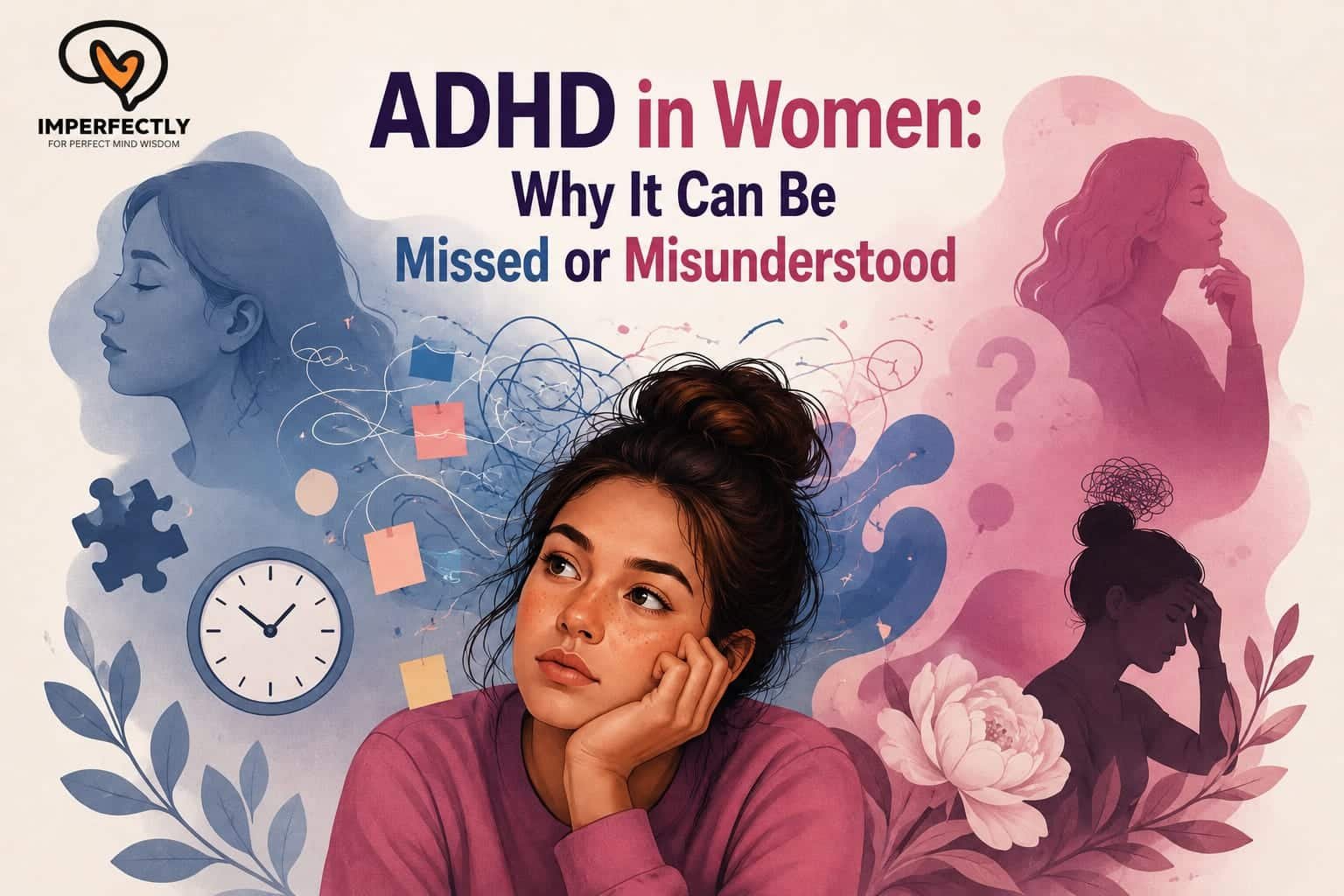
ADHD in Women: Why It Can Be Missed or Misunderstood
ADHD in women is often missed, misunderstood, or diagnosed much later than it should be. While ADHD is commonly associated with hyperactive children—especially boys—the reality is far more complicated. Many women with ADHD learn to hide their difficulties, compensate through intense effort, or simply assume that their struggles with focus, organization, emotions, or daily responsibilities are personal shortcomings.
That is one reason ADHD in women can remain unnoticed for years. A woman may appear organized and successful on the outside while privately struggling to remember appointments, complete routine tasks, regulate emotions, manage time, or maintain focus. In many cases, she develops coping strategies that conceal the underlying symptoms rather than resolve them.
For psychologists, psychiatrists, physicians, coaches, and mental-health professionals, recognizing these less obvious presentations is essential. For women themselves, understanding ADHD can also replace years of self-blame with a more accurate explanation of what they have been experiencing.
Why ADHD in Women Is Often Missed
ADHD does not necessarily look like constant physical hyperactivity.
In women, symptoms may be more strongly associated with inattention, internal restlessness, emotional dysregulation, forgetfulness, executive-function difficulties, and chronic overwhelm. Consequently, ADHD in women may not immediately fit the stereotypical image many people have of the condition.
A woman may sit quietly through meetings, complete a university degree, maintain a career, or manage a family and still have significant ADHD-related difficulties.
The important question is not simply, “Does she look hyperactive?”
Instead, clinicians need to consider how much effort is required for her to perform tasks that appear easy for other people.
The hidden effort behind “having it together”
One of the most overlooked aspects of ADHD in women is compensation.
Some women develop elaborate systems to stay functional: multiple reminders, detailed calendars, last-minute bursts of productivity, constant lists, alarms, over-preparation, or working late into the night.
From the outside, these strategies can look like excellent organization.
In reality, they may be signs that everyday organization requires an extraordinary amount of mental effort.
A woman might say:
- “I can do it, but only at the last minute.”
- “I need five reminders for one appointment.”
- “I am productive when the deadline is terrifying.”
- “My house looks organized until I stop pushing myself.”
- “I know what I need to do, but I cannot seem to start.”
These experiences can be particularly relevant when considering ADHD in women.
ADHD in Women Can Look Like Anxiety or Depression
Another reason ADHD in women is misunderstood is that the emotional consequences can become more visible than the underlying attention difficulties.
For example, someone who repeatedly misses deadlines may begin worrying excessively about work. Someone who constantly loses things may develop intense self-criticism. Someone who struggles to complete household responsibilities may feel guilty or inadequate.
Eventually, the person may seek help for anxiety, low mood, burnout, or chronic stress.
Those concerns can be genuine. However, sometimes they are occurring alongside an unrecognized ADHD pattern.
When emotional symptoms are only part of the picture
A useful clinical question is:
“What happens underneath the anxiety or low mood?”
If a woman reports anxiety but also describes lifelong procrastination, forgetfulness, time-management problems, distractibility, disorganization, and difficulty starting ordinary tasks, it may be worth exploring whether ADHD symptoms are contributing to the overall picture.
This does not mean every woman with anxiety has ADHD.
Rather, it means that ADHD in women should not automatically be overlooked simply because emotional symptoms are more obvious.
Common Signs of ADHD in Women
ADHD can present differently from one woman to another. Therefore, symptoms should always be considered in the context of the individual’s history and functioning.
Common experiences can include:
Difficulty starting tasks
Knowing exactly what needs to be done does not always translate into being able to begin.
A simple task such as replying to an email, paying a bill, cleaning a room, or making an appointment can feel disproportionately difficult to initiate.
Interestingly, once urgency becomes high enough, the task may suddenly become much easier to complete.
Time blindness
Some women with ADHD struggle to accurately sense how much time has passed or how long a task will take.
Consequently, they may frequently underestimate preparation time, arrive late, become absorbed in an activity for hours, or suddenly realize that an entire afternoon has disappeared.
This is one of the practical features of ADHD in women that can be mistaken for carelessness.
Forgetfulness and losing everyday items
Keys, phones, documents, chargers, appointments, passwords, and small commitments can become recurring sources of frustration.
The problem is not necessarily that the woman does not care.
Often, the difficulty involves attention, working memory, task switching, or maintaining information long enough to act on it.
Hyperfocus
ADHD is not simply an inability to concentrate.
Many women can concentrate intensely when something is highly interesting, emotionally stimulating, new, or urgent.
That can create a confusing pattern: “I can spend six hours researching something I love, so why can’t I answer three emails?”
This apparent contradiction is one reason ADHD in women can be misunderstood.
Emotional overwhelm
Some women experience strong emotional reactions, frustration, sensitivity to criticism, or difficulty shifting out of an emotional state.
These experiences do not independently prove ADHD. However, when they occur alongside longstanding executive-function difficulties, they can be clinically relevant.
Why Women Can Become Experts at Masking ADHD
Masking is particularly important when discussing ADHD in women.
Many women learn early that they need to compensate for difficulties that others seem to manage naturally.
A student may stay awake late to finish assignments because she could not start earlier. A professional may spend hours checking work because she is afraid of missing something. A parent may rely heavily on routines and reminders to keep the household functioning.
Over time, these strategies can become so automatic that even the woman may not recognize how much effort she is expending.
Success does not rule out ADHD
One of the most persistent misconceptions is that a successful career, good education, marriage, parenting, or financial stability automatically rules out ADHD.
It does not.
A person can be highly capable and still experience substantial executive-function difficulties.
In fact, achievement can sometimes delay recognition because other people see the outcome rather than the effort behind it.
A woman who consistently delivers excellent work may be assumed to have no attention-related difficulties, even if she completes everything through exhausting periods of hyperfocus and last-minute pressure.
ADHD Symptoms Can Change Across a Woman’s Life
ADHD in women also needs to be understood within the context of life stages.
The demands placed on a person’s attention and executive functioning change dramatically over time.
Childhood and adolescence
Girls with ADHD may be less disruptive than boys and therefore receive less attention from teachers.
Instead of being viewed as behaviorally difficult, they may be described as dreamy, sensitive, disorganized, talkative, forgetful, or simply “not reaching their potential.”
Because academic ability can compensate for organizational problems, some girls manage school relatively well until demands increase.
College and early adulthood
University and early employment can expose difficulties that were previously hidden.
Suddenly, there may be fewer external structures, more deadlines, more independence, and more decisions to make.
Someone who previously relied on parents, teachers, or rigid school routines may struggle significantly when those supports disappear.
Parenthood and increased responsibilities
For some women, ADHD becomes much more difficult to manage after having children.
The reason is practical: there are suddenly more schedules, appointments, meals, household tasks, interruptions, decisions, and competing priorities.
A system that worked when life was relatively predictable may collapse under a much heavier cognitive load.
Hormonal Changes and ADHD in Women
Hormonal changes are another area that deserves careful attention.
Some women report changes in their ADHD symptoms around different stages of the menstrual cycle, pregnancy, postpartum periods, or perimenopause.
However, these experiences are individual, and hormonal changes should not be used as a simplistic explanation for every attention or mood problem.
Instead, clinicians can look at whether symptoms fluctuate alongside hormonal changes and whether longstanding ADHD features were present before those periods.
This broader timeline can be especially useful when evaluating ADHD in women who seek help for new or worsening concentration problems in adulthood.
How ADHD in Women May Be Misdiagnosed
A woman experiencing ADHD-related difficulties may initially receive help for problems such as anxiety, depression, stress, sleep difficulties, or burnout.
Sometimes that treatment is appropriate.
However, if the underlying attention and executive-function difficulties remain unrecognized, the person may continue experiencing the same practical problems.
Look beyond the current complaint
A useful assessment does not focus only on what is happening this month.
Instead, professionals often need to explore the person’s developmental history:
- What were school years like?
- Was she frequently forgetful?
- Did she procrastinate despite understanding the work?
- Was organization unusually difficult?
- Did she frequently lose belongings?
- Were deadlines the only thing that created enough motivation?
- Did she have a pattern of intense interest followed by difficulty maintaining attention?
- How much effort did it take to appear organized?
This historical perspective can help distinguish a longstanding neurodevelopmental pattern from difficulties that developed more recently.
ADHD in Women and the Problem of Self-Blame
One of the most significant consequences of delayed recognition is the story women can build about themselves.
After years of unfinished tasks, forgotten commitments, inconsistent productivity, and emotional overwhelm, a person may conclude:
“I am lazy.”
“I am irresponsible.”
“Everyone else manages this.”
Those conclusions can become deeply ingrained.
That does not mean ADHD removes responsibility.
Instead, it creates an opportunity to use strategies, treatment, environmental changes, and professional support that actually match the person’s needs.
What Professionals Should Pay Attention To
For mental-health professionals, the practical lesson is simple: look beyond stereotypical ADHD presentations.
When assessing ADHD in women, consider both visible symptoms and the compensatory strategies hiding them.
Pay particular attention when a woman presents with a combination of:
Longstanding executive-function difficulties
Look for patterns involving planning, organization, prioritization, task initiation, working memory, and time management.
High achievement with disproportionate effort
Ask not only what the person accomplishes but how she accomplishes it.
Two people may submit the same project on time. One may have spent two hours on it; the other may have required three days of panic, avoidance, reminders, and an all-night work session.
The final result looks identical.
The lived experience is not.
Repeated cycles of overwhelm
A pattern of becoming overwhelmed, creating a strict system, functioning well temporarily, and then abandoning the system can provide useful information.
Rather than labeling this simply as poor discipline, explore what makes maintaining the system difficult.
When Should a Woman Consider an ADHD Evaluation?
There is no single symptom that means someone has ADHD.
However, professional evaluation may be worth considering when attention, organization, impulsivity, time management, or executive-function difficulties are persistent, interfere with daily life, and appear to have a longstanding pattern.
Importantly, self-diagnosis from social media or online checklists is not enough.
ADHD assessment should consider the person’s developmental history, current symptoms, functional impairment, and other possible explanations.
A qualified mental-health professional can help determine whether ADHD fits the overall picture and whether other conditions or factors need attention as well.
What Helps After ADHD Is Recognized?
Treatment is not about forcing someone to become “more disciplined.”
Instead, effective support usually involves understanding how the person’s brain and environment interact.
Depending on the individual, treatment may involve professional assessment, psychotherapy or coaching, medication when clinically appropriate, behavioral strategies, environmental modifications, sleep and lifestyle support, and practical systems for managing daily responsibilities.
A complicated productivity system that lasts two weeks is rarely more useful than a simple system someone can continue using for six months.
Practical Strategies That Can Make Daily Life Easier
Externalize memory
Do not rely entirely on remembering.
Use calendars, visible reminders, alarms, written checklists, and consistent locations for frequently misplaced objects.
Reduce unnecessary decisions
Create repeatable routines for common tasks.
For example, keeping essential items in the same place can eliminate dozens of small decisions each week.
Make tasks smaller
“Clean the house” is vague.
“Put dishes in the sink for five minutes” is specific and easier to initiate.
Breaking tasks into visible actions can reduce the mental barrier to starting.
Use urgency carefully
Deadlines can temporarily increase motivation, but living permanently under crisis-level pressure is exhausting.
The goal is to create enough structure and accountability that everything does not need to become an emergency.
A Final Perspective on ADHD in Women
ADHD in women is not always obvious.
Sometimes it looks like distraction. It looks like anxiety. Sometimes it looks like perfectionism, chronic procrastination, emotional overwhelm, burnout, or an exhausting need to keep everything under control.
Most importantly, the person who appears to be “managing perfectly” may actually be working incredibly hard to compensate for difficulties nobody else can see.
Therefore, recognizing ADHD in women requires looking beyond stereotypes and asking better questions about the person’s lifelong patterns, daily functioning, and the effort behind their achievements.
If these experiences sound familiar, that does not automatically mean you have ADHD. However, it may be worth discussing your concerns with a qualified mental-health professional who can conduct an appropriate assessment.
Start Your Mental Wellness Journey Today with Imperfectly
At Imperfectly, we believe mental healthcare should be accessible, connected, and centered around the individual—not limited to a single appointment or diagnosis. Through one platform, you can connect with experienced Psychiatrists, Psychologists, Life Coaches, and Physicians, book online or in-clinic appointments, monitor your wellness journey, and securely access relevant prescriptions, therapy notes, and medical records. Whether you are exploring ADHD in women, struggling with anxiety, experiencing burnout, or simply looking for better mental-health support, Imperfectly brings different aspects of care together in one place.
Download the Imperfectly App
📱 Connect with experienced Psychiatrists, Psychologists, Life Coaches, and Physicians.
📅 Book online or in-clinic appointments in minutes.
📈 Track your recovery journey with personalized wellness insights.
🔒 Access secure prescriptions, therapy notes, and medical records anytime.
💙 Experience complete 360° mental healthcare in one application.
Contact Imperfectly
Imperfectly – Your Trusted 360° Mental Health Platform
🌐 Website: https://imperfectly.co
📱 Patient Portal: https://imperfectly.co/application/
📞 Phone: +91 8448073838
📧 Email: admin@imperfectly.co