

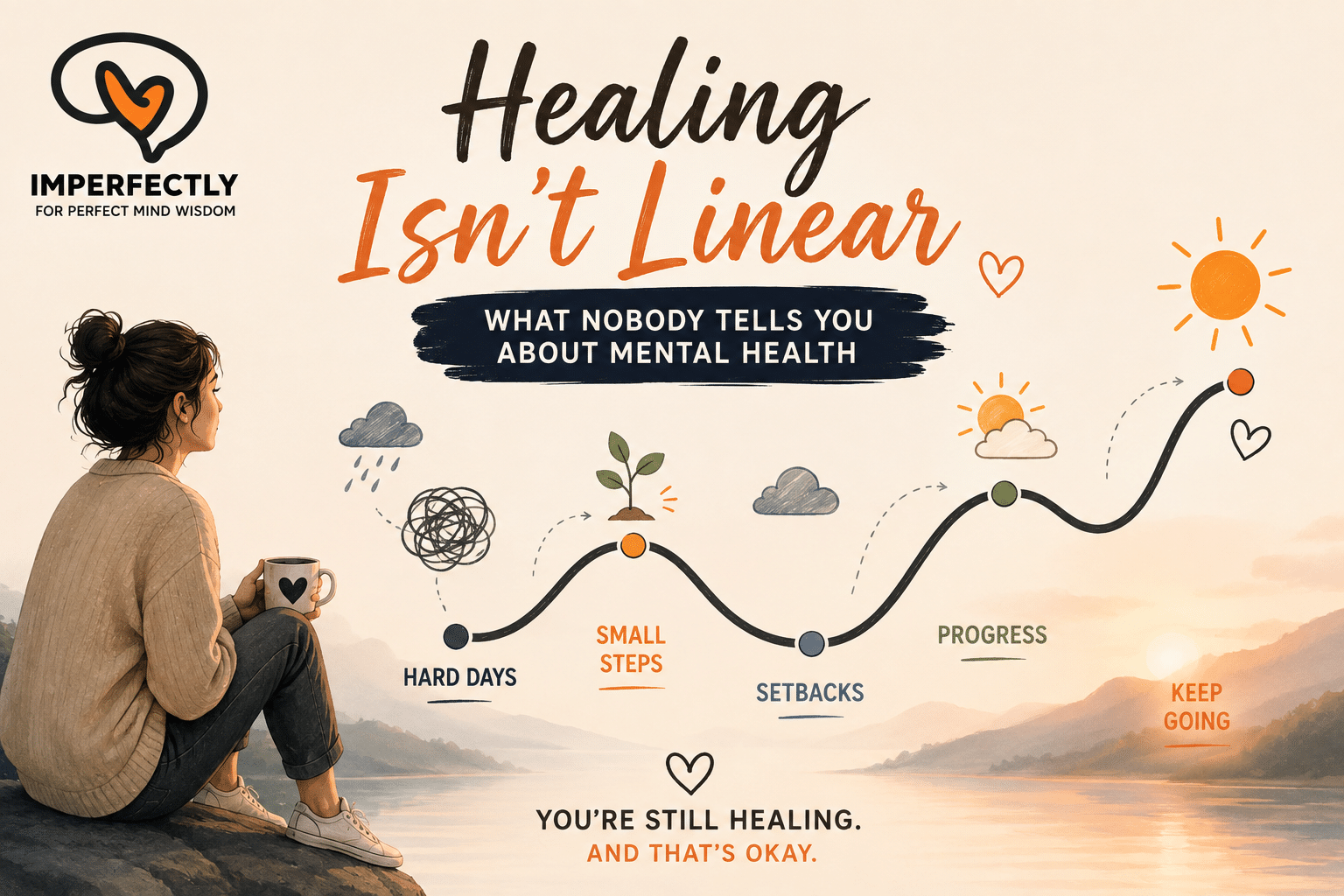
Healing Isn’t Linear: What Nobody Tells You About Mental Health
Healing isn’t linear, and that is one of the hardest realities to accept when you are trying to feel better. You may have a few good weeks and suddenly wake up feeling overwhelmed again. You might think you have finally moved past something, only to find yourself reacting to it months later. From the outside, this can look like going backward. In reality, mental health recovery often involves progress, setbacks, adjustment, and learning at the same time.
One of the biggest mistakes people make is expecting healing to look like a straight line from “struggling” to “fine.” Real life rarely works that way. Your circumstances change, relationships change, your responsibilities change, and so does your emotional capacity.
That does not mean your previous progress disappeared.
It means you are still human.
Why Healing Isn’t Linear in Real Life
When people imagine recovery, they often picture a steady improvement: fewer difficult days, more confidence, better sleep, and eventually no symptoms at all.
Sometimes progress does look like that.
Often, it does not.
You may feel better because you have learned how to manage difficult emotions, and then experience a stressful event that tests those skills. You may become more comfortable setting boundaries and then feel guilty when you actually enforce one. You may understand your triggers intellectually but still react emotionally when something unexpectedly brings them back.
That is not necessarily failure.
Rather, it is part of learning how to live differently.
In practice, healing isn’t linear because mental health is affected by the whole context of your life—not simply by how much effort you put into getting better.
A Good Week Does Not Mean Everything Is Fixed
One of the most common misunderstandings about mental health recovery is believing that feeling good means the problem has disappeared.
Imagine someone has struggled with anxiety for months. They finally have two calm weeks. They sleep better, concentrate at work, spend time with friends, and feel like themselves again.
Then a difficult day arrives.
The anxious thoughts return.
The immediate reaction might be, “I thought I was better.”
That thought can create a second layer of distress on top of the original problem.
Instead, it can be more useful to think, “I had two weeks where things felt manageable. Now something is difficult again. What do I need today?”
That small change in perspective matters.
Progress is not erased by a difficult day.
Setbacks Do Not Automatically Mean You Are Back at the Beginning
A setback can feel surprisingly discouraging because it often reminds people of how difficult things used to be.
However, there is an important difference between revisiting a difficult feeling and returning to your old starting point.
You may experience anxiety again, but respond to it differently.
You may become overwhelmed, but recognize what is happening sooner.
You may have a difficult conversation, but recover from it faster.
You may notice negative thinking without automatically believing every thought.
Those changes are easy to miss because they do not always feel dramatic.
Nevertheless, they are often signs of genuine progress.
Look for Changes in How You Respond
Instead of asking only, “Do I still feel this way?”, ask:
- Do I understand my triggers better?
- Do I recognize warning signs earlier?
- Do I recover more quickly?
- Am I more willing to ask for support?
- Do I speak to myself differently?
- Am I setting boundaries that I previously avoided?
- Can I tolerate difficult emotions without immediately escaping them?
These questions provide a much more realistic picture of recovery.
Healing Isn’t Linear Because Life Keeps Happening
You can work hard on yourself and still experience difficult circumstances.
A relationship can end.
Work can become stressful.
Financial pressure can increase.
Someone you care about can become unwell.
You can move to a new city, become a parent, lose a routine, or take on responsibilities you were not expecting.
During those periods, old emotional patterns may become louder.
That does not necessarily mean your mental-health work failed.
It may simply mean your current circumstances are demanding more from you than usual.
This is one reason healing isn’t linear: recovery does not happen in a controlled environment. You are learning new ways of coping while continuing to live an unpredictable life.
Sometimes the First Sign of Progress Is Awareness
People often expect progress to feel like happiness.
Sometimes it feels like noticing.
You notice that you are exhausted before reaching complete burnout.
You recognize that a particular conversation consistently leaves you distressed.
You realize that you have been saying yes because you are afraid of disappointing people.
You catch yourself becoming overly critical.
You recognize that you need support instead of pretending everything is fine.
These moments may not look impressive from the outside.
Still, awareness gives you something you did not have before: a choice.
Once you can recognize a pattern, you have an opportunity to respond differently.
Awareness Can Feel Uncomfortable
There is also a less comfortable side to this stage.
Sometimes becoming more self-aware initially makes you feel worse.
You may suddenly notice how often you criticize yourself.
You may recognize unhealthy relationship patterns you previously ignored.
You may realize that certain coping mechanisms helped you survive a difficult period but are no longer helping you live well.
That can be painful.
However, discomfort does not automatically mean you are moving backward.
Sometimes you are simply seeing something clearly for the first time.
You May Outgrow Coping Strategies That Once Helped You
A coping strategy is not necessarily “bad” because it is no longer useful.
Perhaps you learned to stay quiet because speaking up once felt unsafe.
Perhaps you became extremely independent because relying on others led to disappointment.
Perhaps you kept yourself constantly busy because slowing down made difficult emotions harder to avoid.
At one point, these responses may have served a purpose.
Later, they may begin creating new problems.
This is a practical part of mental-health recovery that is rarely discussed: healing isn’t linear because the strategies that help you survive one stage may need to change as you grow.
The goal is not to judge your past self.
The goal is to understand what that version of you was trying to accomplish.
Healing Doesn’t Mean You Will Never Struggle Again
There is a dangerous expectation that once you have “healed,” difficult emotions should disappear.
That is not realistic.
Even emotionally healthy people experience grief, anger, fear, disappointment, insecurity, loneliness, and stress.
The difference is often in how they relate to those experiences.
You can feel anxious without concluding that you are incapable.
You can feel sad without believing your entire life is hopeless.
You can experience rejection without deciding that you are unworthy.
You can have a bad day without turning it into a judgment about your entire recovery.
In other words, healing isn’t linear, but it can change the way you move through difficult periods.
Stop Using Your Worst Day as Evidence of Failure
This is a mistake worth taking seriously.
When someone has a difficult day, they may mentally collect evidence against themselves:
“I knew I wasn’t getting better.”
“I always end up here.”
“Nothing has changed.”
“I have ruined all my progress.”
Notice what happens here.
One difficult experience becomes a verdict about the entire recovery journey.
Instead, try looking at the complete picture.
What was different six months ago?
What do you understand now that you did not understand then?
What would your previous self have done in this situation?
What are you doing differently today?
Sometimes progress becomes visible only when you compare your current response with your past response—not when you compare your current mood with an imaginary perfect version of yourself.
There Is No Universal Timeline for Mental Health Recovery
Another source of unnecessary pressure is the belief that you should be better by a certain date.
Someone else may feel significantly better after several months of therapy. Another person may need considerably more time. Someone else may have periods of improvement followed by periods of difficulty.
There is no single timetable that applies to everyone.
Your history, environment, support system, coping patterns, circumstances, and individual needs all matter.
Therefore, comparing your recovery timeline with someone else’s can create an entirely new problem.
You do not need to recover according to somebody else’s schedule.
Faster Is Not Always Better
There is also a temptation to turn healing into another productivity project.
You start tracking everything.
You want to improve faster.
You become frustrated when you do not feel different quickly enough.
Eventually, the pressure to heal becomes another source of stress.
Mental health recovery is not a competition.
Sometimes the more useful question is not, “How quickly am I getting better?”
It is, “Am I becoming more capable of taking care of myself when things become difficult?”
What to Do When You Feel Like You Are Going Backward
First, resist the urge to make a permanent conclusion from a temporary experience.
Pause.
Look at what has changed.
Then ask yourself what might have contributed to the difficult period.
Have you been sleeping poorly?
Have your responsibilities increased?
Have you stopped doing things that normally support you?
Have you been isolating yourself?
Has a relationship or work situation changed?
Have you been carrying something emotionally difficult without enough support?
These questions are not about blaming yourself. Instead, they help you understand the context.
Return to What Already Helps
When life becomes difficult, people sometimes abandon the basic things that support their mental wellbeing.
They stop attending appointments.
They isolate themselves.
They stop sleeping properly.
They avoid people they trust.
They stop doing activities that previously helped them feel grounded.
Consequently, the difficult period can become harder than it needed to be.
You do not need to restart your entire life.
Return to the basics that are realistic for you.
Sometimes the next step is simply reconnecting with a professional, talking honestly with someone you trust, getting back into a routine, or giving yourself permission to slow down.
Healing Isn’t Linear, But You Can Still Notice Progress
Progress is often quieter than people expect.
It might be saying no without spending the entire evening feeling guilty.
It might be leaving a conversation before it becomes emotionally overwhelming.
It might be asking for help before reaching a breaking point.
It might be recognizing a negative thought and choosing not to act on it.
It might be realizing that you deserve support.
These moments may not feel like dramatic transformations.
They are still meaningful.
And sometimes, the strongest evidence of recovery is not that difficult emotions disappear. It is that they no longer control every decision you make.
When Professional Support Can Help
You do not need to wait for a crisis before speaking with a mental-health professional.
If difficult emotions, anxiety, low mood, stress, relationship problems, or recurring patterns are interfering with your everyday life, professional support can help you understand what is happening and identify appropriate ways forward.
Likewise, if you have been trying to manage everything alone and feel stuck, asking for help is not a sign that your recovery has failed.
It can be part of recovery.
A qualified professional can also help you distinguish between an expected difficult period and concerns that may require more structured support.
The Goal Is Not a Perfectly Straight Line
Perhaps the most useful way to think about mental-health recovery is to stop expecting perfection from it.
There may be progress.
Then uncertainty.
Then progress again.
There may be difficult days followed by surprisingly good ones.
There may be moments when you feel strong and moments when you need more support.
That does not make your healing less real.
Healing isn’t linear. It is a process of learning, adapting, recovering, and sometimes beginning again with more knowledge than you had before.
So, if today feels harder than yesterday, do not automatically assume you are back at the beginning.
You may simply be having a difficult day.
And a difficult day is not the same thing as a failed recovery.
Start Your Mental Wellness Journey Today with Imperfectly
At Imperfectly, we understand that mental wellness does not follow a perfect timeline. Whether you are taking your first step toward professional support or continuing a journey you have already started, Imperfectly helps you access qualified mental-health and healthcare professionals in a way that fits real life. With convenient appointments and tools to help you stay connected to your care, you can focus less on having everything figured out and more on taking the next step that feels right for you.
Download the Imperfectly App
📱 Connect with experienced Psychiatrists, Psychologists, Life Coaches, and Physicians.
📅 Book online or in-clinic appointments in minutes.
📈 Track your recovery journey with personalized wellness insights.
🔒 Access secure prescriptions, therapy notes, and medical records anytime.
💙 Experience complete 360° mental healthcare in one application.
Contact Imperfectly
Imperfectly – Your Trusted 360° Mental Health Platform
🌐 Website: imperfectly.co
📱 Patient Portal: Imperfectly Patient Portal
📞 Phone: +91 8448073838
📧 Email: admin@imperfectly.co