

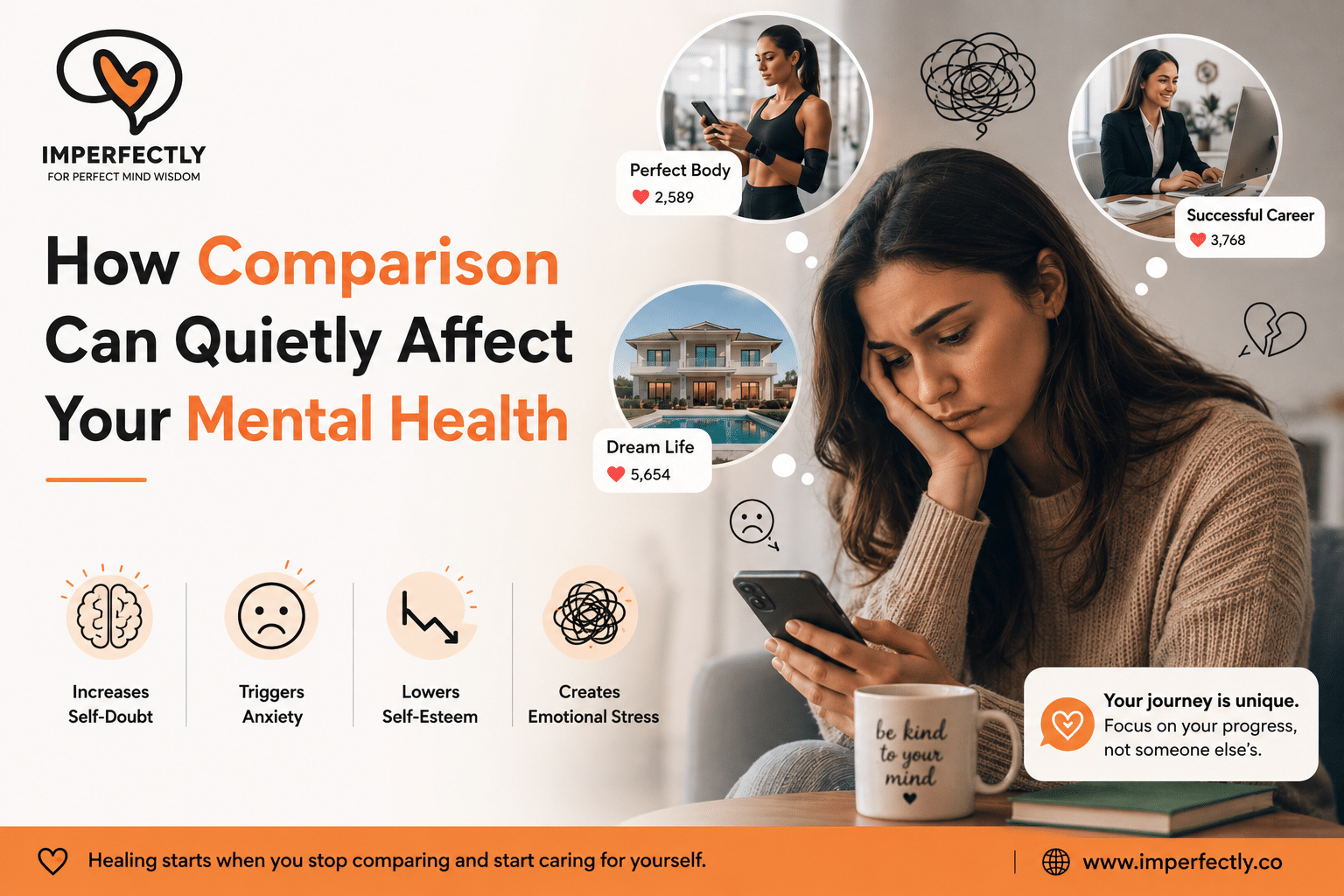
How Comparison Can Quietly Affect Your Mental Health
Comparison and mental health are more closely connected than many people realize. Comparison is one of those habits that rarely announces itself as a problem. It can look harmless: checking someone’s LinkedIn update, scrolling through Instagram, noticing a friend’s promotion, or wondering why someone else seems to have their life together.
Then, almost without noticing, your mood changes.
You start questioning your own progress. You feel behind. Someone else’s success becomes evidence that you are failing. Eventually, comparison stops being something you do and starts influencing how you see yourself.
From years of working around mental health and listening to people describe what actually happens in their day-to-day lives, one pattern comes up repeatedly: comparison is rarely about the other person. It is usually about the story we tell ourselves after looking at them.
Why Comparison and Mental Health Feel So Personal
Human beings naturally compare themselves with others. It can help us understand where we stand, learn from people around us, and set goals.
The problem begins when comparison becomes the primary way we measure our worth.
For example, imagine two people receiving the same promotion. One thinks, “I worked hard, and this is a good opportunity.” The other immediately thinks, “Everyone else is moving faster than me.”
The event is identical. The emotional experience is completely different.
That is an important distinction because comparison itself is not necessarily unhealthy. The meaning we attach to comparison is what can make it damaging.
Over time, repeated comparisons can create a mental habit where your achievements are discounted while somebody else’s achievements are magnified. This is where the relationship between comparison and mental health can become increasingly difficult.
The Comparison Trap Is Usually Invisible
One of the most common mistakes is assuming that comparison only happens when we consciously think, “I wish I had their life.”
It is often much quieter.
You might:
- Check someone’s profile when you are already feeling insecure.
- Compare your salary with a colleague’s.
- Look at another parent and feel that you are doing less.
- See someone travelling and conclude that your life is boring.
- Compare your appearance with carefully edited photographs.
- Measure your career progress against someone who started years before you.
- Feel unsuccessful because a friend reached a milestone earlier.
At first, these moments may seem insignificant. However, repeated often enough, they can affect your confidence, mood, motivation, and expectations of yourself.
That is why comparison and mental health can be difficult to connect at first. There may not be one dramatic moment when things change. Instead, there is a gradual shift in how you evaluate yourself.
Social Media Makes Comparison and Mental Health More Complicated
Social media has changed the environment in which comparison happens.
You are no longer comparing yourself only with the people you know personally. In a few minutes, you can see hundreds of people displaying careers, relationships, holidays, homes, bodies, achievements, and lifestyles.
The problem is that you are usually comparing your behind-the-scenes with somebody else’s highlight reel.
You know about your missed opportunities, arguments, financial worries, unfinished projects, bad days, and insecurities.
You generally do not know the full story behind the person appearing successful on your screen.
That imbalance matters.
Someone may post a promotion without mentioning years of uncertainty. Someone may post a beautiful relationship without showing the difficulties within it. Someone may share a fitness transformation without explaining the circumstances behind it.
So, when you compare your entire life with a carefully selected portion of somebody else’s, the comparison is already uneven. Consequently, the impact on comparison and mental health can be much greater than the original social-media interaction suggests.
When Comparison Starts Affecting Your Mental Health
Comparison does not affect everyone in exactly the same way. However, there are a few patterns worth paying attention to.
Your Achievements Stop Feeling Like Achievements
You accomplish something you worked hard for.
For a moment, you feel proud.
Then you see somebody else doing something bigger.
Suddenly, your achievement feels ordinary.
This is one of the quieter effects of comparison. Instead of allowing yourself to experience satisfaction, your mind immediately moves the goalpost.
Consequently, you can become successful on paper while constantly feeling inadequate internally.
You Start Measuring Your Worth Through Other People
Another warning sign is when your self-esteem becomes dependent on where you believe you stand relative to others.
If someone succeeds, you feel smaller.
If someone struggles, you temporarily feel better.
If somebody compliments you, you feel valuable.
If somebody appears ahead of you, your confidence drops.
That creates an unstable sense of self-worth because your emotional state is being controlled by external benchmarks. In other words, comparison begins influencing not only how you evaluate your achievements but also how you evaluate yourself.
Comparison Can Turn Into Envy and Shame
People sometimes feel ashamed of experiencing envy.
But envy is an emotion, not a character verdict.
The useful question is not, “Why am I such a jealous person?”
Instead, ask, “What is this comparison showing me that I want, fear, or feel I am missing?”
Perhaps you want recognition.
Perhaps you want financial security.
Perhaps you want companionship.
Perhaps you are exhausted and wish your life felt easier.
Once you identify the underlying need, the comparison becomes information rather than ammunition against yourself.
The Most Damaging Comparison Is Often With Your Own Past
People frequently talk about comparing themselves with others, but another form can be equally painful: comparing yourself with who you used to be.
“I was more productive before.”
“I used to be happier.”
“I used to look different.”
“I should be further ahead by now.”
This can become particularly difficult during periods of stress, burnout, grief, major life changes, or recovery.
Your previous version of yourself may have had different responsibilities, circumstances, finances, relationships, energy levels, or support.
Therefore, expecting the current you to perform exactly like the previous you may not be realistic.
Progress is not always about becoming more productive. Sometimes progress looks like surviving a difficult season, setting a boundary, asking for help, or finally admitting that something is not working.
Why “Just Stop Comparing” Usually Doesn’t Work
A common mistake is treating comparison like a bad habit that can simply be switched off.
It usually cannot.
If you tell yourself, “Don’t compare yourself to others,” your attention may actually become more focused on comparison.
Instead, the goal is to notice the process earlier.
For instance:
Trigger: You see a former colleague’s promotion.
Automatic thought: “They are doing so much better than me.”
Emotion: Anxiety or inadequacy.
Reaction: You start checking their profile and comparing your career.
Result: You feel worse.
Once you recognize this sequence, you have somewhere to intervene.
You can ask:
“What exactly am I comparing?”
“Is this person’s situation actually comparable to mine?”
“What information am I missing?”
“Do I genuinely want what they have, or do I want what I believe it represents?”
That last question is particularly useful.
You may not want another person’s life. You may simply want the confidence, freedom, security, recognition, or belonging that you associate with it.
A Healthier Approach to Comparison and Mental Health
Comparison does not have to disappear completely.
Instead, it can become more intentional.
Turn Comparison Into Curiosity
Rather than thinking, “Why am I not where they are?” try asking:
“What can I learn from their path?”
This shifts the focus from self-judgment to useful information.
However, there is an important condition: learn without assuming that copying somebody else’s path will produce the same outcome for you.
Compare Actions, Not Worth
It is reasonable to compare strategies.
For example, you might notice that someone consistently exercises, manages their time well, or invests in professional development.
You can learn from that.
What becomes harmful is turning those observations into conclusions about personal worth:
“They are disciplined, so they are better than me.”
That second statement is no longer useful comparison. It is self-criticism disguised as analysis.
Create Your Own Measures of Progress
One of the most effective shifts is deciding what success actually means to you.
Maybe your measure is not earning the most money.
Maybe it is having enough financial stability to spend time with your family.
Maybe success means building a career without sacrificing your mental wellbeing.
Maybe it means becoming more confident, maintaining meaningful relationships, or having enough energy to enjoy your life.
Once your definition becomes personal, somebody else’s achievement has less power to define your own. As a result, comparison has less control over your emotional wellbeing.
Pay Attention to What You Consume When You Feel Vulnerable
There is a practical lesson here that is easy to overlook.
The same social-media feed can affect you differently depending on your mental state.
When you are feeling confident, another person’s success might inspire you.
When you are exhausted or insecure, the same post might make you feel inadequate.
Therefore, notice when you tend to compare.
If you repeatedly scroll through certain accounts when you are lonely, tired, anxious, or upset, you may be reinforcing a cycle without realizing it.
You do not necessarily need to delete every social-media app. Sometimes, simply changing what you consume, when you consume it, and how long you stay online can make a meaningful difference.
What to Do When Comparison Has Already Become a Habit
Start small.
When you notice yourself comparing, pause before reacting.
Name the feeling: I feel behind.
Then identify the thought: I believe everyone else is progressing faster than me.
Finally, question the conclusion: Do I actually have enough information to know that?
This may sound simple, but that pause matters.
You are creating space between the trigger and the judgment.
Over time, that space can become easier to access.
Also, keep track of your own evidence of progress. Not just major achievements, but smaller changes: conversations you handled differently, boundaries you maintained, difficult situations you got through, habits you developed, or moments when you were kinder to yourself.
These things rarely make impressive social-media posts.
They still count.
When Comparison Is Affecting Your Daily Life
Occasional comparison is part of being human.
However, it deserves more attention when it consistently affects your mood, relationships, sleep, confidence, work, or ability to enjoy your own life.
If you find yourself repeatedly thinking that you are not good enough, constantly checking what others are doing, withdrawing because you feel inferior, or experiencing persistent anxiety or low mood, consider talking with a qualified mental-health professional.
You do not have to wait until things become overwhelming before seeking support.
In fact, getting help earlier can make it easier to understand what is driving the comparison and develop healthier ways of responding to it.
Start Your Mental Wellness Journey Today with Imperfectly
At Imperfectly, we believe mental healthcare should fit into real life—not require you to have everything figured out first. Whether you are dealing with persistent stress, anxiety, low mood, burnout, relationship difficulties, or simply want to understand yourself better, professional support can give you a place to start. Through the Imperfectly platform, you can connect with qualified mental-health and healthcare professionals, book appointments, and keep your wellness journey organized in one secure place.
Download the Imperfectly App
📱 Connect with experienced Psychiatrists, Psychologists, Life Coaches, and Physicians.
📅 Book online or in-clinic appointments in minutes.
📈 Track your recovery journey with personalized wellness insights.
🔒 Access secure prescriptions, therapy notes, and medical records anytime.
💙 Experience complete 360° mental healthcare in one application.
Contact Imperfectly
Imperfectly – Your Trusted 360° Mental Health Platform
🌐 Website: https://imperfectly.co
📱 Patient Portal: https://imperfectly.co/application/
📞 Phone: +91 8448073838
📧 Email: admin@imperfectly.co